








Towards AI-Driven Banking
For the banking and financial services (BFS) industry, artificial intelligence (AI) has moved rapidly from hype to reality. It is no longer a question on if they should adopt AI, but how fast and deeply they must embed upgraded capabilities across operations to meet modern customer expectations.
While ambition is high, execution remains uneven. Complex legacy systems, unclear ROI frameworks, regulatory pressure, and cybersecurity risks continue to slow progress.
This white paper, based on proprietary global research by East & Partners with Tech Mahindra, brings together the combined voices of 150 senior banking executives across the Asia Pacific (APAC), the Americas, Europe, and the Nordics, and unveils the vision of an AI-driven bank of tomorrow. Leading banking CXOs share detailed insights into how AI adoption and investments, customer experience (CX), legacy modernization, and data transformation converge into a single powerful “slate for change” as key determinants of competitive differentiation.
The Global Race to Operationalize Agentic and Generative AI
Agentic and generative AI (GenAI) have moved beyond the experimental phase to become transformative tools reshaping CX, risk management, compliance and product innovation.
Our research shows over 1 in 3 financial institutions (FIs) are already investing aggressively in GenAI to capture the early-mover advantage. (37%). European banks (49%) are outpacing peers in AI investment by a considerable margin, ahead of Americas (39%), the Nordics (32%) and APAC (26%). However, 1 in 4 banks still struggle to adopt new AI solutions, risking being left behind (25%).
The stakes are high: banks that fail to act decisively risk inefficiency and irrelevance.
AI Outlook - % of Total
(N: 150)
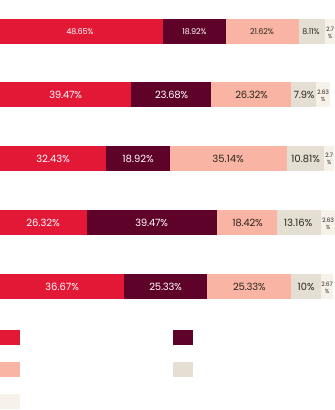
8 in 10 banks globally have established a dedicated AI budget. The average proportion of IT budget currently allocated to AI stands at 8.5%, or US$40 billion, led by the Americas (12%) and Europe (9%) ahead of APAC (7%) and the Nordics (6%).
After the advent of the internet and smartphones, AI is the biggest transformation we will see. The key is not to automate minor processes. Create new revenue streams or deliver significant impact because the technology is there. The question is do we have the right use case to deliver outcomes using the power of AI?
Strategic Imperatives for the AI-Driven Bank
1. Legacy Modernization at Scale and Speed
Legacy systems remain a critical challenge for CIOs and CTOs, representing a core IT investment focus for 36% of banks globally, alongside operational stability (48%) and regulatory compliance (51%).
Over 9 in 10 banks currently run full-scale modernization programs to retire legacy systems across front-end applications and back-end applications running on the mainframe. Yet most admit to timeline overruns and cost escalations.
Successful players adopt a dual-track approach: maintaining operational stability while incrementally replacing core functions with cloud-native, composable platforms. While front-end systems have evolved to software-as-a-service (SaaS) and agile models, back-end systems largely remain slow, inflexible, and unable to support real-time personalization. This directly impacts revenue, customer satisfaction, and competitive positioning.
Preferred Full-Scale Legacy Modernization Approaches - % of Total
(N: 150)
GenAI is now duly accelerating this transformation journey by converting legacy code, simulating architectures, and identifying modernization pathways.
CIOs estimate an average of 4 years to fully retire legacy platforms, and will need to rely on strong systems integration partnerships and clear ROI alignment.
Our legacy systems upgrade program has consistently undershot its timelines and overshot its budgets, but we’re hopeful that AI is going to make a difference. We’re also much more tuned to external solutions here rather than continuing to try most of the upgrade inhouse.
2. Reimagining Digital Customer Experience
Key CX Priorities
Top 3 CX Objectives
- Customer Retention and Product Cross Sell
- Relationship Value Add
- Most Trusted for Data Security and Privacy
Top 3 CX Factor Needs
- Holistic Customer Relationship Dashboard
- Reduced Onboarding Friction
- Enhanced Transactional Information Flow
3. Data as Competitive Advantage
Only 1 in 5 institutions globally have robust, real-time data governance frameworks in place. An important CX factor banks seek to deliver, yet are restricted by existing digital capability, is an end-to-end customer relationship dashboard overview. CIOs, CTOs and CDOs globally cite this as key to attaining competitive advantage ahead of reducing customer onboarding barriers and enhancing information flow around transactions.
Leading banks are moving from centralized data warehouses to distributed data meshes and products, embedding governance and security while enabling flexibility. They are embracing explainable AI and continuous monitoring to balance innovation with accountability.
Significant data management maturity variance exists: only 1 in 5 FIs have a robust data governance to ensure availability of high quality, standardized data in near real time, highest in APAC and Americas, lowest in Europe and Nordics.
Organizational Data Maturity Level - % of Total
(N: 150)
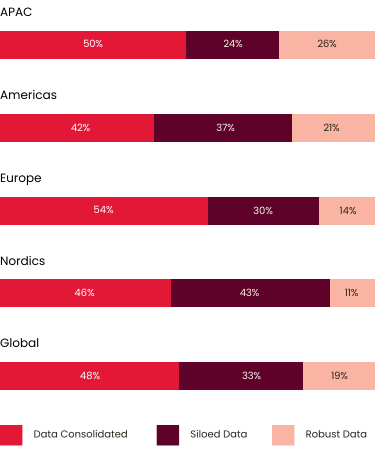
1 in 2 FIs globally have consolidated their data, but lack effective governance implementation with minimal variance by region. 1 in 3 FIs have proficiently siloed their data without establishing data governance standards and practices.
Banks must ensure algorithms are transparent, auditable, and secure through continuous model monitoring, fairness checks, and contingency planning for system failures. Embedding governance mechanisms and managing human oversight helps balance automation with accountability.
4. Embedding Trust and Security
Your Next Step in Transformation
The Bank of Tomorrow,
Powered by AI
The future of banking will combine the following traits:


Bank of Tomorrow
Pervasive
- Banking as ambient utility
- Always on
- Embedded in journeys
Cognitive
- Contextual interactions
- Hyper-personalized
- Proactive outreach
Autonomous
- AI-driven orchestration
- Self-correcting, self-healing
- Limited human touchpoints
Ingenious
- Co-innovation & collaboration
- Advisory over balance sheet
- New concepts: crypto, CBDC
Al Foundation
- Secure, ethical, explainable Al practices
- Choice of technology to maximize ROI
Data Platforms
- Realtime, on-demand access to data
- Quality & completeness
- Integration & unification
Modernization
- Composable platforms, replacing monolith legacy
- Interoperable, reusable, agile digital platforms
- Al leverage for modernization
Cybersecurity
- Zero trust architecture
- Compliance by design
- Al powered defence
- Multi-factor authentication
Advanced Al
- GenAl, Agentic Al
- Foundational models
- Deep neural networks
- Computer vision
Cloud & Data
- Poly cloud strategy
- Edge Computing
- Al driven cloud services
- APIs, microservices
- Cloud data platforms
Quantum
- Radical leap in processing
- Unprecidented efficiency
- Cryptographic security
Immersive Experience
- AR/VR, Google Glass
- Metaverse
- Web3.0, Digital twins
- Blockchain, digital assets
Trust & Integrity
Customer Centricity
Commercial Viability
Regulatory Compliance
Successful transformation will require
From antiquated code to cloud-native platforms.
Designing CX that anticipate, not just respond.
Turning complexity into clarity and insight.
Embedding trust and ethical AI across every interaction.
Looking Ahead
Today, AI represents the most profound shift yet. Banks that hesitate will find themselves outpaced; those that act decisively will redefine the industry. The future will see an increasing convergence of AI with green technology, environmental, social and governance (ESG) targets and quantum computing to offset power demands, alongside full AI integration into the CX offering. The era of AI-powered banks begin now.