

Scale at Speed™







 English (Global)
 French (Canada)

- AI testing now extends beyond basic functionality checks. It brings in accuracy, fairness, security, and the ability to explain how the desired outcomes can be achieved.
- Organizations must embed QA cycles in live production environments to monitor AI in real-time instead of conducting periodic QA assessments.
- Testing in the AI space evolves from mere test cases to curated datasets, trusted ‘gold’ answers, and tricky inputs that can identify weak spots.
- AI brings its own set of risks such as hallucination, bias, model drift over time, prompt injection, and autonomous agent actions.
- Service providers have a strong opportunity to build a differentiated, end-to-end offering of AI assurance test fabric.
Moving Beyond Functionality to Trust
For decades, organizational testing circled back to one simple check: does the application work as expected? The scope was limited to functional correctness, performance checks, and security aspects.
AI systems change this proposition. These systems do not behave in a fixed or predictable way. They shift with context, learn from patterns, and are constantly evolving. Therefore, organizations cannot focus on system behavior alone; they need to continuously check if these systems operate safely, fairly, and reliably at scale.
This shift drives the need for a new operating model called the AI assurance test fabric, a trust layer that constantly verifies every dimension of AI behavior across the lifecycle.
Traditional Test Factories Are Falling Behind
Traditional testing models were built for static systems that worked on stable codebases, followed fixed lifecycle gates (SIT, UAT, release) and were verified using predefined test cases, and delivered predictable outputs.
However, AI systems’ behavior changes with shifting data, model updates, variations in prompts, and evolving user interactions even without changing the code. It creates a structural gap that highlights the need for a dynamic testing approach.
The gap translates into a business risk when organizations deploy AI in critical domains such as finance, healthcare, insurance claims, and IT operations.
What Is an AI Assurance Test Fabric?
AI assurance test fabric is an advanced testing model that continuously verifies AI systems across every trust dimension. It tracks the behavior continuously while the system operates, the process adapts to outcomes as the results vary, integrates multiple disciplines such as QA, data science, cybersecurity, and responsible AI controls, and focuses on organizational trust and reliability rather than just defects. Testing transforms from a validation process to a trust certification method.
The Emerging Risk Landscape of AI
The testing scope of AI applications spans new risk dimensions. These risks transform testing from a technical function to an enterprise risk management mechanism.
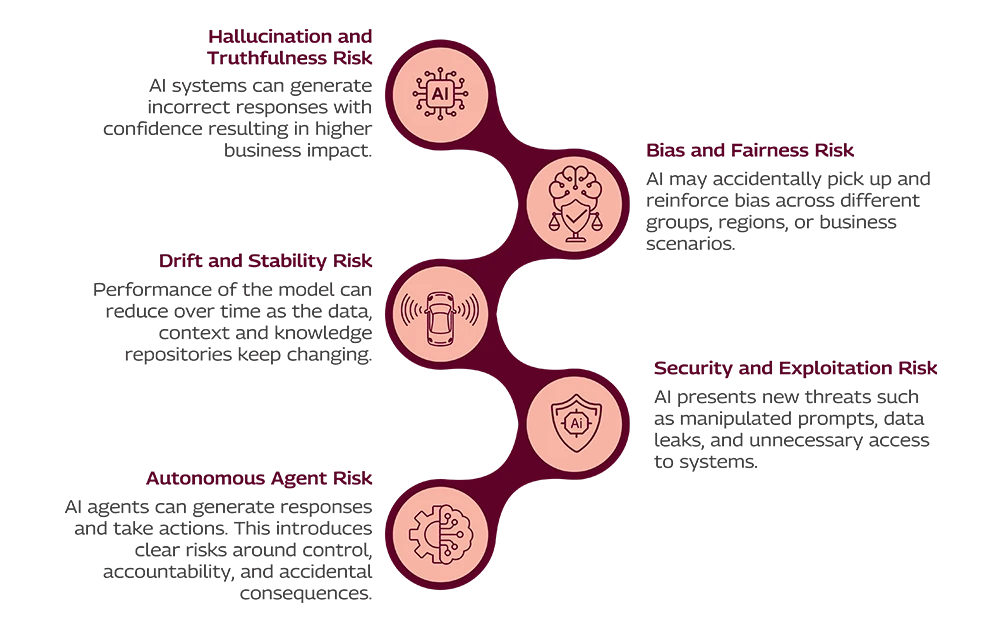
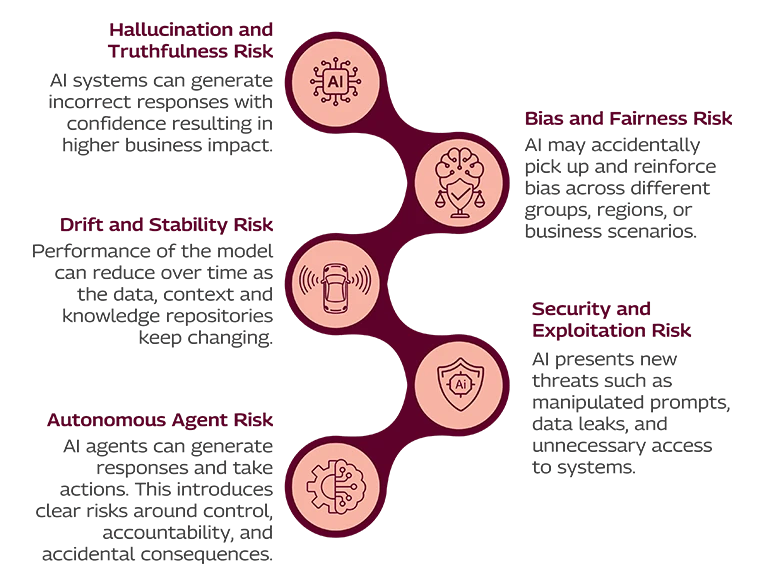
Figure 1: The Emerging Risk Landscape of AI
Evolving Architecture Toward AI Evaluation Ecosystems
AI resets the way testing is approached.
| Traditional QA | AI Test Fabric |
|---|---|
| Scripted test cases | Curated datasets and benchmark checks |
| Expected outputs | Variable scoring models |
| Pass or fail validation | Layered trust scoring across multiple dimensions |
| Static regression suites | Evaluation pipelines that keep running |
Test assets are transformed from test scripts to enterprise-grade data products. The following illustration covers the key components.
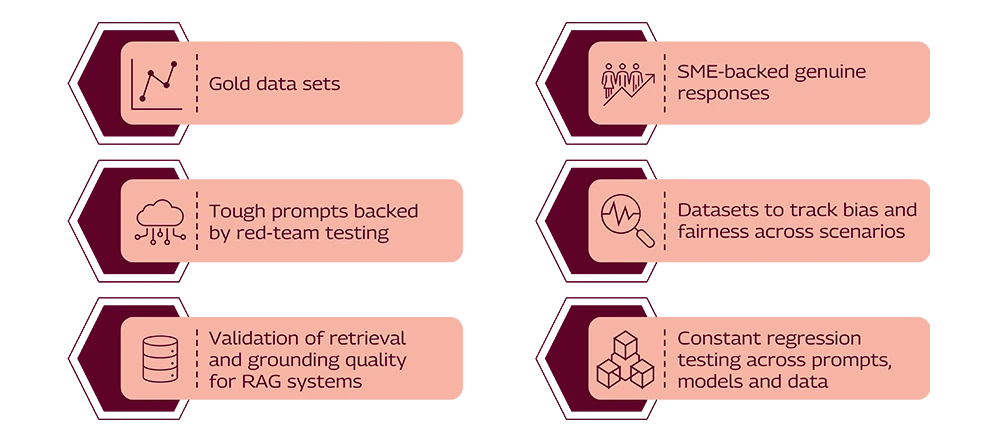
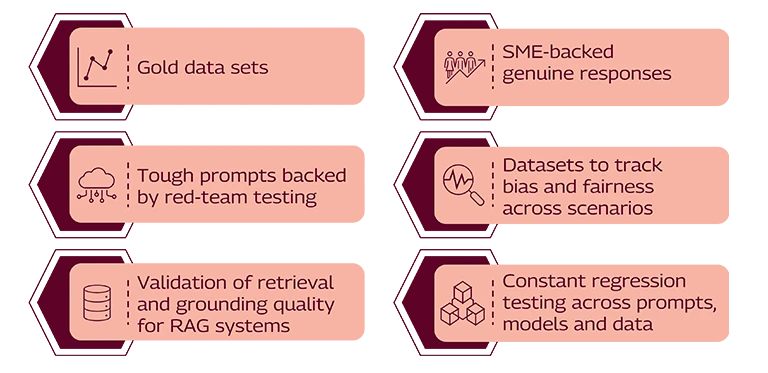
Figure 2: Foundational Test Assets for AI Trust Fabric
Moving towards Action Assurance
With the rise of AI agents, testing becomes more about validating actions.
- Does the agent execute the correct workflow?
- Are permissions implemented correctly?
- Are decisions reversible?
- Is human oversight applied appropriately?
This focuses on a new discipline called Agent Action Safety Testing, covering:
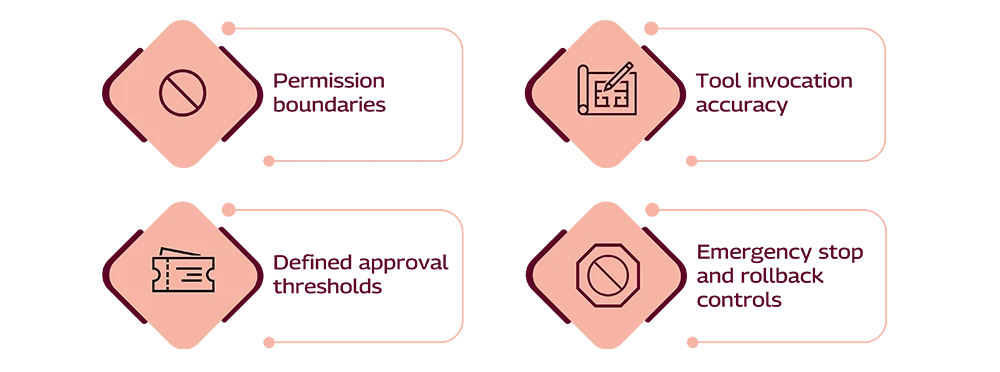
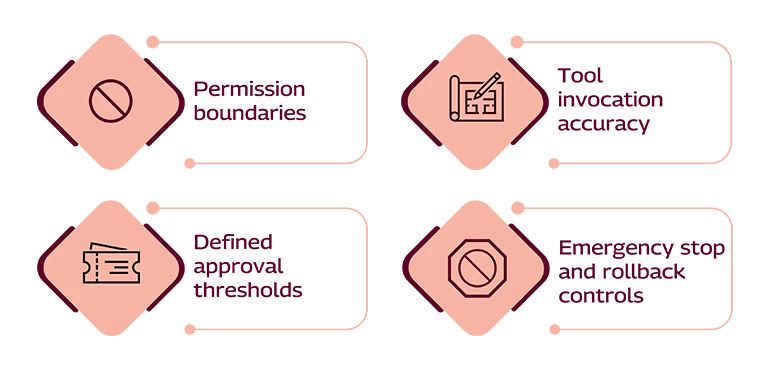
Figure 3: The features of Agent Action Safety Testing
As AI systems become more autonomous, testing shifts to governance on the go.
Why AI Assurance Test Fabric Matters Now
Organizations are moving towards AI-driven operations, autonomous workflows, and agentic ecosystems. However, scaling AI without trust is not feasible. Without ongoing assurance, AI initiatives fail to move past pilot stages, increasing regulatory risks and reducing business trust.
AI assurance test fabric forms the foundation for scaling AI responsibly, ensuring systems remain accurate, fair, secure, explainable, and stable over time.
The Seven Layers of AI Assurance Test Fabric
Organizations can structure test fabric across seven layers of assurance. These layers create a holistic trust architecture for AI systems.
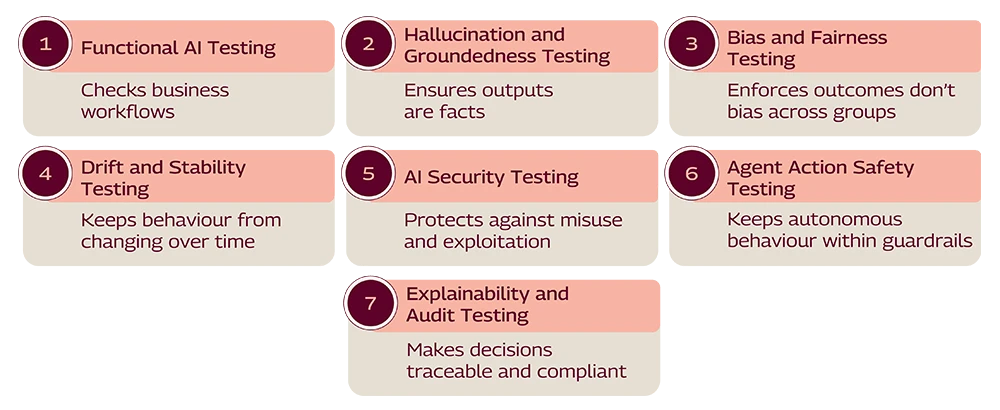
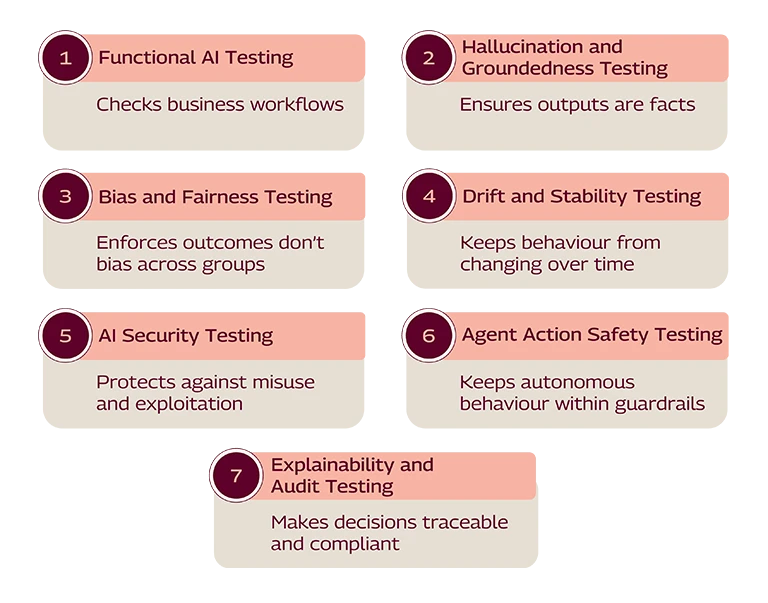
Figure 4: The seven layers of AI Assurance Test Fabric
The Evolving Differentiation for Service Providers
For service providers, this serves as an excellent opportunity to move beyond traditional testing services.
From Test Factory to AI Assurance Partner
Service providers can reset their positioning by building AI Assurance Centers of Excellence (CoE) that anchor capability, integrating QA with MLOps, LLMOps, SecOps, and Responsible AI, and offering continuous trust validation services.
Differentiated Offerings
- AI trust certification frameworks
- Hallucination and bias testing services
- Agent governance and safety validation
- AI risk monitoring platforms
- Continuous drift and performance assurance
Outcome-Based Positioning
The solution continuously monitors and validates AI systems in live organizational environments, determining trust in real operating conditions. This facilitates a shift from effort-based testing models to outcome-driven trust assurance services.
Conclusion: Trust Will Define the Future of AI Testing
As organizations move from fixed, rule-based applications to adaptive AI systems, testing undergoes a major transformation. Simple functional validation is not sufficient. What matters is whether these systems can operate autonomously, behave responsibly, and reliably sustain at scale.
AI assurance test fabric addresses this by integrating trust into every stage of the AI lifecycle. The fabric enables testing that validates outcomes, intent, behavior, and impact. For service providers, this is a strategic opportunity to become custodians of organizational AI trust. In today’s AI-led environment, testing becomes the continuous engine that sustains and reinforces trust.
TAGS:
Artificial Intelligence
Frequently Asked Questions
Our FAQ section is designed to guide you through the most common topics and concerns.
AI Assurance Test Fabric is a continuous testing model designed to verify AI systems across multiple trust dimensions—accuracy, fairness, security, explainability, and reliability—throughout their lifecycle.
Traditional testing relies on static codebases and predefined test cases. AI systems, however, evolve with data, prompts, and user interactions, making static testing inadequate for identifying risks like bias, drift, or hallucinations.
It covers emerging risks such as hallucination, bias, model drift, prompt injection, and autonomous agent actions—transforming testing into an enterprise risk management mechanism.
It enables faster AI rollouts, smoother audits, stronger regulatory compliance, and greater customer trust by embedding governance and monitoring into live production environments.
Service providers can differentiate by offering end-to-end AI assurance services, including trust certification frameworks, bias testing, agent safety validation, and continuous risk monitoring platforms.