

Scale at Speed™







 English (Global)
 French (Canada)

- AI voice bots aid in enhanced and cost-effective customer experience at scale.
- The adoption of bots is on a steady rise due to an increase in customer expectations and operational pressures.
- Large language models (LLMs), natural language processing (NLP) and automatic speech recognition (ASR) are the primary technological foundations for the AI voice bots.
Introduction
Insurance carriers are struggling to meet rising customer expectations, offer personalized services, improve processing time, and reduce costs. Traditional systems make it nearly impossible to meet these changing expectations, resulting in frustrated customers and higher operational costs.
AI voice bots help to address these challenges by delivering natural, personalized, and conversational experiences. While bots accelerate transactions, they also enhance customer satisfaction by enabling simple voice commands to make premium payments, file claims, change the beneficiary on a policy, or transfer funds.
According to the Precedence Research report, the size of the AI market in the insurance industry is projected to reach USD 10.82 billion in 2025. The report also predicts an increase from USD 14.39 billion in 2026 to approximately USD 176.58 billion by 2035, representing a CAGR of 32.21% from 2026 to 2035.1
Forrester’s predictions for 2026 point out that one in four insurance brands will see a 10% increase in successful self-service interactions by the end of 2026, driven by growing trust in generative AI 2. Moreover, the Gartner customer service predictions benchmark indicates up to a 30% reduction in insurance operational costs.3
How AI BOT Agents are Helping Insurance Carriers
AI voice bot agents are conversational AI systems that understand natural human language, verify the caller's identity, retrieve policy data, validate policy status, and gather required information to process the transaction end-to-end, entirely through conversation with humans. The bots also provide a sentimental and emotional touch to the dialogue while chatting with customers.
Beyond this, chat history can be used for continuous learning, sentiment analysis, predictive insights, product design, market research, customer satisfaction scores, and more. Other notable benefits of AI voice bots are as follows:
- Natural language understanding aligned to customer intent
- Context awareness and personalized responses
- Asks relevant follow-up questions
- Capable of handling end-to-end transactions and completing the task
- 24/7 availability and scalability
- Better decision-making capability
The Technological Building Blocks Behind AI Voice Bot Agents
AI voice bot agents are built on a combination of:
- Automatic speech recognition (ASR) that converts voice to text
- Natural language processing (NLP) that interprets intent and context
- Large language models (LLMs) that handle language variations, complex conversations, and knowledge retrieval (RAG) from other enterprise applications such as PAS, claims, and policy systems
- Natural language generation (NLG) and text-to-speech (TTS) that generate natural replies or outputs from the system
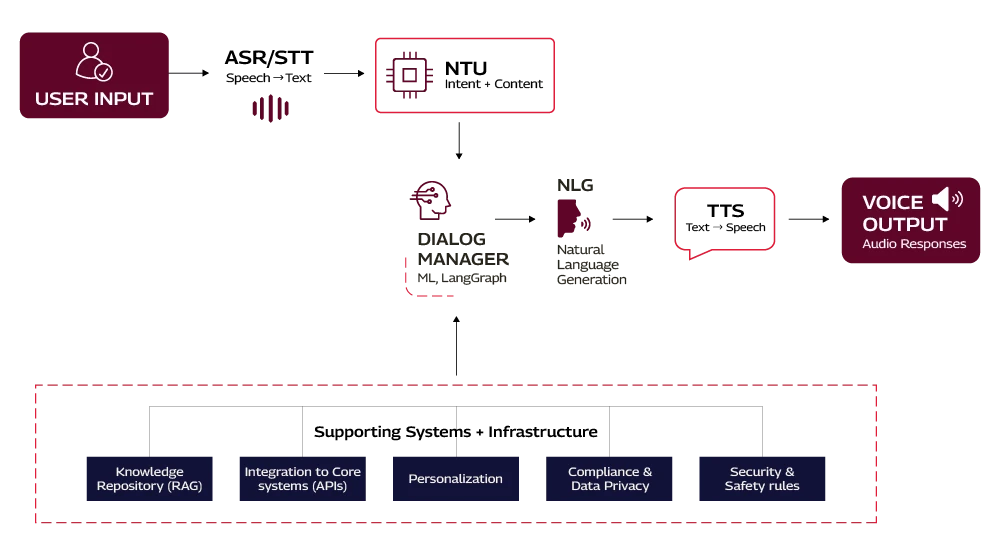
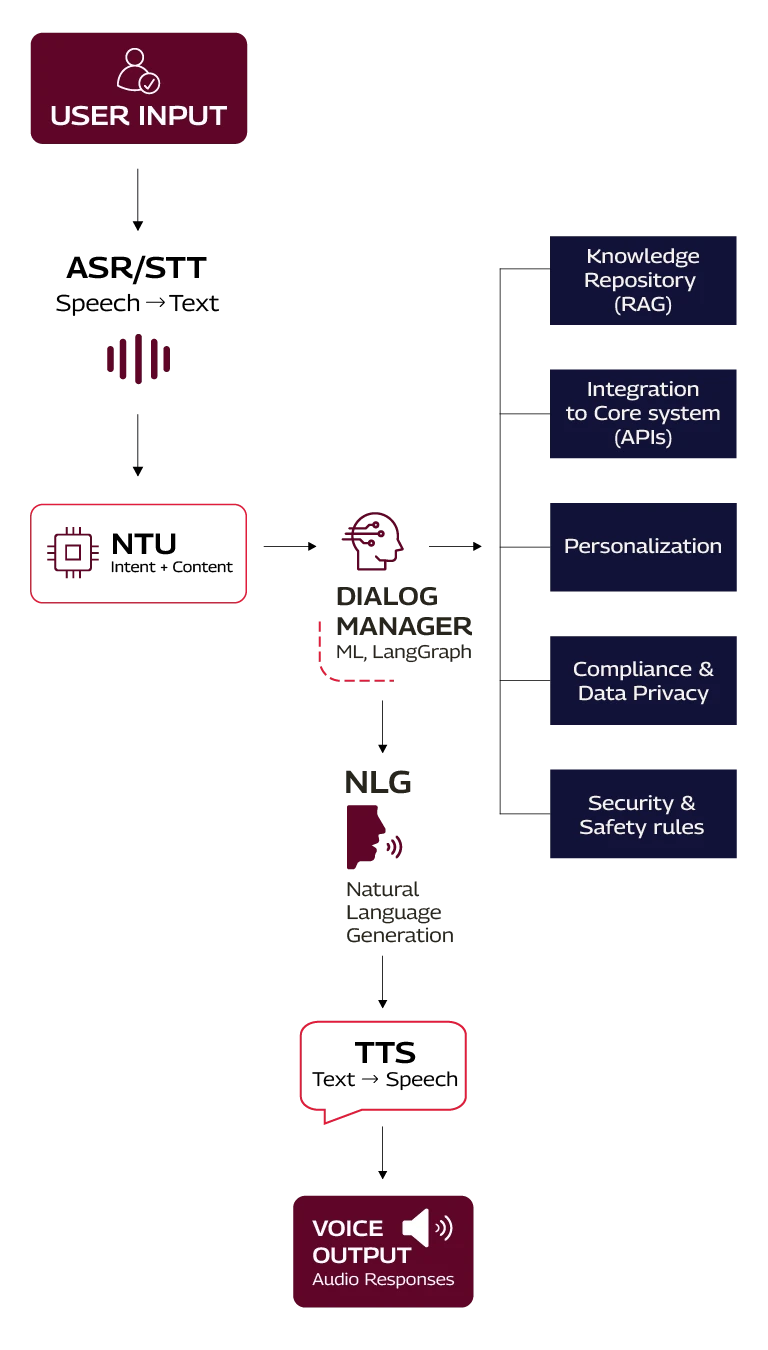
Figure 1: Technologies behind AI voice bots
How AI Voice Bots are Reshaping Insurance Operations
Today, AI voice bots are revolutionizing the insurance industry through intelligent automation and human-like conversations. The benefits and improvements cited below are based on internal proofs of concept developed on Orion and our other platforms. Key use cases are:
- Policy and claim status inquiry: AI voice bots authenticate users and provide real-time policy or claims status by fetching or integrating with core systems. The bots also reduce wait time by half and operational costs by 30-40%.
- First notifications on loss and claims intake: Voice bots capture the FNOL details, validate information, and speed up the claim registration process through natural language conversation. Thus, reducing the overall cycle time by 40-50% and cost by 30-40%.
- Premium payment processing: The bot sends reminders to customers and enables a secure gateway to process premium payments. Enables 2-8% lapse reduction and 10-15% improvement in on-time premium collections.
- Billing and loan inquiries: Voice bots aid in real-time retrieval of billing and loan information and provide a breakdown of the schedules, enabling 30-50% call deflection for routine billing or loan queries.
- Non-financial policy servicing: Bots help process non-financial servicing transactions such as beneficiary change, address change, duplicate policy document request, and others. This is possible when bots capture the customer requests, validate the details, and apply business rules. In turn, 50% STP of servicing requests and reduces manual efforts.
Compliance and Security Measures for Voice Bots in Insurance Operations
AI voice bots must comply with region-specific data privacy regulations like GDPR, DPDP, HIPAA, DORA, and others. Organizations must enforce strong authentication (multi-factor authentication), encrypt all voice and transaction data, maintain audit trails, and follow strict AI governance. Secure infrastructure, transparency, and human fallback are mandatory to ensure trust, regulatory compliance, and operational resilience.
Conclusion
Today, AI voice bot agents are not a far-fetched dream but a reality. And most insurance organizations have already adopted bots. Organizations adopting bots are reaping the benefits of reduced operational costs, improved customer service, and increased interactions. AI-powered voice bots unlock measurable outcomes in efficiency, cost optimization, and customer satisfaction.
TAGS:
Artificial Intelligence
Intelligent Automation
Insurance
Frequently Asked Questions
Our FAQ section is designed to guide you through the most common topics and concerns.
AI voice bots are conversational systems that understand natural speech, verify identity, retrieve policy information, and complete service requests through voice interactions. They can support tasks such as premium payments, claims intake, policy updates, and status inquiries while providing faster and more personalized customer service.
Insurers are adopting AI voice bots to meet rising customer expectations, improve service speed, reduce costs, and scale support without increasing manual effort. Voice bots help organizations deliver 24/7 service, reduce wait times, and create more natural customer interactions while addressing growing operational pressure.
High-value use cases include policy and claim status inquiries, first notice of loss, premium payment processing, billing and loan inquiries, and non-financial policy servicing. These processes benefit because voice bots can authenticate users, gather information, apply business rules, and complete routine requests with less manual intervention.
AI voice bots are built on automatic speech recognition (ASR), natural language processing (NLP), large language models (LLMs), retrieval-augmented generation (RAG), natural language generation (NLG), and text-to-speech (TTS). Together, these technologies help bots understand spoken language, interpret intent, retrieve relevant data, and deliver natural-sounding responses.
Insurance voice bots should follow region-specific privacy and regulatory requirements such as GDPR, DPDP, HIPAA, and DORA. Key measures include strong authentication, encryption of voice and transaction data, audit trails, AI governance, secure infrastructure, transparency, and a human fallback option to support trust, compliance, and resilience.
End Notes
- Shivani Zoting. (Jan 2026). Artificial Intelligence (AI) in Insurance Market Size, Share and Trends 2026 to 2035.
- Rohit Makhijani, Indranil Bandyopadhyay, David Hoffman. (Oct 30 2025). Predictions 2026: Significant Shifts In CX, AI, And Microinsurance Across The …
- Brad Fager. (December 2025). Customer Service and Support Leaders Must Prioritize Blending Human Strengths with AI Intelligence in 2026
