

Scale at Speed™







 English (Global)
 French (Canada)

- Gaming companies collect massive volumes of player data across apps, web, CRM systems, and contact centers. But fragmented systems and manual processes turn that data into a compliance and experience liability instead of insight for decisions.
- The landscape of consents, obligations, preferences, and permissions is evolving fast, driven by data privacy regulations like GDPR and CCPA that protect players and keep gaming experiences transparent and user-controlled.
- Databricks Lakehouse acts as a trusted data ecosystem: it integrates consent data in real time and processes suppressions through a purpose-built rule engine that keeps player data safe.
Gaming Has a Data Problem Nobody Talks About
When we think about data in gaming, we usually picture the telemetry: button clicks, choices, session metrics, match results, and other gameplay activities. That's part of it. But behind the scenes are quieter, messier data challenges that most gaming companies struggle with: managing customer consent, preferences, and compliance.
With 3.6 billion players worldwide and revenue projected to reach $206.5 billion by 2028, according to Newzoo's 2025 Global Games Market Report, the gaming industry generates massive volumes of behavioral data.
Despite this unprecedented scale of telemetry, most gaming companies continue to lack meaningful insights. The raw data piles up, but batch-processed outputs turn it into a rear-view mirror, i.e., showing what already happened, never what is happening now or what comes next.
Gaming companies capture everything about their players and still can't see what's coming next.
As player numbers grow, real-time management of consent has become both crucial and inevitable. For users, consent events, preference updates, and opt-in or opt-out actions are generated across mobile apps, websites, emails, SMS, CRM systems, customer service calls, and subscriptions. But most gaming companies lack a unified, real-time view of each customer's consent status across all these platforms.
Consent data is fragmented across systems, delaying marketing suppressions by hours or days after a customer opts out. Since channels are not integrated with a single view, changes made in one channel aren’t reflected in others until the next batch update. When regulators request audits, compiling a complete trail requires pulling data from multiple sources, which can lead to gaps. Every one of these failures, such as delayed suppressions, fragmented views, and audit gaps, traces back to the same root cause.
The tools already exist. What's missing is the architecture to connect them. And in an industry where player attention is the most fiercely contested resource, that delay costs topline revenue.
Data with Deferred Trust Engine and its Real Consequences
For a gaming operator, the player safety promise (PSP) means responsible gambling standards are no longer optional. If concerns such as marketing suppression lag or consent data are not processed immediately, the damage compounds: regulatory fines, broken player trust, and rising churn. Fixing this requires moving away from batch systems toward a real-time data flow, where suppression rules trigger instantly, and every pipeline action leaves a clean, compliant audit trail.
Databricks Lakehouse Architecture
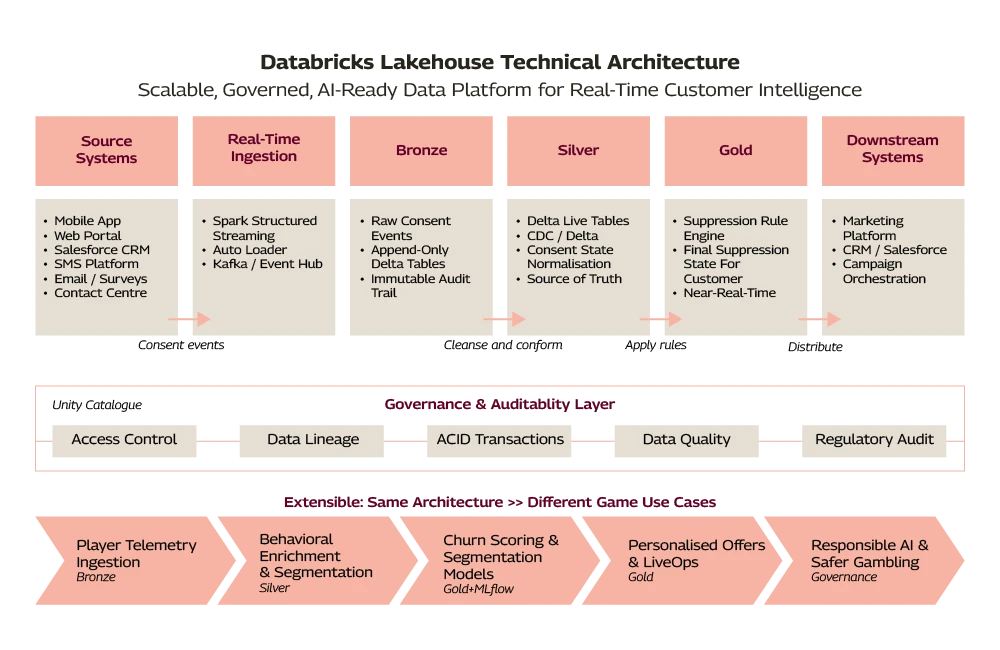
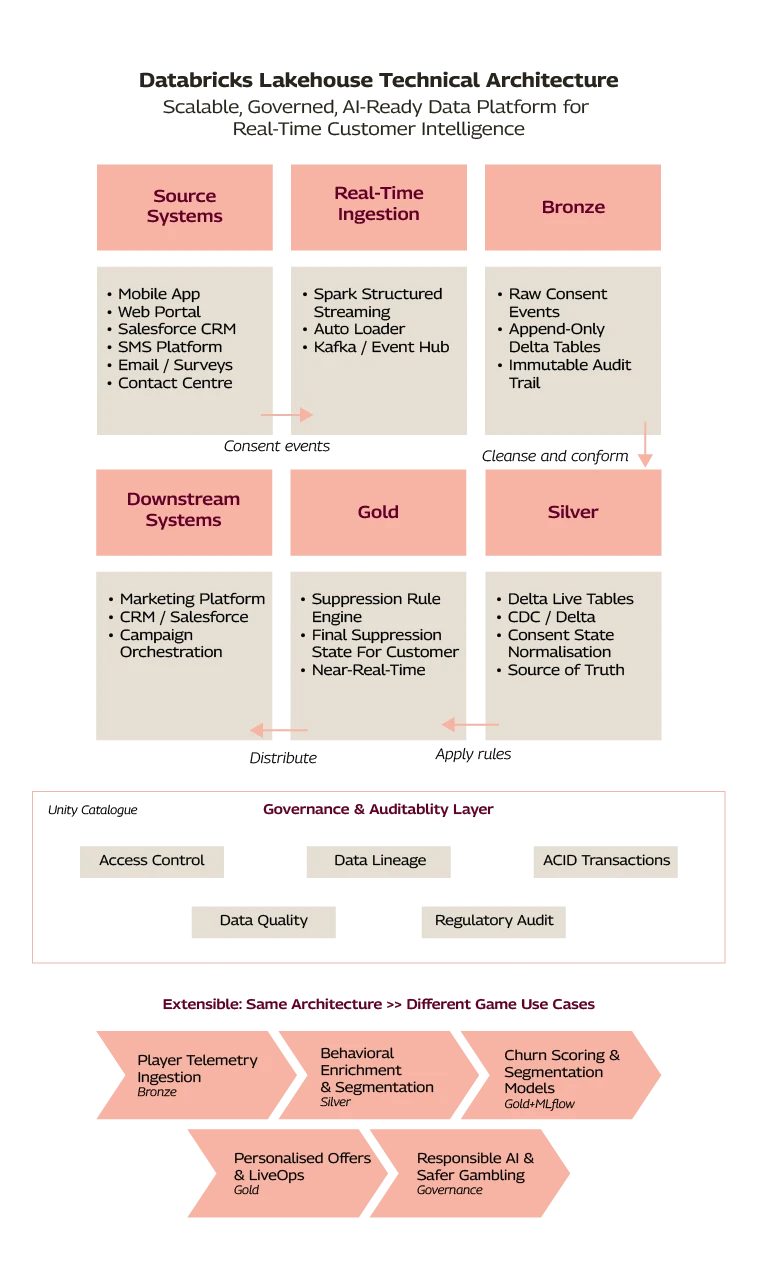
Databricks Lakehouse lets us centralize consent and preference data across every customer channel. The pipeline follows the standard Medallion architecture, organized into three progressive layers:
- Bronze Layer: Raw ingestion: Consent events from all interaction channels stream into the Lakehouse in real time via Spark Structured Streaming. Data is loaded directly into append-only Delta tables as is, without any filters or transformation rules. This creates a permanent, immutable audit trail for compliance.
- Silver Layer: Cleanse and Transform: The Delta Live Tables (DLT) framework handles data deduplication, validates schemas, and normalizes consent states. Change Data Capture (CDC) tracks historical updates, while Delta's native ACID transactions protect data integrity during simultaneous writes. The Silver layer is our single source of truth.
- Gold Layer: Suppression Rule Engine: This layer hosts a dedicated rule engine that evaluates active opt-outs, regulatory mandates, self-exclusions, and cooling-off periods. It calculates the final suppression state for each customer and pushes these updates to downstream marketing systems in near real time.
Data Governance and Compliances
Unity Catalog manages the data lineage and provides fine-grained access control across the pipeline. If a regulator requests a review, we can use the Delta Lake Time Travel feature to run point-in-time queries and reconstruct a customer's exact historical consent state.
Future Extensible
This data pipeline establishes a foundation for broader gaming use cases. Without changing the core architecture, we can extend it to handle player telemetry ingestion at the Bronze layer, behavioral analysis at the Silver layer, and machine learning for churn scoring and responsible gaming alerts at the Gold layer.
By capturing consent and acting on it in real time, every decision becomes traceable and compliant. And because the foundation is modular, the same architecture reaches beyond compliance — into how we engage players directly.
Elevating the Player Experience
Beyond compliance, a centralized data Lakehouse fundamentally changes how we engage players. The same infrastructure that handles consent management can simultaneously power machine learning to predict churn, tailor personalized offers, and optimize LiveOps, all on a single platform.
Key Agentic AI Use Cases on Lakehouse
Next-Best-X (NBX) for Agentic Personalization: Instead of static batch promotions, models evaluate real-time signals such as session length, betting shifts, and deposit frequency. This helps to immediately trigger relevant in-game recommendations or rewards.
Intelligent Player Support Agents: A RAG-powered conversational AI agent that draws on a player's betting history and consent state before the conversation even starts, and knows what you follow and what you have opted into in real time.
Responsible AI Agent - Proactive Harm Prevention: An always-on agent that monitors behavioral patterns such as escalating bets, chasing losses, and deposit spikes, and autonomously triggers cooling-off reminders or escalations before harm occurs.
Localized Dynamic Marketing: Generative tools can safely build tailored banners, copy, and creative assets mapped directly to specific player segments while also respecting regional compliance and legal boundaries.
Spot the Risk Before it Escalates: An always-on agent monitors behavioral patterns such as escalating bets, chasing losses, and deposit spikes. It autonomously triggers cooling-off reminders or escalations before a session tips into problem gambling.
The Agent Already Knows the Player: A RAG-powered conversational agent draws on a player's betting history and consent state before the conversation begins. So the player never has to repeat their history or re-state preferences.
React to the Player in Real Time: Models evaluate real-time signals such as session length, betting shifts, and deposit frequency. They trigger relevant in-game recommendations or rewards instantly instead of relying on static batch promotions.
Localized Dynamic Marketing: Generative tools build tailored banners, copy, and creative assets for specific player segments. Each asset will respect regional compliance and legal boundaries.
Building these capabilities does not require tearing down the existing data pipeline. Once a secure real-time foundation is set in place, unlocking these use cases is a matter of shifting operational logic.
Databricks Lakehouse Architecture: Technology, Transparency, and Trust
The gaming industry continues to evolve rapidly and is driven by technology. From blockchain-based gaming platforms to AI-driven analytics that monitor player behavior, the innovation is reshaping the compliance landscape. Databricks Lakehouse architecture opens up opportunities for greater transparency, faster regulatory reporting, and better player protection.
Operators who have modernized their data stack gain a massive operational edge. They read player behavior instantly, personalize experiences, and protect their margins. On the flip side, companies that are stuck patching together fragmented legacy systems and running slow overnight batch jobs will keep losing players to churn.
The underlying data platform for this exists. The real challenge is deciding whether your organization is ready to move away from the legacy debt. Players are already broadcasting their preferences, boundaries, and intent to leave through real-time data, which are essentially insights. What’s needed is an infrastructure capable of responding to those signals immediately.
Key Outcomes of Databricks-Driven Architecture
- Instant Compliance: Automated, real-time enforcement of player consent and regulatory rules.
- Proactive Protection: Immediate detection of high-risk gambling behaviors before any harm occurs.
- Frictionless Personalization: Tailored player experiences driven by live data, not by yesterday's batch updates.
TAGS:
Data Analytics
Artificial Intelligence
Cloud and Infrastructure Services
Communications
Media & Entertainment
Frequently Asked Questions
Our FAQ section is designed to guide you through the most common topics and concerns.
Modern gaming operators engage with players across multiple touchpoints, from in-app notifications and SMS to web platforms and customer support desks. The moment a player opts out or triggers a self-exclusion flag, that choice must update across every single channel instantly. Even a tiny processing delay can cause a suppressed customer to receive a promotion. That mistake immediately breaches compliance, risks massive regulatory fines, and destroys player trust. In today's market, real-time enforcement is a baseline expectation, not a nice-to-have.
The Medallion architecture is a data design pattern that organizes information into three distinct, progressive stages: Bronze (raw data ingestion), Silver (validation and cleansing), and Gold (production-ready business logic).
For gaming operators, this replaces the need to maintain separate, siloed systems for different data types. Instead, player telemetry, live consent events, and behavioral data all run through the same unified pipeline. Raw data lands instantly in Bronze to secure your audit trail, moves to Silver to resolve conflicting player states, and feeds into Gold to drive live compliance checks, marketing triggers, and machine learning models.
Suppression rules are the operational logic that dictates exactly when, where, and why a player must be excluded from marketing communications. These rules account for multi-dimensional factors, including direct user opt-outs, regional compliance laws, cooling-off periods, and formal self-exclusion registers. In the gaming sector, these aren't just preferences-they are hard legal boundaries. Operators are required to stop all outbound marketing the exact second a player changes their settings. Slipping up means risking massive compliance fines, triggering regulatory audits, and permanently damaging player trust
The Databricks Lakehouse solves this by streaming consent events into Bronze via Spark Structured Streaming, normalizing them in Silver via Delta Live Tables, and evaluating suppression rules on the Gold layer, then distributing outcomes to downstream systems in near real time with full governance and auditability.
The Databricks architecture can serve beyond consent management. Once your real-time data foundation is live, you can scale the exact same pipeline to power broader player experience and ML initiatives.
- Predictive Churn Control: Score player behaviors in real time to trigger automated retention campaigns the moment a high-value user flags signs of disengagement.
- Live Monetization and Analytics: Track in-game actions, session velocity, and spending patterns to help product teams instantly optimize game economies and LiveOps.
- Dynamic Segmentation: Replace static weekly marketing lists with continuous, behavior-triggered audience segments that keep campaigns accurate.
- Contextual In-Game Offers: Deliver hyper-personalized promotions, challenges, or rewards based on real-time player telemetry rather than stale historical averages.
- Real-Time Ad Bidding: For free-to-play games, process live player context instantly so ad servers can serve high-yield programmatic ads without adding gameplay latency.
Five core features handle the heavy lifting for live game data:
- Spark Structured Streaming: Ingests live telemetry and consent events from millions of concurrent game clients without dropping data.
- Delta Lake: Enforces strict schemas and guarantees ACID compliance, preventing data corruption during simultaneous player writes.
- Delta Live Tables (DLT): Automates the entire data pipeline while running continuous data quality checks behind the scenes.
- Unity Catalog: Centralizes governance and data lineage, making sure compliance teams can instantly track who accessed player data.
- MLflow: Moves fraud-detection or churn models from test notebooks to production without requiring a separate engineering rebuild.
