

Scale at Speed™







 English (Global)
 French (Canada)

Escaping Legacy Gravity
Agentic AI promises to reshape how telcos operate, compete, and create value. But that promise cannot be realized while operators remain anchored to fragmented, technology debt-ridden legacy stacks that exert a constant gravitational pull on every transformation initiative.
Telcos are investing aggressively in AI, autonomous operations, self-optimizing networks, and next-generation digital services. Yet many initiatives remain trapped at the pilot stage because operations are fragmented, data is inconsistent, and critical business logic, meaning, and enterprise knowledge are locked in legacy systems.
Zero Gravity Telco Architecture™ introduces Tech Mahindra’s architectural framework for reducing legacy debt by externalizing enterprise context, and creating the governed foundation required for trusted agentic AI at scale. The framework also presents the Zero Gravity Index, a structured diagnostic that shows every operator where it stands on the journey from legacy inertia to agentic autonomy and provides the architectural blueprint to break free.
7×3 Matrix
Enterprise taxonomy that pinpoints exactly where gravity hides
2×2 Grid
Zero Gravity Index, navigational tool for operators to assess readiness, sequence investments & plan transformation
8 Layers
Architectural layers that externalize trapped business meaning and logic into shared, governed foundations
What Is Legacy Gravity?
Legacy Gravity is the cumulative, compounding pull exerted on every business initiative by the mass of an organization's existing application, integration, and data estate. The cumulative effect is an estate so heavy that even simple changes become disproportionately slow, costly, and risky.
The Challenge Manifests Across Three Interconnected Gravity Wells
Application Gravity
Business logic, workflows, configurations, and policies tightly coupled within enterprise applications, making every business change a technology program.

Integration Gravity
ESBs, custom APIs, and batch interfaces that have quietly become an informal process model nobody dares touch, as change-resistant as the applications they connect.

Data Gravity
Business semantics hardcoded into ETL pipelines, metric definitions, and BI dashboards, leaving AI to inherit fragmented, inconsistently governed data with little transparency into meaning.
Autonomous IT represents a fundamental shift in how enterprises operate and manage technology. Rather than reacting to incidents after they occur, intelligent platforms continuously analyze operational signals, predict potential risks, and initiate corrective actions in real time. From a CIO's perspective, the objective is to build an IT environment that can learn, adapt, and self-heal with minimal human intervention while maintaining resilience and business alignment. Achieving this vision requires the integration of observability, artificial intelligence, machine learning, AI agents, service management, and real-time data into a unified operating model. While automation drives greater efficiency and responsiveness, human expertise remains critical for governance, architectural oversight, strategic direction, and complex decision-making.
The real value of autonomy lies not in automation for its own sake, but in its ability to dramatically improve customer experience through resilient, responsive, scalable, and business-aligned operations.
Sukhdeep Gill,
Acting Chief Digital Officer,
Indosat Ooredoo Hutchison
Measure Your Gravity.
Define Your Path Forward.
Identifying the Sources of Gravity
Reducing gravity requires more than modernization initiatives. Telcos must first understand where enterprise intelligence is trapped.
Tech Mahindra’s proprietary 7×3 Enterprise Taxonomy provides a structured framework for identifying the execution logic, policies, data assets, integrations, security controls, observability mechanisms, and lifecycle processes embedded across today’s application estate.
The Anatomy of Legacy Gravity
| What It Contains | Business | Domain | Technology |
|---|---|---|---|
| Execution Logic | Business Journeys (Ex. Lead to Customer Acquisition) | Domain Process Flows (Ex. Account Creation & Maintenance) | Executing Engines (Ex. Event Driven n State Transitions) |
| Data | Business Data (Ex. Churn Propensity Scores) | Domain Entities (Ex. Cases, Complaints & Tickets) | Persistence & Storage (Ex Golden Customer Record) |
| Rules & Policies | Business Rules (Ex. Offer Eligibility by Segment) | Domain Rules (Ex. Case Priority & Routing) | Tech & Compliance (Ex AI Explainability Policy) |
| Integrations & Interfaces | Business Interfaces (Ex. Chatbot, Virtual Assistant) | Cross-domain Integration (Ex. Order Management → Order Trigger) | Technical Middleware (Ex. Kafka Event Streaming) |
| Identity, Access & Security | Persona Governance (Ex. Consumer Consent) | Data Object Classification (Ex. Consumer pricing data classification) | Security Mechanisms & Protocols (Ex. RBAC on catalog operations) |
| Observability & Auditability | Business Health Monitoring (Ex. Order Cycle Time) | Functional Logs & Data Lineage (Ex. End-to-end order lineage trace) | Telemetry Frameworks (Ex. Kafka consumer lag monitoring) |
| Configuration & Lifecycle | Business Updates (Ex. Rate Plan Updates) | Structural Schema Evolution (Ex: CDM format additions for 5G/6G/IoT) | Automation & Delivery Pipelines (Ex: CI/CD for Billing rule deployments) |
| Embedded in Application Code | Locked to One SOR’s Data Model | ARD Coded & Version Locked |
What It Contains ↓
Execution Logic
Business Journeys
(Ex. Lead to Customer Acquisition)
Data
Business Data
(Ex. Churn Propensity Scores)
Rules & Policies
Business Rules
(Ex. Offer Eligibility by Segment)
Integrations & Interfaces
Business Interfaces
(Ex. Chatbot, Virtual Assistant)
Identity, Access & Security
Persona Governance
(Ex. Consumer Consent)
Observability & Auditability
Business Health Monitoring
(Ex. Order Cycle Time)
Configuration & Lifecycle
Business Updates
(Ex. Rate Plan Updates)
Execution Logic
Domain Process Flows
(Ex. Account Creation & Maintenance)
Data
Domain Entities
(Ex: Cases, Complaints & Tickets)
Rules & Policies
Domain Rules
(Ex: Case Priority & Routing)
Integrations & Interfaces
Cross-domain Integration
(Ex: Order Management – Order Trigger)
Identity, Access & Security
Data Object Classification
(Ex: Consumer pricing data classification)
Observability & Auditability
Functional Logs & Data Lineage
(Ex: End-to-end order lineage trace)
Configuration & Lifecycle
Structural Schema Evolution
(Ex: CDM format additions for 5G/6G/IoT)
Execution Logic
Executing Engines
(Ex. Event Driven & State Transitions)
Data
Persistence & Storage
(Ex: Golden Customer Record)
Rules & Policies
Tech & Compliance
(Ex: AI Explainability Policy)
Integrations & Interfaces
Technical Middleware
(Ex: Kafka Event Streaming)
Identity, Access & Security
Security Mechanisms & Protocols
(Ex: RBAC on catalog operations)
Observability & Auditability
Telemetry Frameworks
(Ex: CDM format additions for 5G/6G/IoT)
Configuration & Lifecycle
Automation & Delivery Pipelines
(Ex: CI/CD for Billing rule deployments)
By mapping enterprise capabilities across business, domain, and technology dimensions, operators gain a clear view of where gravity exists and where it must be externalized to support future AI-led transformation.
The Zero Gravity Index
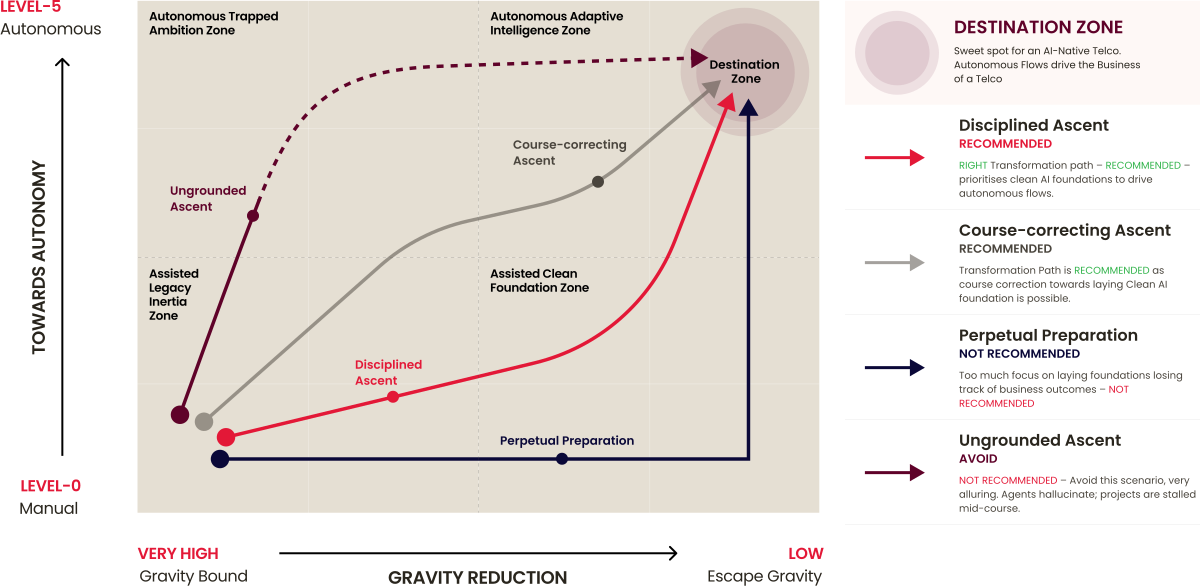
We can now map a telco's readiness on the journey from legacy inertia to agentic autonomy with the Zero Gravity Index, a 2×2 grid across two axes.
AXIS
PROGRESSION
Horizontal:
Gravity Reduction
Gravity Reduction
From complex unmanaged state to a governed, externalized state that agents can safely reason and operate
Vertical: Towards
Autonomy
Autonomy
From manual and human-operated to autonomous, multi-agent operation
Where an Operator Sits Defines Its Reality and Its Risk
Assisted Legacy Inertia
Gravity wells active and compounding; automation limited in scope. Where most Tier-1 and Tier-2 operators start.
Autonomous Trapped Ambition
A zone to be mindful of. Autonomous agents deployed onto unreformed legacy, where they are likely to hallucinate and fail at every seam, eroding executive confidence despite heavy investment.
Assisted Clean Foundation
The hidden value zone: rules externalized and data governed, delivering faster time-to-market, lower change cost, and better data quality before a single agent goes live.
Autonomous Adaptive Intelligence
The target state: every system agent-ready, multi-agent ensemble operating end-to-end within governed boundaries. New products launch in days; networks self-heal; customer intent drives fulfilment end to end.
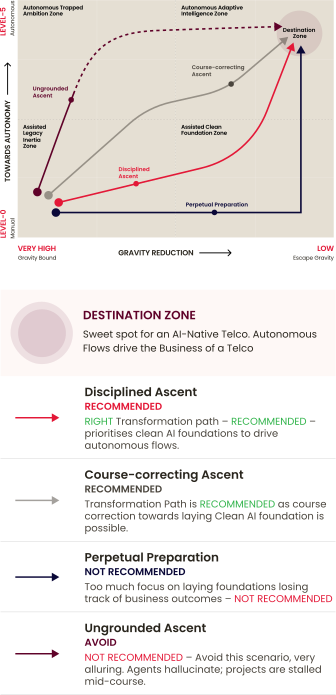
Strategic Insight: The instinctive path is to deploy agents first to show AI progress. This can lead towards trapped ambition. The disciplined path moves horizontally first, into clean foundation, and only then vertically, into adaptive intelligence.
2-Dimensional Zero Gravity Index Grid
The Zero Gravity Architecture
Traditional architectures force every application to have its own business meaning, operational context, and decision logic. Zero Gravity Architecture introduces a structurally different model.

Context is treated as a shared enterprise asset

Intelligence is externalized

Systems of record become agent-ready

Execution becomes deterministic and tightly governed
The Eight-Layer Target Architecture
01
Intent & Experience Layer
Captures and interprets business and customer intent
02
Agent Mesh
Hosts autonomous and semi-autonomous AI agents
03
Data Foundations
Governed data products and AI/ML capabilities
04
Enterprise Context Layer
Provides shared meaning and enterprise knowledge
05
Deterministic Execution Fabric
Ensures reliable, auditable execution of agent actions
06
Agent-Ready Systems of Record
Legacy and modern systems externalized for agent access
07
Digital Core
Cloud, edge, and on-premise infrastructure
08
Observability & Governance Layer
Continuous monitoring, compliance, and control
Together, these components establish the architectural foundation required for AI-native operations at enterprise scale.
Know Your Zero Gravity Index Position
Most operators are spending on AI without architectural readiness. The Index can map your journey, build Clean Foundation first, scale agents, and avoid the costly trap of Trapped Ambition.
Download Whitepaper Download WhitepaperBuilt to Work with Industry Standards
The Zero Gravity Telco Architecture™ is built directly upon prevailing industry standards rather than acting as a proprietary alternative. This architectural framework operationalizes and extends the core principles established by the TM Forum Open Digital Architecture (ODA), providing a practical blueprint for telcos to transition toward structured, open digital autonomy.
Industry Standard
Alignment Within Zero Gravity Telco Architecture™
TM Forum's AI-Native ODA (TMF448)
Aligned with TMF448's principles for cross-domain autonomous flows and a governed agent execution layer.
TM Forum Information Framework (SID)
The Layer 4 context layer translates operational assets into canonical SID terms.
TM Forum Intent Ontology (TR 292)
Applies the TIO/TR292 intent-ontology approach, extended to commercial intent.
Autonomous Networks Framework (IG1230)
Network performance data products, architected per IG1230, are exposed through the shared context layer so commercial-domain agents can consume them.
AI will not deliver its full potential on fragmented architectures and inconsistent business logic. Operators that want to become autonomous enterprises must first build trusted foundations, shared understanding and governance that allow AI to operate safely and at scale. Tech Mahindra's Zero Gravity Telco Architecture™ aligns closely with the principles behind TM Forum's AI-Native Open Digital Architecture and highlights a reality the industry can no longer ignore: AI doesn't move from pilot to production without trust.
Nik Willetts,
CEO,
TM Forum
Gravity Reduction Impact
By reducing gravity, the Zero Gravity Telco Architecture TM delivers differentiated impact to the telco. As gravity reduces, a CXO will notice differentiated impact across critical outcome scales – Business Velocity, Commercial Agility, Transformation Risk and Operational Resilience.
MONTHS
High Gravity
Months
Months
HOURS
Low Gravity
Hours
Hours
Business Velocity
(Decision ⟶ Live Change)
QUARTERS
High Gravity
Quarters
Quarters
DAYS
Low Gravity
Days
Days
Commercial Agility
(Opportunity ⟶ Market)
HIGH
High Gravity
High Debt
High Debt
LOW
Low Gravity
Low Debt
Low Debt
Transformation Risk
(Technical Debt)
FRAGILE
High Gravity
Fragile
Fragile
SELF-HEALING
Low Gravity
Self-healing
Self-healing
Operational Resilience
(Detect ⟶ Heal)
Value is unlocked only when you systematically reduce the gravity that the existing stack exerts on the next initiative, and every initiative after it. The telcos that break free of gravity first are the ones that will be better positioned to shape the competitive landscape over the next ten years.
Amol Phadke,
Chief Transformation Officer,
Tech Mahindra

Begin with Balance,
Not with Agents
Every operator is already somewhere on the Zero Gravity Index, knowingly or not. The question is whether the move is governed and sequenced or left to happen by accident at considerable cost.
In the first 90 days, a Zero Gravity Diagnostic:
- 01 Establishes your current position on the index
- 02 Identifies the principal sources of application, integration, and data gravity
- 03 Prioritizes the journeys where gravity reduction creates the fastest business impact
- 04 Provides a sequenced roadmap to your target state