

Scale at Speed™







 English (Global)
 French (Canada)

- Data standards have improved interoperability across files, tables, and APIs, while semantic definitions remain fragmented.
- Open Semantic Interchange (OSI) aims to provide a vendor-neutral format for exchanging business metrics, dimensions, relationships, and rules.
- A shared semantic definition can help BI, analytics, and AI systems work from consistent business meaning.
- OSI complements semantic layers, ontologies, and knowledge graphs rather than replacing them.
- Its long-term impact will depend on industry adoption, platform support, and governance.
The Missing Standard for Semantic Layers in the AI Era
As organizations scale with AI and agentic AI solutions, challenges become apparent regarding access to data. Modern data and AI architectures leverage multiple platforms and tools, each serving a specific purpose. However, no common standards for describing and exchanging information exist, which can lead to conflicts across the technology stack.
Formats like Parquet became popular for storing data files, Iceberg provided an efficient approach for handling analytical tables, and OpenAPI offered a unified way to describe APIs, facilitating communication and collaboration across different technologies without needing to understand their internal mechanics.
Semantic information experiences the exact same problem. Metrics, dimensions, relationships, and other definitions are usually platform-specific. Open Semantic Interchange (OSI) is an effort to solve this problem by providing a common, machine-readable representation of semantic definitions.
This is where Open Semantic Interchange (OSI) comes in.
What Is Open Semantic Interchange?
As an open, vendor-neutral standard, OSI is designed for defining and exchanging semantic metadata, such as business metrics, dimensions, relationships, and business rules, across analytics, BI, data, and AI platforms.1
The objective is to ensure that a metric such as revenue, churn rate, or monthly active users has the same meaning across tools and AI agents.2
It is easiest to think about OSI in terms of its function. The standard is not a semantic layer, BI tool, data warehouse, or collection of key performance indicators (KPIs). Even with analytics or BI tools such as Power BI, Tableau, and dbt, queries need to be generated, security must be applied, caching occurs, and reporting is done. OSI is a specification that enables the writing of semantic definitions in a common language. OSI is a specification that allows the creation of semantic definitions in a standard form of a language. This specifies a uniform structure for business meaning representation, which gives possibilities for exchanging semantic models among tools and platforms. As a result, organizations can understand business concepts uniformly and integrate data, analytics, and AI systems.
A Simple OSI Semantic Model
Suppose we have two business entities, subscriber and revenue, and one KPI, Average Revenue Per User (ARPU). An OSI model could define the datasets, their relationship, and the metric calculation.
- Datasets: Subscriber, Revenue
- Relationship: Revenue relates to subscribers
- Key Performance Indicator (KPI): ARPU = Revenue / Number of Active Subscribers
This allows for the same interpretation of KPIs on all platforms without any need for duplicate definitions, as the idea is to define business meaning once and let multiple tools consume the same definition.
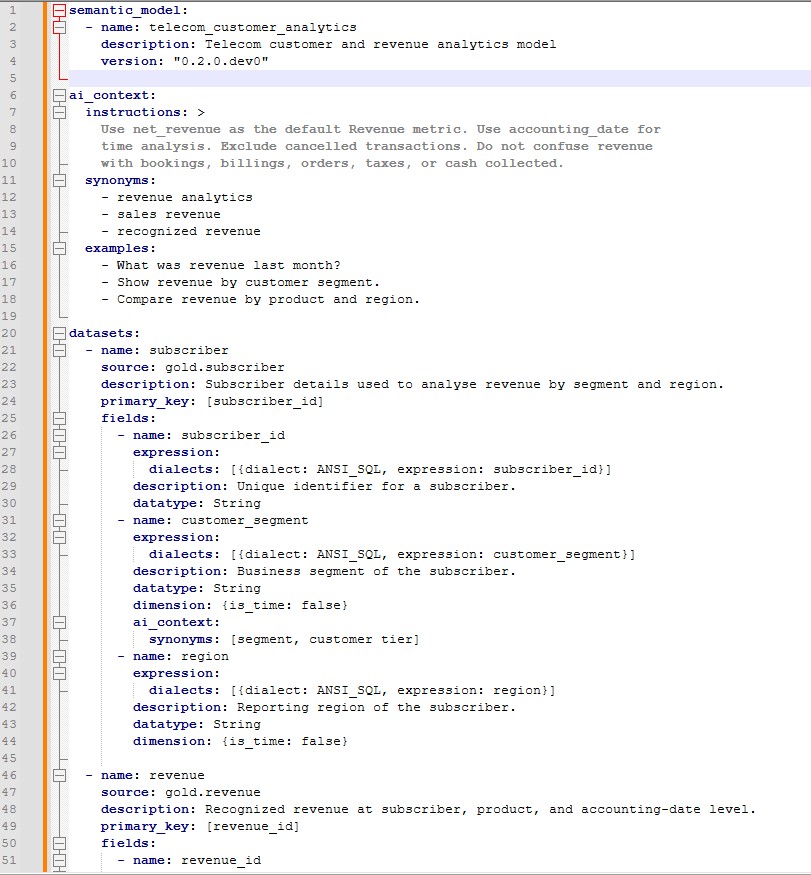
Figure 1: Sample OSI Semantic Model Showing Datasets, Relationships, and the ARPU Metric
Why Semantic Consistency Matters
Most discussions about AI hallucination focus on foundation models generating incorrect facts. Enterprises face another challenge when different systems use different definitions for the same business metric.
Consider a simple question: What is ARPU?
Finance may define ARPU one way, marketing another, and a Power BI dashboard may use a different calculation altogether. As organizations deploy AI assistants to answer business questions, these inconsistencies create a new challenge. AI can produce an answer based on a business definition that differs from the definition the user expects.3 This is called semantic hallucination. For example, if an AI assistant receives the question, 'Show me ARPU by region’ it may encounter multiple definitions of ARPU across different systems. Without a common definition, the answer may be technically correct in one system and incorrect in another.
OSI provides a machine-readable and portable definition of business semantics, including:
- Metrics: Measurement
- Dimensions: Context
- Relationships: Connectivity
- Business Entities: Meaning
The goal isn't to eliminate hallucinations but to reduce confusion caused by inconsistent business definitions.
AI needs access to enterprise data and a consistent understanding of what that data means.
Where Does OSI Fit in Modern Data Architecture?
OSI addresses a different need from the semantic layer of portability. While semantic layers manage and apply business logic within a platform, OSI provides a common way to describe and exchange that business meaning across tools. A modern architecture may therefore include source systems, a data platform, a semantic layer, OSI, and BI and AI tools. OSI provides a portable way to describe business concepts that can be exchanged across tools.
Positioning OSI within the architecture is only part of the story. Organizations also need to understand how it complements the technologies they already rely on to define, manage, and govern business meaning.
OSI Compared to Existing Approaches
The question is not whether OSI replaces these technologies, but how it works alongside them. The comparisons listed below help clarify the distinct role OSI is intended to play within the data and AI ecosystem.
| Approach | Primary Purpose | Relationship With OSI |
| Semantic Layers | Execute business logic, generate queries, enforce security, and serve analytics | OSI provides a standard way to describe business logic that semantic layers can consume |
| dbt and Power BI | Define and manage semantic models within specific platforms | OSI enables portability of semantic definitions across platforms |
| Ontologies and Knowledge Graphs | Describe business entities, concepts, and relationships | OSI focuses on business metrics, calculations, and performance measurement |
These approaches help AI understand how business entities are related.
OSI focuses on business measurements such as ARPU, revenue, churn, and network availability. It helps describe how metrics are calculated and how business performance is measured.
In the future, AI systems may need both ontologies and OSI. Ontology can help AI understand the business world, while OSI can help it understand business metrics.
Where OSI Fits in Enterprise Use Cases
Over time, definitions of metrics such as revenue and customer lifetime value can change from one dashboard, report, and data mart to another.
An AI assistant is likely to select a metric definition that does not match the business definition. OSI provides a common definition of metrics, dimensions, and relationships that machines can understand.
| Use Case | Scenario | OSI Value |
| Different Business Metrics Across BI, Analytics, and AI | Metrics such as revenue and customer lifetime value may be defined differently across dashboards, reports, and data marts. This can lead to inconsistent reporting and AI outputs. | OSI provides common, machine-readable definitions for metrics, dimensions, and relationships, helping different platforms work from consistent business definitions. |
| Agentic AI and AI-to-AI Collaboration | Multiple AI agents may work across functions such as forecasting, risk, and customer service. Differences in how they interpret business metrics can result in inconsistent outputs. | OSI gives AI agents a shared understanding of business metrics and relationships, helping improve consistency across AI-driven workflows. |
| Platform Modernization and Analytics Migration | Metrics are often tied to specific BI or semantic platforms. During modernization or migration, organizations may need to recreate and validate these definitions. | OSI represents semantic definitions in a common, portable format, making them easier to reuse and exchange across platforms. |
OSI aims to provide a portable semantic representation that can be exchanged across platforms. Long-term benefits could include reusable business logic, reduced migration effort, and easier adoption of new analytics and AI technologies without redefining business meaning from scratch.
Portable semantic definitions could let organizations carry business logic across platforms instead of rebuilding it with every migration.
From Emerging Standard to Enterprise Adoption
OSI is establishing a common foundation for semantic interoperability across the modern data and AI ecosystem. With an open specification designed to make metrics, dimensions, and business context portable across tools, the initiative addresses a growing enterprise need. Data and AI systems can work from consistent business meaning rather than platform-specific definitions.
The level of involvement by companies such as Snowflake, Databricks, Oracle, Salesforce, and Mistral AI indicates that support for OSI is increasing. Snowflake's interoperability features, which include exporting Semantic Views to Ossie YAML and creating Semantic Views from Ossie YAML, provide an early instance of this kind of adoption.3
As AI moves from experimentation to enterprise-scale adoption, semantic interoperability will become increasingly important for building trusted analytics and AI agents. Business meaning needs to become as portable and interoperable as the data and APIs that carry it. OSI has the potential to provide the common language that connects business definitions across platforms. This reduces duplication and enables organizations to define semantics once and reuse them across their technology ecosystem. Its long-term impact will depend on broader adoption, native support across platforms, and sustained open governance.
TAGS:
Artificial Intelligence
Data Analytics
Hi Tech
Frequently Asked Questions
Our FAQ section is designed to guide you through the most common topics and concerns.
No. OSI cannot solve missing data, poor retrieval, or incorrect reasoning. It can help reduce confusion caused by inconsistent business definitions. Its role is to provide a common representation for business metrics and related semantic information.
No. A semantic layer still performs functions such as query generation, security enforcement, caching, and report execution. OSI provides a standardized format that semantic layer engines can share.
dbt and Power BI support semantic modeling, but each platform stores definitions in its own format. OSI aims to improve portability by providing a shared representation for semantic definitions.
Ontologies and knowledge graphs focus on business meaning and relationships among entities. OSI focuses on semantic definitions for business measurements, including metrics and calculations. AI systems may benefit from both approaches.
Potentially. If major platforms adopt OSI, organizations could exchange semantic definitions rather than recreate every metric manually during migration. The extent of this benefit will depend on implementation and industry adoption.
