

Scale at Speed™







 English (Global)
 French (Canada)

- MBE uses digital models and simulation to connect design, manufacturing, quality, and supply chain processes across the product lifecycle.
- Manufacturers are adopting MBE to reduce rework, improve traceability, accelerate launches, and support a single source of truth.
- The shift to MBE is driven by Industry 4.0, faster time-to-market needs, customization demands, compliance requirements, and supply chain coordination.
- A practical MBE journey starts with assessing maturity, defining standards, connecting PLM to downstream workflows, and scaling validated use cases.
The Transformation Gap
Today, BMW completes the critical digital verification for any new vehicle—ensuring the model fits seamlessly into an existing production line—in three days, a task that once took four weeks of manual testing. This massive acceleration is achieved by building and testing its factories as complete ‘digital twins’ in a virtual world first. With platforms like NVIDIA Omniverse, the auto major simulates every detail, from robotic workflows to the entire factory layout, to perfect manufacturing before a single piece of equipment is installed. It represents a significant shift in how products are brought from blueprint to execution.
Yet, this level of digital integration remains a benchmark, not the norm. The consequences of this foundational gap are stark. A recent BCG survey reveals that 74% of companies are stuck in ‘pilot mode,’ struggling to generate value from their AI investments, as their initiatives lack the clean, enterprise-wide data that a connected digital backbone provides.1
Without an integrated digital backbone, many organizations struggle to move from pilot initiatives to enterprise-scale value.
That’s where an MBE strategy comes into play.
What is Model-Based Enterprise (MBE)?
BMW’s operational transformation demonstrates the National Institute of Standards and Technology’s (NIST) definition of a model-based enterprise: an organization that applies modeling and simulation technologies to integrate technical and business processes across the complete product lifecycle, using models to define, execute, and manage all enterprise operations while applying simulation tools to optimize every step.
But as revolutionary as it may sound, MBE is an evolution of existing practices: it takes the proven model-based design methodologies from the engineering realm and scales them across the enterprise by integrating production workflows, supply chain operations, and organizational functions. It harnesses the power of engineering models to automate downstream processes, improve efficiency and quality, and lower costs.
MBE extends engineering models beyond design, enabling connected workflows and automation across the entire enterprise.
Manufacturers are seeing measurable improvements:
- 40% reduction in drafting creation time
- 60% reduction in manufacturing non-conformances
- 80% reduction in NC programmer time
- 90% reduction in SQE time on ballooning
The initial successes of this approach were recorded in the aerospace, defense, and naval sectors, followed by the automotive industry. Defense leader Lockheed Martin is advancing MBE adoption with their playbook for suppliers titled ‘Accelerating Transformation,’ released in 2024 to expedite the transition of their entire supplier ecosystem from drawing-based to model-centric operations by 2028.
Meanwhile, to accelerate new-vehicle launches and maximize efficiency, BMW is creating full virtual replicas of production processes, allowing it to perfect manufacturing in a digital world first.
This strategic shift now extends far beyond the aerospace and automotive sectors. GE Appliances, a Haier company, accelerates product development and problem-solving through a comprehensive digital thread. This thread dismantles fragmented data silos, providing the team with a single source of truth for all CAD models and 3D measurement data. It resulted in a faster, data-driven decision-making process that helped them resolve complex design issues virtually, saving significant time and prototyping costs. This digital approach also enhances team collaboration and traceability, driving faster new product introductions and improved quality.
The Race Toward Model-Based Operations
As Industry 4.0 reshapes the competitive landscape, manufacturers view MBE as a core part of their digital transformation strategy to build more responsive and resilient enterprises.
The urgency is driven by critical business imperatives that legacy systems cannot meet:
- Faster Time-to-market: Establish a single source of truth that reduces rework and shortens development cycles, with a NIST benchmark showing a potential 78.4% reduction in the entire design-manufacturing-inspection cycle
- Modern Customer Demands: Move beyond 2D drawings to support faster delivery, deep customization, and the AR-ready assets that define modern digital experiences
- Regulatory Compliance and Traceability: Create a complete, traceable digital thread that provides the watertight audit trail required in sectors like aerospace and medtech
- Global Supply Chain Unification: Enable seamless collaboration through a single, unambiguous master model, reducing friction across partners
These pressures are rooted in changing market dynamics. Today, 62% of manufacturers say consumer demand is pushing them to accelerate product development, according to a Protolabs report2. Meanwhile, delays of even a few months can significantly erode profitability, making faster, more efficient product launches a business necessity.
Organizations that respond effectively are already seeing tangible outcomes. According to TechClarity research, 77% of companies with MBE strategies report revenue growth, compared to 48% without.3
Model-based operations are becoming essential as manufacturers respond to faster cycles, customization demands, and increasing complexity.
In this environment, MBE is a strategic foundation for competing in a market defined by speed, complexity, and continuous change.
Core Components of an MBE
MBE's foundation lies in model-based design: creating sophisticated digital models that combine detailed 3D representations with comprehensive simulations.
From this, a successful enterprise architecture is built on three interconnected components:
- Model-based Definition (MBD) for a Single Source of Truth: This practice involves embedding all machine-readable product manufacturing information (PMI) directly into the 3D model. This creates an authoritative technical data package (TDP) that serves as the single, unambiguous set of instructions for design, manufacturing, and inspection.
- A Centralized PLM Backbone to Manage and Link Data: As a digital nervous system, it manages and connects the MBD models across the enterprise. It orchestrates the flow of data using interoperable formats, such as STEP AP 242, connecting the master model to all functions: digital product architecture, performance analysis, cost modeling, quality management, and manufacturing processes.
- Integrated Model-based Processes to Enable Downstream Automation: These unified digital workflows use the master model to link design, manufacturing, and quality. This seamless connectivity unlocks powerful automation for a wide range of applications, including CNC programming, CMM inspection, and AR/VR experiences.
This is where many MBE initiatives fall short in practice.


Figure 1: The Pillars of Model-Based Enterprise
These interconnected components create the digital infrastructure necessary for digital thread and digital twin implementations, positioning MBE as the backbone of Industry 4.0 strategy.
A Practical 4-Step Playbook to Start
With the architecture defined, the challenge shifts from understanding the 'what' to executing the 'how'. This four-step playbook provides a structured path for moving from concept to practice, designed to reduce risk and deliver tangible outcomes:
- Assess Maturity and Pick a Pilot: Establish a clear baseline. Using a framework like the NSC MBE maturity index, an organization can benchmark its current practices. This index maps the journey from a Level 0 (drawing-centric) state, where 2D drawings are the official and legally binding source of truth, to the highest level, Level 6 (extended model-based enterprise), where model-based processes are automated and integrated across the entire supply chain. By identifying its current level, a company can define a realistic target and select a targeted, low-risk pilot program to begin the transformation.
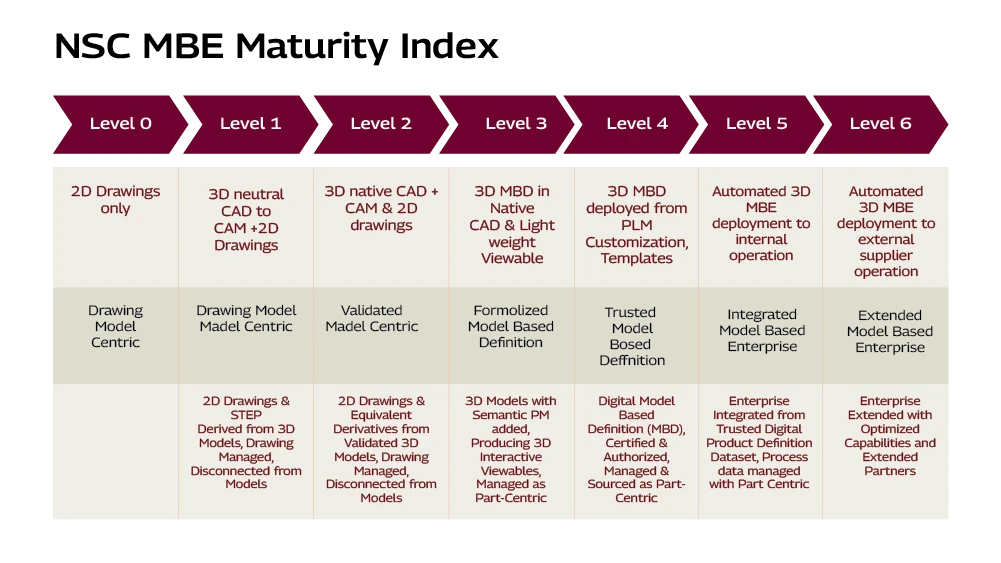
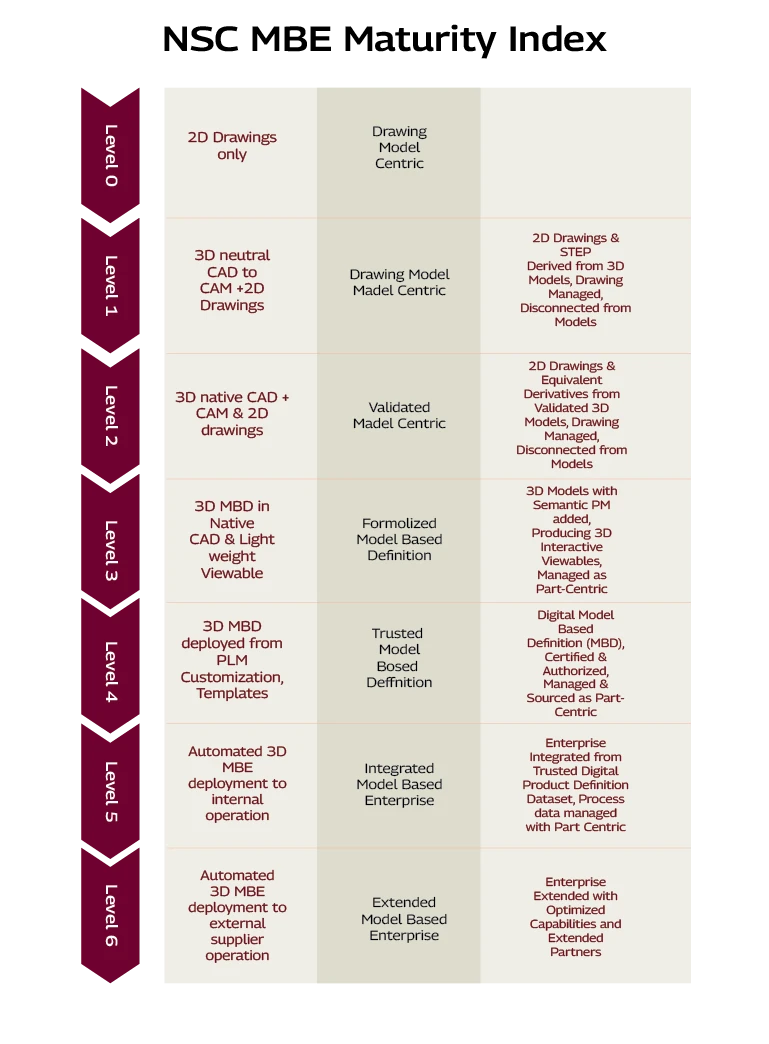
Figure 2: NSC MBE Maturity Index Illustrating the Shift from 2D Drawings to a Model-Based Enterprise
- Establish Single-Source Models and Standards: Adopt MBD as the authoritative data source and set consistent practices across teams to create and manage models with rich, machine-readable PMI
- Connect PLM and Downstream Workflows: Integrate models within the PLM backbone and extend them to manufacturing, quality, and inspection processes
- Validate, Measure, and Scale: Prove downstream use cases, capture KPIs, and use the results to build the business case for enterprise-wide expansion
Why Tech Mahindra: Your Strategic Partner in MBE Transformation
Tech Mahindra is among the few organizations to demonstrate end-to-end MBE adoption, from engineering and PLM integration to downstream use cases such as AR/VR, inspection automation, and digital twins.
Our competency encompasses:
- Digital Experience Center (XPDI): Experience MBE live, from MBD and PLM integration to XR-enabled downstream applications
- Complete Service Portfolio: Deep expertise spanning engineering design, PLM integration, and enterprise adoption delivers measurable results across pilot programs and global deployments
- Proven Cross-Industry Results: Successful MBE transformation in aerospace, appliances, and MedTech, accelerating product launches, improving compliance, and enhancing quality
Case in point: an HVAC manufacturer was facing significant inefficiencies in their current PLM, with disconnected processes stitched together by human glue. Tech Mahindra delivered the data-driven clarity needed to break this critical deadlock. By assessing their maturity against NIST standards and benchmarking PLM vendors across more than 50 criteria, we provided a definitive MBE roadmap to help the client confidently select their future digital backbone.
Building the Future-Ready Enterprise
The road ahead is about expediting new product innovation while building a more agile, intelligent factory of tomorrow. MBE provides the digital backbone for both. It creates the infrastructure needed to innovate New Product Introduction (NPI) programs, enabling predictive analytics and powering digital twin capabilities that define Industry 4.0.
The question is how quickly organizations can implement it to secure their competitive position in the digital manufacturing era.
Transform faster, compete smarter. Connect with our Digital Experience Center to explore how a strategic MBE pilot can accelerate your journey from traditional manufacturing to Industry 4.0 excellence.
TAGS:
Engineering Services
Frequently Asked Questions
Our FAQ section is designed to guide you through the most common topics and concerns.
MBE is an approach that uses models and simulation to define, execute, and manage technical and business processes across the product lifecycle.
Model-based design focuses on creating digital models for engineering. MBE extends that approach across the enterprise by linking design with manufacturing, quality, and supply chain processes.
Manufacturers are adopting MBE to improve speed, reduce non-conformances, strengthen traceability, and create a single source of truth for product data.
The core components are model-based definition, a centralized PLM backbone, and integrated model-based processes that enable downstream automation.
They should assess their current maturity, choose a low-risk pilot, establish standards, connect PLM to downstream workflows, and then validate and scale.
