
Scale at Speed™





 English (Global)
 French (Canada)

- Connectivity is the foundation. Shop floor integration is a strategic shift in enterprise transformation.
- Modernization is a risk management strategy. Manufacturers must address legacy debt through a structured, phased approach to reduce risk, improve reliability, and maintain stable operations.
- AI drives operational autonomy. Moving intelligence to the edge shifts the plant from a reactive approach to a self-adjusting, proactive system.
- Tech Mahindra’s approach to operational technology OT transformation delivers a resilient digital backbone, ensuring more stable operations, faster issue resolution, and better control across the shop floor.
The Reality of OT
For decades, manufacturers designed operational technology (OT) for deterministic production and operational control. However, in the age of digital manufacturing, we are witnessing a fundamental pivot. OT is no longer confined to a plant-floor function; it now serves as the core pillar of modern manufacturing and enterprise transformation.
Specific structural shifts drive this evolution. First, a transition towards software-defined automation, virtual programmable logic controllers (PLCs), and containerization breaks traditional hardware lock-in. Simultaneously, IT/OT convergence anchored by a unified namespace (UNS) removes data silos to create a single source of truth for the entire organization. Decision-making also moves to the edge; processing data where it is generated allows the shop floor to act in real-time rather than reacting to delayed insights. Next, the improvements to OT cybersecurity, zero-trust architectures, and proactive threat management protect assets without disrupting production uptime. Finally, these forces enable autonomous operations, shifting the factory from reactive troubleshooting to a self-adjusting, resilient system.
The Shift: OT as the Digital Operations Backbone
To transform manufacturing, enterprises must focus on the core elements of OT. Whether in process, discrete, or hybrid manufacturing, the proposed key pillars drive the shop-floor efficiencies and outcomes modern enterprises require.
Connected Shop Floor
OT environments are inherently complex, with a wide range of industrial control system (ICS) OEMs, diverse industrial network protocols, and multiple hardware and software systems across machines.
To manage this complexity, a centralized, connected platform is essential. It enables all shopfloor ICS systems to connect and share data across different industrial network protocols, whether Ethernet-based or serial communication protocols.
Here’s a rundown on key initiatives enabling a connected shop floor.
- Machine connectivity unifies ICS systems across the floor.
- Use case-driven data modeling to align data and achieve plant KPIs.
- IT/OT convergence with UNS architecture establishes a flexible, scalable data layer that serves as a single source of truth.
- Shopfloor 5G enables high-speed, accurate, and secure data streams with scalable connectivity.
- Low-code and No-code platforms expedite changes on the shop floor with minimal dependency on specialized skills.
OT modernization is a key initiative to reduce downtime risks and improve overall reliability.
Infrastructure Transformation and Modernization
Most of the OT stack is legacy. This reliance creates five immediate challenges: hardware unavailability, unplanned downtime, skill scarcity, low reliability, and high maintenance costs. Operating production on such outdated OT systems also poses significant operational risks. To manage this, manufacturers need a structured modernization approach that starts by assessing the current stack, identifying obsolete assets, and upgrading them in a planned, phased manner. Additionally, modernization from OT obsolescence also demands:
- Continuous asset lifecycle visibility
- Risk-based modernization planning (short/mid/long term)
- Controlled upgrades of PLCs, SCADA, MES, and historians
- Hardware-independent and virtualized control strategies
Modernization is no longer just a hardware replacement. Instead, specific technological shifts are driving the transformation. Here’s a rundown:
- Software-defined Automation via Virtual PLCs: PLCs run on IT hardware, the cloud, and edge devices. Giving complete hardware independence and the possibility of containerization.
- Edge AI and Analytics: Processes data directly on the factory floor, enabling real-time decisions such as instant quality inspections. These capabilities are further enhanced by AI at the edge, generating actionable insights as operations unfold.
- Operational Digital Twin: Connect factories and production lines to 3D virtual environments. By using real-time PLC data, these platforms simulate new product launches, labor planning, and sensor layouts. This allows manufacturers to optimize shop floor efficiency in a virtual world before physical execution.
When these technologies are deployed into active operations, they accelerate the transition towards paperless operations and expose energy waste throughout the factory. Maintenance teams can use these insights to move away from fixed schedules toward condition-based monitoring (CBM), improving reliability over time.
AI is no longer limited to IT. It is now being adopted across the shop floor, improving efficiency, strengthening analytics, and driving better operational performance.
AI-powered OT Innovations
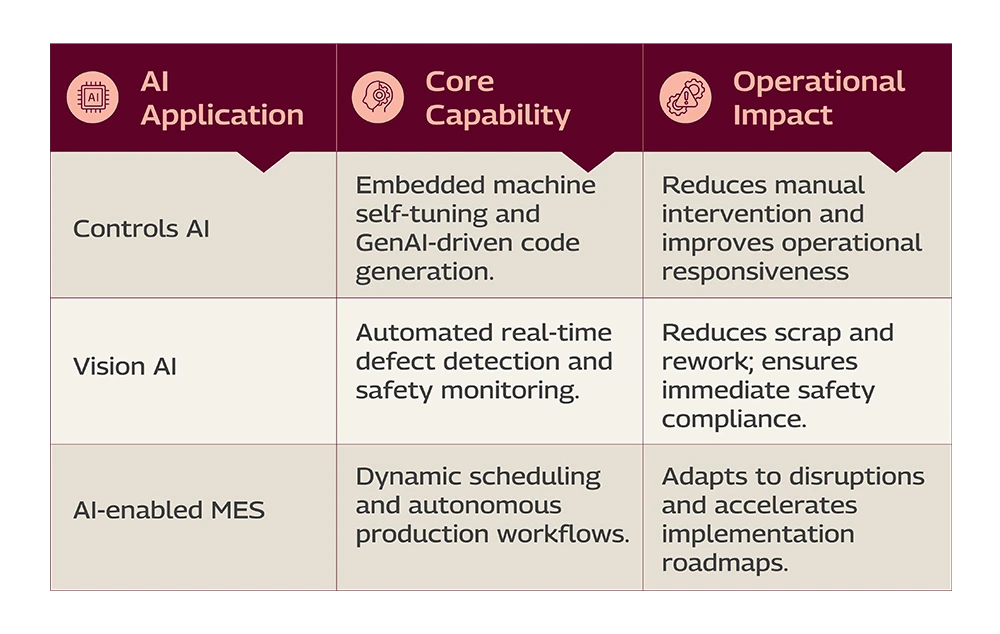
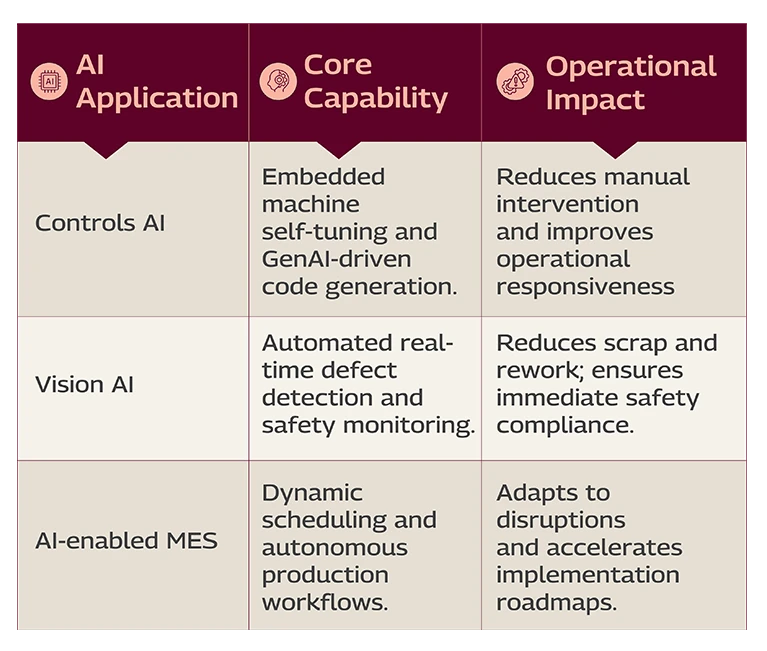
AI is moving into OT systems, extending beyond IT-driven use cases. Across industrial control, supervisory, and manufacturing execution system (MES) layers, it supports faster responses, improves decision accuracy, and reduces manual effort on the shop floor.
AI in OT is primarily used to automate decision-making, improve quality, and speed up operations. This is already visible across three key areas.
Operating Model for OT Management
Operations management of OT systems is intricate. Sustaining complex environments requires centralized oversight, continuous monitoring, and industrial-grade support to manage the scale and availability of modern plants. For this to work, OT has to be managed as a governed, production-first service that fits how manufacturing actually runs.
At its core, the future-ready model follows five principles.
- Production First - Every OT decision prioritizes safety, uptime, and OEE
- Line-aware Operations - Incidents, changes, and patches are contextualized to line criticality
- Secure by Design - Zero-trust OT security embedded into core operations
- AI-driven Proactivity - Transition from reactive to predictive to fully autonomous operations
- Standardization at Scale - Uniformity across operations without any disruptions
Execution of OT Operations
Turning the vision of a digital operations backbone into a reality requires a disciplined framework that bridges the gap between strategy and the shop floor. TechM's approach to the implementation depends on five imperatives.
Phased OT Transformation Roadmap (3–6–9 Months)
The transformation is structured into an outcome-based approach across solution areas:
- OT platform lifecycle management
- IT/OT integration
- 24×7 ICS support
- Patch and vulnerability management
- Security, networks, and service desk
Each phase (Discovery → Optimization → Modernization) is tied to clear KPIs, ensuring predictable value realization and risk-controlled transformation.
KPIs and SLAs
To ensure enterprise-grade accountability, performance, control, and transparency, the approach establishes:
- Availability targets for OT infrastructure and critical systems
- SLA-based response and resolution times
- MTTR tracking and incident recurrence reduction
- Explicit dependency assumptions, such as vendors, site access, and maintenance windows
Operating Model
By deploying a centralized OT managed services model, supported by onsite teams, offshore CoEs, and OEM ecosystems, the transformation provides:
- 24×7 OT monitoring and incident management
- End-to-end asset visibility via CMDB and OT discovery
- Predictive intelligence using AIOps
- Structured L1–L3 support with OEM coordination
- ServiceNow-based OTSM aligned with ISA and ITIL standards
With this model in place, operations yield measurable outcomes:
- 98% SLA adherence
- Reduced MTTR and repeat incidents
- Predictable cost and scalable support across global plants
Governance and Ownership
Accountability requires clear decision rights and defined escalation paths. This model establishes critical roles to ensure compliance across global, multi-plant operations. Roles and responsibilities are defined based on core functions:
- OT service ownership
- OT infrastructure operations
- OT security and compliance
- Vendors/OEMs support
AI-enabled OT Operations
From support to autonomy, AI agents play an increasingly prominent role in OT operations. They eliminate human dependency, improve response times, and enable proactive and self-healing OT environments. Agents can now automate diagnostics, RCA, patching, MES health monitoring, asset management, and SOP generation. Serving as a co-pilot for OT engineers, agents drive autonomy, speed, and consistency. A few notable examples of agents in OT include:
- Diagnostics and auto-resolution agent
- Log intelligence and RCA agent
- MES health agent
- OT patch orchestration agent
- Vulnerability correlation agent
- Service desk copilot (L1/L1.5)
Finally, this AI-enabled approach to OT transformation results in higher OT availability (99.5–99.9%), reduced cybersecurity risk, and faster issue resolution with fewer repeat incidents. It also helps lower the total cost of ownership through standardization and the use of AI, while supporting more consistent operations across plants.
Proactive OT Security: Zero-trust Without Production Disruption
As OT environments become more connected and autonomous, security needs to keep up without affecting production. Therefore, OT security is approached with a risk-based prioritization. This includes zero-trust access, network segmentation, controlled remote access, and continuous vulnerability monitoring. Additionally, patching and updates also account for production schedules while complying with industry standards.
Holistically, this proactive security prioritization protects operations, reducing risk without interrupting the plant.
Legacy systems are exposed to cyber threats and vulnerabilities and need to be addressed through proactive OT security measures.
Conclusion
The era of isolated, hardware-bound OT is over. Manufacturers now face a clear choice: continue managing the risks of legacy debt or build a foundation for digital performance.
Transitioning to a digital operations backbone turns the shop floor from a disconnected cost center into a strategic engine for growth. By integrating AI, establishing connectivity, and adopting an autonomous operating model, enterprises achieve the scale and resilience required to compete.
This is the new standard for modern manufacturing. Those who build this backbone today will own the operational advantages of tomorrow.
TAGS:
Artificial Intelligence
Manufacturing
Frequently Asked Questions
Our FAQ section is designed to guide you through the most common topics and concerns.
Operational technology is evolving as manufacturing becomes more data-driven, connected, and adaptive. Traditional ICS focused on deterministic control within isolated plants. Modern manufacturing requires real-time data sharing, enterprise integration, and faster decision-making. As a result, OT now supports analytics, AI at the edge, cybersecurity, and integration with IT systems, positioning it as a central digital foundation for operational performance rather than a stand-alone control layer.
A connected shop floor allows machines, control systems, and applications to exchange data across diverse protocols and vendors. This connectivity enables unified visibility, consistent data models aligned to KPIs, and a single source of truth through architectures such as a unified namespace. It also supports faster change implementation, improved traceability, and scalable integration of new technologies without disrupting production.
Modernization addresses risks created by aging hardware, unsupported software, and skill shortages. A phased, risk-based approach improves system reliability, reduces unplanned downtime, and enhances asset visibility. Updating platforms also enables stronger security controls such as segmentation, continuous monitoring, and safer patching practices. Together, these changes lower failure risks while protecting production systems from growing cyber threats.
AI enhances OT by enabling faster, data-driven decisions directly on the shop floor. Applications include self-tuning control systems, real-time quality inspection using vision analytics, and adaptive scheduling within manufacturing execution systems. By moving intelligence closer to physical processes, AI helps operations shift from reactive responses to predictive and self-adjusting behaviors with reduced manual intervention.
Managing OT at scale requires centralized governance, standardized processes, and production-first priorities. Key practices include line-aware incident management, continuous monitoring, structured lifecycle management, and security embedded by design. Combining onsite expertise with centralized support models and AI-driven analytics helps maintain high availability, reduce repeat incidents, and ensure consistent performance across multiple plants.

