


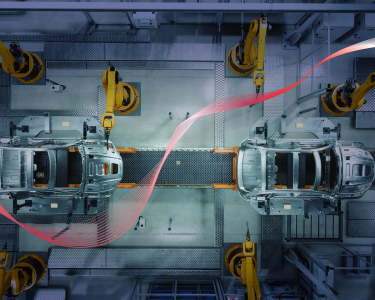





- Autonomous systems are moving from controlled environments to real operational settings.
- GenAI strengthens autonomous robotics by enabling faster interpretation and decision-making.
- Scaling autonomous operations requires strong platforms, ecosystems, and safety frameworks.
- TechM supports this transition with AI platforms, accelerators, and a global partner ecosystem.
Autonomous Delivery is Gaining Momentum
As autonomous systems with level 4 robots, drones, and GenAI become central to everyday delivery, these systems are no longer confined to secure environments; they are well-suited to real-world applications.
Many leading industries are now leveraging autonomous systems to move critical products from one location to another. Powered by GenAI-based LLMs, these systems understand instructions, respond to natural language, and analyze their surroundings, enabling more natural interaction between people and machines, which improves operational efficiency and ensures delivery workflows are safe and reliable.
Next Generation Autonomous Intelligence
With the evolution of generative and agentic AI, autonomous systems can make critical delivery decisions faster. At the core, the autonomy stack interprets real-time conditions and ensures robots respond instantly to changing environments.
Level-4 robots powered by GenAI have crossed a threshold. They no longer execute tasks. They are now sensing, reasoning, and autonomously operating in real time to deliver outcomes.
Opportunities Across Cross-functional Industries
Autonomous systems can create value across industries. Here’s an overview.
Healthcare
Imagine a robot traversing through a busy hospital corridor. It can move smoothly within testing and production environments of healthcare R&D hubs, hospitals, and laboratories, improving efficiency and avoiding obstacles. By assisting with the routine movement of items such as medicines, lab samples, and sterile supplies from one department to another, robots allow teams to focus more on patient care than internal logistics.
Operating through natural language, teams can instruct robots with simple commands such as ‘deliver a blood sample to OT-3.’ GenAI interprets these instructions and guides robots through corridors or elevators as needed. Drones support ground robots with rooftop-to-floor transfers, reducing staff workload and minimizing infection risks.
Manufacturing and Logistics
The manufacturing sector benefits the most from this autonomy. Robots can move materials across factory floors and distribution centers during peak operations, transporting raw materials, work-in-progress items, and finished goods. By adjusting to production speeds and coordinating with printers and robotic manipulators, robots collaborate and share AI-driven insights, improving operational efficiency by up to 30–50%.
In addition, logistics firms can deploy robots for last-mile delivery, navigating service roads and sidewalks while rerouting in real time to avoid pedestrians and vehicles. They receive continuous weather, traffic, and operational updates across the network. If a delivery is delayed or blocked, the system immediately alerts them and adjusts routes.
30–50% operational efficiency gains when autonomous robots collaborate and share AI-driven insights in real time.
The Synergy of Observation and Decision-Making—A TechM Model
By combining robotic sensing with LLM-driven decision-making, enterprises can advance autonomous intelligence. This integration allows systems to move beyond basic automation and make independent decisions at scale. Using data from LiDAR, cameras, and ultrasonic sensors, autonomous systems build real-time 3D views of their environment to support complex decisions. Tech Mahindra, with our software and GenAI expertise, uses our proprietary Orion platform to proactively tackle challenges and provide tailored solutions for different industries.
Accelerating Autonomous Robot Adoption with Tech Mahindra
Tech Mahindra delivers transformations using accelerators, AI platforms, and curated partner ecosystems. Our approach includes:
- Extensive experience as an IT, software integrator, and developer of tailor-made solutions for varying industries.
- Our partner ecosystem of global technology OEMs and GSI service providers enhances our ability to deliver stable GenAI-driven transformation programs.
- Our ready-to-build accelerators and AI platforms, including TechM Orion, help us develop models, test, and create new delivery workflows.
- Clearly defined SLAs and next-generation governance guide our service delivery.
Compliance and Safety Adherence
Apart from adoption, we also prioritize compliance and operational safety in autonomous deployments.
- Our approach to level 4 systems helps reduce human-error accidents, with AV data showing five times fewer injury crashes in controlled test environments.
- We deploy redundant sensors and responsible AI decision-making to comply with evolving compliance and industry standards.
- During pilots, we ensure the systems handle privacy-sensitive parcels with better tracking and reporting.
Navigating Practical Limitations
We address the challenges of deploying autonomous systems in real-world environments, such as
- In anomalous environmental conditions like bad weather and heavy rains, robots encounter significant operational challenges. Our recommended model uses hybrid fleets to manage climatic challenges and integrates GenAI to improve performance.
Conclusion
The move to autonomous intelligence and AI-led delivery signals a broader shift in enterprise operations. Early adopters of level 4 autonomy driven by GenAI are already reporting operational benefits, ROI, and substantial year-on-year productivity gains. Through TechM’s approach and global partnership ecosystem, enterprises are primed for real-world results with safe and reliable solutions.
The era of autonomous intelligence is not far-fetched. It is already here. And TechM will help enterprises realize it effectively.
Frequently Asked Questions
Our FAQ section is designed to guide you through the most common topics and concerns.
L4 robots and drones play a major role when integrated with GenAI pre-trained models in use cases such as healthcare, logistics, manufacturing, energy, mining, and construction. These deployments have demonstrated strong performance, delivering improved operational efficiency and ROI.
The modern industry will shift from turnkey projects to full-scale deployments, with a high focus on domestic manufacturing and integration into AI-driven, data-centric workflows across major business verticals.
The payload capacity and battery usage still face challenges, although they are improving with modern technology and more specialized drones with AI integration.
Global operators must adhere to country-specific aviation guidelines and registration processes, like no-fly zones, privacy regulations, and local security compliance standards.
L4 robots and drones increase productivity, reduce operational costs, enhance safety by removing humans from hazardous environments, and provide high-accuracy data for timely decision-making.