


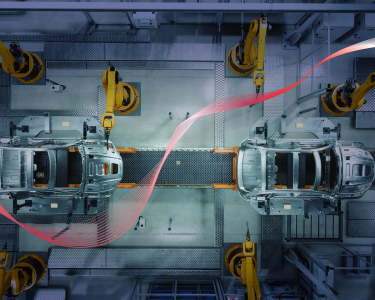





- IT/OT Convergence forms the backbone of realizing smart factory initiatives.
- Modernization plant-level IT and OT accelerates the execution of smart factory programs.
- As ISA-95 automation layers continue to blur, solutions should must remain flexible and scalable to meet future requirements.
- Shop floor readiness, despite increasing complexity; forms the foundation for efficient manufacturing operations.
The Data Gap Holding Smart Manufacturing Back
Manufacturing leaders are not asking whether they should digitize any more. They are asking why their $10M investments can’t tell them the root cause of a 2% margin dip in real time.1 The bottleneck is the 'Data Gap' between the PLC and the ERP. Without a consistent structure across the production stack, operational insights remain trapped in silos, leaving leadership to manage by the rearview mirror. The assets that power production, from shop-floor sensors to enterprise systems and Industrial Internet of Things (IIoT) platforms, are not consistently structured across the production stack. This limitation makes it difficult to capture, connect, and act on operational insights at scale.
The Barriers for Smart Manufacturing to Go Beyond the Pilot Stages
Talent shortages add another layer of difficulty. Nearly half of manufacturers report moderate to significant challenges in filling production and operations management roles, while 69-72% struggle to hire people with IT/OT, data science, and analytics skills.2 These gaps delay the adoption and integration of digital capabilities, making it difficult to turn technology investments into operational outcomes. At the same time, a survey of 600 manufacturing executives found that fewer than half are investing at scale in critical technologies such as IIoT (27%), cloud (29%), and AI (29%).2
In short, these trends point to a familiar pattern: digital initiatives stall at the pilot stage due to misalignment across assets, systems, and skills. The International Society of Automation (ISA) helps clarify this complexity by defining automation layers from L0 to L5, which offers manufacturers a practical framework for organizing assets and aligning Information Technology (IT) and Operational Technology (OT) to build a foundation for better, smarter, and more sustainable operations.
Manufacturers face persistent shop floor challenges that limit seamless and integrated transactions across their value streams.
Operational Hurdles in Modern Manufacturing
In a modern factory, there is no such thing as an isolated incident. A latency issue at the sensor level (L0) ripples upward, manifesting as a reconciliation error in the ERP (L4) hours later. This systemic friction creates a series of interlocking hurdles that drain OEE and inflate the cost of quality:
- Lack of Shop-floor Connectivity: Machines, sensors, and control systems are often not fully connected, which limits the ability to capture production data consistently.
- Siloed Data Across the Factory: Information is scattered across multiple systems and tools, forcing teams to switch between screens instead of getting a full picture of production performance.
- Time-consuming Shop-floor Data Aggregation: Teams spend hours compiling data from multiple sources, often using spreadsheets, which delays analysis and decision-making.
- Unreliable Shop-floor Data: Manual data entry, inconsistent definitions, and missing signals make teams question whether the numbers truly reflect what’s happening on the floor.
- Lack of Real-time and Historical Performance Visibility: When data isn’t available in the moment—or easy to look back on—teams struggle to see how operations are running or understand patterns and root causes over time.
- Micro-stoppages: Small, frequent stoppages often slip under the radar or aren’t logged at all, but together they add up to meaningful productivity losses.
- Reliability Issues in Critical Machines: Machines fail unexpectedly when they are only fixed after problems arise, which causes unplanned downtime.
- Limited Traceability: Gaps in tracking materials, process steps, and production events make it challenging to trace quality issues back to their source or meet compliance requirements.
- Inconsistent Manual Operations: When tasks are performed differently across shifts or locations, leading to varying results, uneven quality, and less stable processes.
- Quality Defects and Excessive Rework: When issues aren’t detected early or resolved quickly, defects move further down the line, leading to rework, scrap, and delays that could have been avoided with earlier intervention.
- Increasing Maintenance Costs Due to Legacy Systems: Older equipment and outdated systems require frequent maintenance and are more expensive to operate than embracing newer technologies.
- Complex Integration Between Shop-floor and Enterprise Systems: Gaps in IT and OT systems make it hard to align production activities with planning, quality management, and business operations.
- Paper-heavy Operations: Manual records slow down day-to-day work, increase the risk of errors, and limit the effectiveness with which operational data can be digitized and analyzed.
These issues might look manageable on their own. But together, they create discord, making it harder for systems to work in sync and reducing the impact of digital initiatives.
Building a strong data foundation across ISA-95 layers, from shop floor to enterprise, is a key enabler for AI-driven smart manufacturing.
Building the Foundation for Smart Manufacturing
To move past these challenges, manufacturers need to examine how their IT and OT systems are integrated and whether they can scale with the business. Using existing systems as a foundation and bringing in new technologies over time helps make the vision of a smart factory real, not just aspirational. This approach is built on IT/OT convergence principles across the ISA-95 layers.
Manufacturers across industries are working to improve overall equipment effectiveness (OEE), gain visibility into production performance, and pinpoint bottlenecks. As per a report, nearly half (49%) of manufacturers cite operational improvements as the primary benefit of investing in smart manufacturing, while 44% highlight financial gains as a key objective.1
These capabilities are enabled by a unified, namespace-based IT/OT architecture, factory connectivity, and manufacturing operations management (MOM) solutions, which accelerate operations. Manufacturers are also turning to smart assets to predict issues before they occur, updating equipment to reduce maintenance costs, using AI to improve quality, managing energy more efficiently, and moving toward paperless operations to support sustainability goals. This shift is not about adding more tools but about creating a coherent operational backbone that allows data, decisions, and execution to move together.
Conclusion
Building an ecosystem around IT/OT convergence allows manufacturers to detect issues earlier, improve production performance, and scale operations with greater consistency. Organizations can reduce fragmentation between shop-floor execution and enterprise systems by structuring assets and data across the ISA-95 layers.
This clarity helps digital initiatives move beyond isolated pilots and into everyday operations. As manufacturers modernize their assets, improve connectivity, and strengthen operational visibility, they create a foundation that drives efficiency, supports sustainability goals, and enhances long-term resilience.
Frequently Asked Questions
Our FAQ section is designed to guide you through the most common topics and concerns.
The data gap arises from inconsistent structures across sensors, machines, control systems, and enterprise platforms. When production assets are not uniformly connected or standardized, operational insights remain isolated in silos, preventing real time decision making and slowing digital transformation.
Many initiatives stall due to misaligned systems, fragmented IT/OT environments, talent shortages, and limited scaling of critical technologies like IIoT, cloud, and AI. These gaps prevent organizations from converting pilots into scalable, enterprise-wide operational improvements.
Modern factories face hurdles such as poor shop floor connectivity, siloed data, unreliable manual entries, micro stoppages, limited traceability, inconsistent manual operations, and complex IT/OT integrations. These issues collectively slow decision making and impact overall equipment effectiveness (OEE).
IT/OT convergence creates a unified operational backbone where data flows seamlessly from shop floor assets to enterprise systems. This alignment enhances visibility, supports predictive maintenance, enables AI-driven quality improvements, and helps organizations progress toward long term sustainability goals.
ISA 95 layers provide a structured framework for organizing production assets from the sensor to enterprise level. By aligning systems across these layers, manufacturers gain clearer operational visibility, reduce system fragmentation, and enable scalable smart factory initiatives supported by modern technologies such as MOM, IIoT, and AI.