

Scale at Speed™






 English (Global)
 French (Canada)

- Manufacturers are investing in AI, but physical production systems often remain rigid and slow to adapt.
- Intelligence without execution limits a factory’s ability to respond to demand, disruption, or variability.
- Adaptive manufacturing functions as a nervous system, continuously sensing and responding to change.
- Smart Reconfigurable Manufacturing Systems (SRMS) provide modular, flexible production foundations.
- The Living Factory integrates digital intelligence with physical adaptability to build resilience by design.
Every manufacturer I talk to is investing heavily in AI, driving smarter dashboards and sharper forecasts, making their factories more ‘intelligent’ than ever before. With this AI surge in manufacturing, we can now predict supply chain delays, energy spikes, and quality risks before they manifest.
Despite this progress, why does it still take months to respond to demand shifts? Why do minor product tweaks trigger major disruptions? And more importantly, why does a single machine failure still cause ripple effects across the entire production line? The reality lies in a structural paradox: we have built smart digital brains, but they remain connected to rigid, ‘analog’ bodies.
Today, AI decides in seconds. Yet factories take months to adapt. In high-stakes environments like manufacturing, intelligence without the ability to physically act is just observation. To thrive, we need more than just smart factories; we need living factories where the digital and physical layers are designed to adapt and operate in sync.
Adaptive Manufacturing—The Nervous System of Operations
Traditional manufacturing was built for stability: long runs, predictable demand, and fixed processes. That environment no longer exists. Now, variability is the baseline in demand, supply, energy prices, and regulations. To manage this volatility, an adaptive manufacturing approach is required. Operating as the factory’s nervous system, adaptive manufacturing continuously senses and adjusts the production environment. By embedding AI and advanced analytics directly into the ‘muscles’ of daily operations, it accelerates decision-making:
- Self-Correcting Quality: Identifies process drift and rectifies parameters before defects move downstream.
- Golden Batch Optimization: Recognizes ideal operating conditions that deliver optimal performance and automatically steers the system in alignment.
- Real-time Production Management: Balances throughput, cost, and energy use in response to fluctuating demand and utility signals.
Adaptive manufacturing transforms intelligence into action by embedding decision making directly into operational workflows.
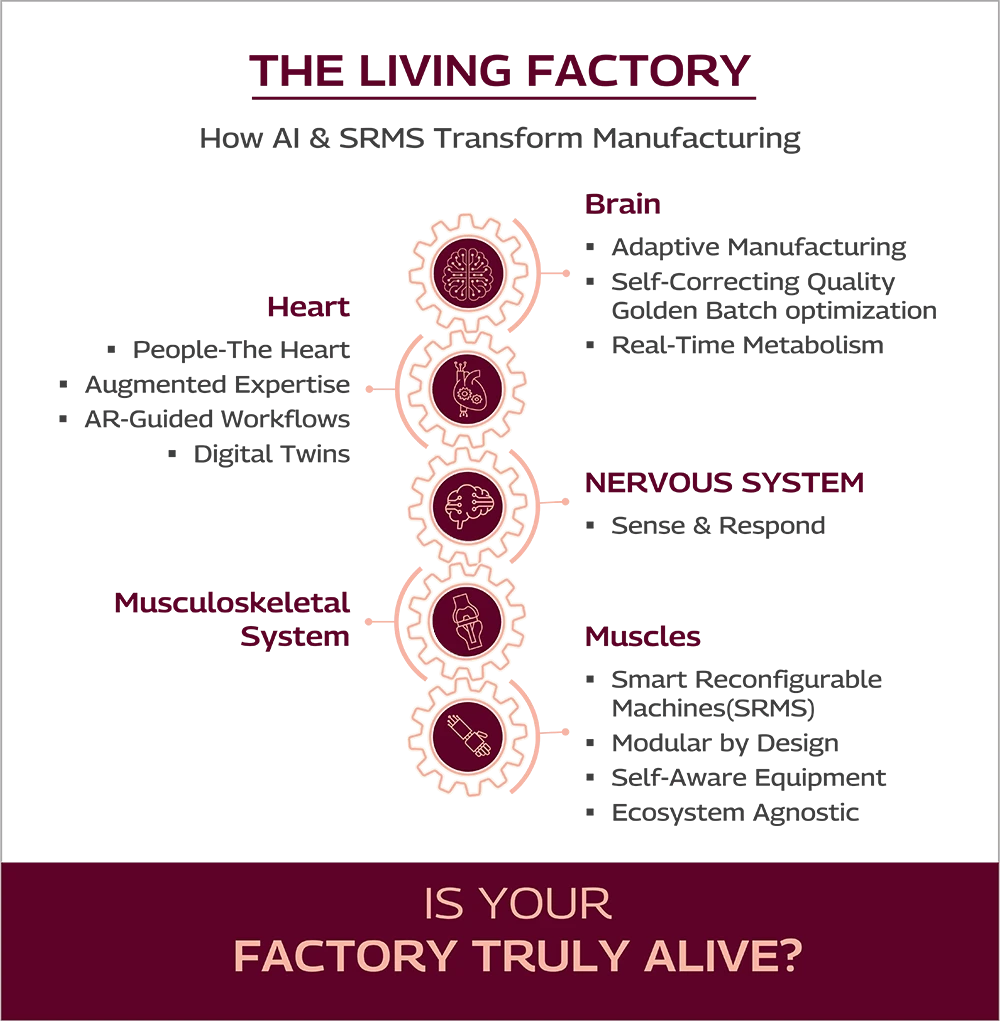
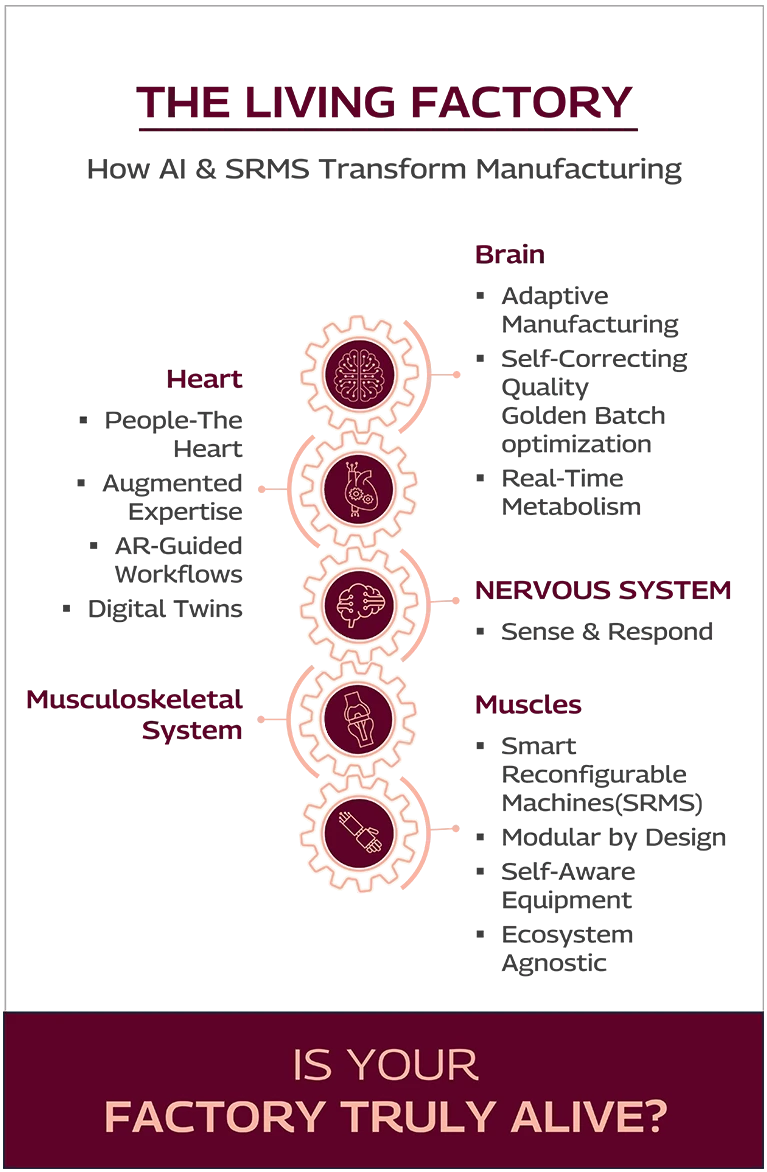
The Living Factory: How AI & SRMS Transform Manufacturing
Smart Reconfigurable Manufacturing Systems (SRMS)-The Muscular Foundation
Factories continue to rely on production systems built around fixed automation. These systems perform well in stable environments. But when demand shifts or product variants expand, they lead to engineering downtime, revalidation cycles, and revenue loss. Smart reconfigurable manufacturing systems (SRMS) are built to overcome these challenges. They serve as the operational muscles, with flexibility engineered into the design from the outset. Instead of monolithic lines, they rely on modular configurations that can evolve as requirements change.
- Modular by Design: SRMS modules are the industrial building blocks. They can be added, removed, or repositioned without dismantling the entire line. When a new product variant is launched, the layout evolves without disruptive reconstructions.
- Self-aware Equipment: Assets use embedded sensing to identify performance drift and trigger timely intervention, reducing unexpected downtime.
- Ecosystem Agnostic: They support integration across OEMs and generations, reducing lock-in and maintaining long-term scalability.
The Living Factory- Where Intelligence Meets Execution
When an adaptive digital layer is paired with a reconfigurable physical body, the factory stops behaving like a static asset and starts behaving like a living, coordinated system. It manages its own operations: if energy costs spike, the factory shifts high-load operations to different windows autonomously, avoiding a financial crisis. It evolves: introducing a new product now begins through a digital twin; it is validated virtually and is then reflected physically through reconfiguration. It heals: if one module goes down, production doesn’t collapse; workflows are rerouted, capacity flexes, and the system keeps running while maintenance steps in. With a Living Factory, resilience is no longer dependent on exceptional efforts; it is built right into the design.
A Living Factory is defined not by intelligence alone, but by how quickly physical operations can act on that intelligence.
People - The Heart of Modern Manufacturing
A Living Factory does not eliminate humans; it empowers them. As systems become more dynamic, the role of the workforce moves from manual labor to augmented expertise. Humans serve as conductors of intelligent, adaptive systems, guiding manufacturing operations toward defined performance, quality, and resilience objectives. The live adaptive manufacturing model supports operators through:
- AR-Guided Instructions: Visual guidance aligned to current machine settings and process states.
- Digital Twins: Simulation-backed insight into root causes and performance dependencies.
- Intelligent Decision Support: Exception-driven alerts and scenario analysis to support informed intervention.
The Bottom Line
For years, the goal was to make factories smart. Now, the real differentiator is making them adaptable. As technologies evolve and markets shift, manufacturers that thrive are not those with the biggest plants or the most AI solutions; they will be the ones that can quickly adjust their factories, layouts, outputs, and operating behavior in response to change. The question is no longer whether your factory has AI. It is how fast your physical operations can act on the intelligence to pivot before the window of opportunity closes.
TAGS:
Artificial Intelligence
Manufacturing
Frequently Asked Questions
Our FAQ section is designed to guide you through the most common topics and concerns.
AI can generate insights quickly, but without flexible physical systems, factories struggle to translate intelligence into timely action.
SRMS are modular and flexible, allowing production systems to evolve without extensive re engineering or downtime.
Human roles shift toward augmented expertise, supported by digital twins, AR guidance, and intelligent decision support.
Yes. Many organizations incrementally introduce adaptive intelligence and modular physical systems. Transitioning does not require full replacement but rather phased integration aligned with operational priorities.
While systems become more dynamic, adaptive platforms simplify decision making by automating responses to variability and surfacing exceptions rather than overwhelming operators with data.