







- Application modernization is no longer adequate; enterprises need an integrated application and data strategy to stay competitive in the era of AI, Gen AI, and agentic AI.
- Enterprises can redirect budgets from heavy application rewrites and toward AI-ready data estates that deliver higher long-term ROI.
- The real differentiator in modernization comes from making siloed enterprise data accessible, contextual, and actionable for AI and agents.
The Data Bottleneck Persists
Enterprises have invested heavily in modernization. The 6R approaches, like rehost, replatform, refactor, re-architect, rebuild, and retire, cut technical debt, improve scalability, and modernize user experiences.
Yet the returns fall short of expectations. According to F5's 2025 State of Application Strategy Report, 96% of organizations are implementing AI, but only 2% are highly ready to scale it. 1 They are struggling to move beyond dashboards and pilots into AI-driven decision-making and automation.
The bottleneck lies in the foundations. As data continues to be fragmented, semantics differ across systems and teams. AI models cannot safely interact with business systems.
Deloitte's 2025 2 research further corroborates this; nearly 60% of AI leaders cite legacy system integration and compliance as their primary barriers to agentic AI adoption. Traditional modernization addresses application layers but misses the semantic or interaction gaps that AI demands.
To address this, AI-first enterprises must augment modernization with two additional layers:
- Data Fabric: Provides shared meaning, semantics, governance, and access across enterprise data estate
- Model Context Protocol (MCP): Defines how AI models and agents safely interact with enterprise systems
Modernization with Data Fabric and MCP builds a non-invasive path to AI readiness, one that builds on existing investments rather than replacing them.
Data Fabric and model context protocol (MCP) can work together and act as a ‘non-invasive modernization layer’ over legacy applications, reducing the need to migrate data or rewrite legacy systems.
The Modernization Paradox in the AI Era
Traditional modernization programs solve a specific set of problems. They lower infrastructure costs, improve reliability, and accelerate release cycles. But they hit a breaking point when tasked with AI.
After modernization, enterprises commonly observe:
- Faster applications, yet data silos keep insights slow
- Modern APIs, with no shared business vocabulary across domains
- Better UIs with limited support for AI reasoning or autonomous actions
- Successful migrations, yet AI use cases are stuck at pilot scale
The root cause is consistent: the absence of a semantic and interaction layer that AI systems can trust.
Modernization optimizes software execution. AI transformation requirements go a level above: systems that understand data, apply business context, and take action across operational boundaries. These are two different problems.
Modern Data Architecture Led by Data Mesh and Data Fabric
Before going further, let’s briefly outline the key architectural concepts that frame this approach.
Data Mesh decentralizes ownership to domains, treating data as a product. Its success depends on federated data governance, with domain teams owning the data creation.
Data Fabric is an architectural pattern that focuses on virtualized access to distributed data, shared semantics, active metadata, lineage, and policy governance. No centralization is needed. The logical and semantic control plane spans the enterprise data estate.
Data Lakehouses provide flexible data architecture for high-performance analytics, with atomicity, consistency, isolation, and durability (ACID) transaction compliance. They combine low-cost storage with transactional and governance capabilities. They solve storage and performance challenges, but not semantic fragmentation on their own.
For instance, Microsoft Fabric, a SaaS analytics platform built on OneLake, can implement aspects of the data fabric pattern. Here, data fabric refers to the architecture powering both analytics and AI use cases, not an OEM-specific product.
The distinction matters: AI depends far more on meaning, context, and governance over storage and access.
Why Application Modernization Struggles with AI
From an AI perspective, modernization programs reveal three gaps:
- Semantic Fragmentation: Each system (within retail domain) defines customers, orders, assets, or events differently which is an inherent problem in multiple, legacy, fragmented systems. Models cannot reason consistently across domains without shared meaning.
- Integration Sprawl: Point-to-point data pipelines, integrations and APIs proliferate quickly becoming expensive to maintain and difficult to govern.
- No 'Model-System' Contract: Models lack a standardized, auditable way to call functions, access data, or execute actions with appropriate controls.
Until these structural gaps are closed, AI remains disconnected from daily business operations making intelligent operations a distant dream.
The Data Fabric-MCP Approach
An effective path to AI-first transformation combines four foundational layers:
- Selective Modernization: Modernize where there is clear value: end-of-life (EOL) platforms, licensing risks, and scalability bottlenecks. Avoid large-scale rewrites when core systems are stable but fragile.
- Data Fabric Foundation: Establish shared semantics, active metadata, lineage, and policy governance across data estates. Prioritize virtualization and reuse over excessive data movement.
- MCP Layer: Introduce a standardized, secure way for AI models and agents to interact with enterprise systems, call tools, invoke APIs, and access contextual data under strict guardrails.
- Agentic AI on Top: With Data Fabric and MCP in place, agents can safely move from recommendation to execution for selected use cases.
This approach accelerates AI outcomes without destabilizing core systems.
What Data Fabric Delivers in Practice
A well-implemented fabric enables:
- Consistent business meaning through shared ontologies and semantic models
- Query-in-place access across databases, warehouses, SaaS platforms, and data streams
- Active metadata and lineage for trust and auditability
- Centralized governance applied uniformly across domains
- Standardized APIs for analytics, applications, and AI agents
The practical impact leads to faster insights and significantly lower integration overhead.
The ‘modernize with Data Fabric’ strategy turns the modernization gains into an AI-ready data foundation that enables analytics, decision augmentation, and autonomous operations.
What MCP Changes for Enterprise AI
MCP acts as a control layer between AI models and enterprise systems.
It ensures:
- Models receive the context they need
- Tool and API calls are explicit, governed, and auditable
- Business logic is exposed to AI without rewrites
- Every action taken by an agent is observable and policy-compliant
In effect, MCP can be visualized as an “API gateway for AI” (that manages agent interactions), enabling models to reason and act safely across the enterprise. While MCP itself is evolving and maturing more towards discovering and connecting to the right functional process through dynamic tooling, implementation should follow thorough due diligence.
A Conceptual View of Architecture
Three transformation layers sit above existing systems, turning legacy data estates into AI-ready data platforms without business disruption:
- At the bottom, the existing systems, such as ERP, CRM, databases, data lakes, SaaS platforms, and streams, remain largely unchanged.
- The middle layer includes a Data Fabric that provides semantics, governance, metadata, and virtualized access. Alongside, MCP governs how AI models interact with tools and functions.
- At the top, AI, Gen AI and Agentic AI experience and capabilities are delivered through copilots and automation workflows that lead the enterprise toward governed, intelligent and autonomous operations.
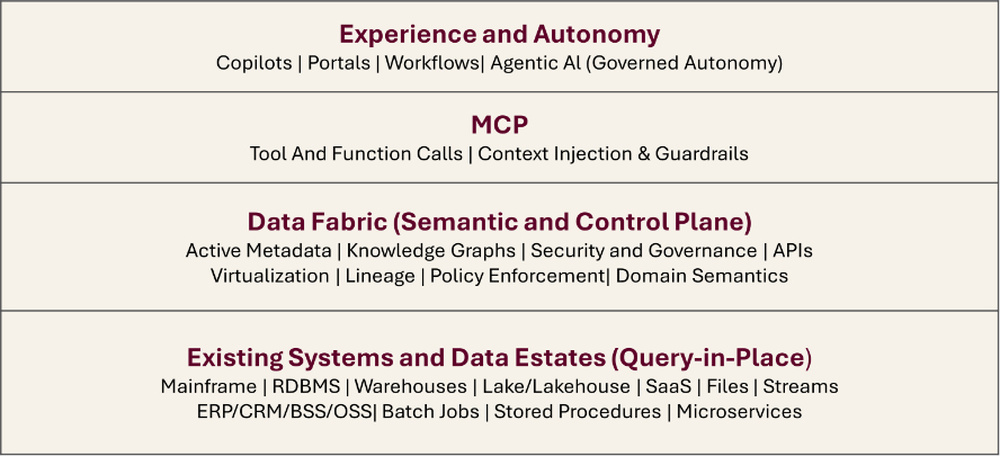
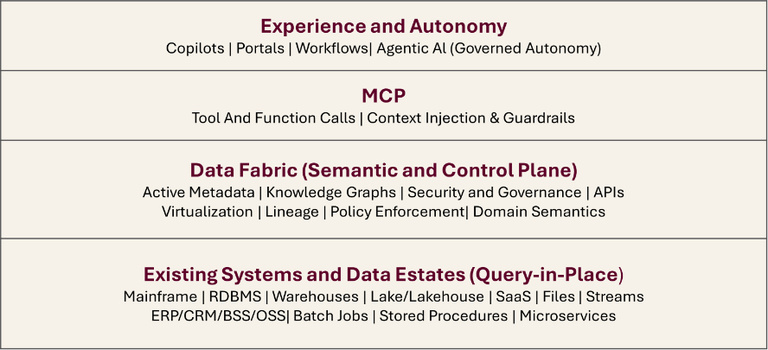
Figure 1: Modernize with Data Fabric and MCP Architecture
Key principles guide the design:
- Define the meaning before moving data
- Wrap systems, not rewrite
- Enforce policy by default
- Design for observability and auditability
- Apply least-privilege access to all agent actions
Choosing the Right Starting Point
Successful enterprises prioritize strategically without overextending resources. Instead of treating modernization and AI as separate initiatives, they deliberately sequence their investments.
Hence, your starting point depends on these factors:
- If systems are stable but risky to change, and AI outcomes are urgent, start with Data Fabric and MCP
- If platforms and systems are end-of-life and AI needs are limited in the short term, prioritize modernization, implement Fabric later
- If cross-domain AI use cases and compliance are critical, Fabric and MCP should lead
Word of Caution: Every project differs; not every case follows the same approach. EOL platforms and license-driven scenarios continue to depend on traditional modernization methodologies.
Make Modernization AI-Ready
Winning the AI game is less about rewrites and more about making enterprise systems coherent and actionable by machines.
Fabric and MCP complete the picture. Selective modernization, shared data semantics via fabric, and standardized model interactions through MCP unlock agentic automation without risky overhauls. Enterprises that treat fabric and MCP as extensions of their modernization strategy move faster, spend smarter, and scale AI with confidence. Traditional automation tools already integrate with AI and Gen AI. Modernization amplifies that potential.
Contact Tech Mahindra to build your AI-first blueprint.
Frequently Asked Questions
Our FAQ section is designed to guide you through the most common topics and concerns.
Traditional modernization improves performance and scalability but does not resolve semantic fragmentation or integration sprawl. AI systems require consistent meaning, governed access, and standardized interaction layers. Without shared semantics and controlled model system interaction, enterprises struggle to scale AI beyond pilots into operational use.
A Data Fabric establishes shared semantics, virtualized data access, and unified governance across distributed data environments. It reduces reliance on data migration, improves trust through lineage and metadata, and offers a consistent foundation for analytics, reasoning, and automated decision-making, thereby accelerating AI adoption.
MCP governs how AI models interact with enterprise systems, ensuring requests are explicit, secure, and auditable. It standardizes tool usage, exposes business logic without rewriting applications, and enables safe execution of AI-driven actions. This creates confidence in scaling agent-based automation across business functions.
Organizations should prioritize Data Fabric and MCP when systems are stable but AI outcomes are urgent, or when data fragmentation and compliance requirements hinder AI progress. This approach minimizes disruption, leveraging existing systems while enabling AI-ready semantics, governed access, and safe model interactions.
Combining selective modernization with Data Fabric and MCP provides a structured foundation where shared semantics, standardized interactions, and governed access enable agents to reason and execute actions safely. This layered approach turns analytics into autonomous operations, allowing enterprises to scale AI confidently and responsibly.