

Scale at Speed™







 English (Global)
 French (Canada)

- The Strategic Shift: GenAI marks the transition of digital technology from a supporting function to an active participant in the scientific process—moving AI from the margins to a ‘co-pilot in the kitchen.’
- The Dual Mandate: Success requires a balanced approach—aggressively accelerating the R&D ‘kitchen’ while doubling down on safeguarding the proprietary ‘recipes’ (IP and safety standards).
- Value Chain Impact: Impact is no longer incremental; by closing the loop between lab experimentation and computation, firms can compress target-to-lead timelines by 3–12 months.
- New Risk Profiles: As AI moves to the core, the risk surface expands to include ‘AI assets’ (models and weights), requiring a move from reactive compliance to proactive, AI-native security.
- Operating Model Evolution: Leading firms are adopting a ‘federated governance model,’ where central councils set the rules while functional teams are empowered to innovate within safeguardrails.
The Biopharma Industry: The Story Thus Far
Over the past five decades, biopharma has enjoyed a remarkable run, delivering robust growth (~7% CAGR) and demonstrating a unique resilience. By developing defensible intellectual property in pursuit of innovative therapies, the industry has withstood economic downturns and sustained margins that few other sectors can match.
This resilience is a core feature of the business model, established long before the modern digital transformation wave. While ‘digital’ has helped the industry amplify scale and efficiency, it hasn't fundamentally altered the scientific core. Competitive advantage remains ‘baked in the kitchen’—discovery and development—where scientific insight is poured into carefully guarded experiments (recipes), perfected over years of effort and masterful human judgment.
In observing the technology trajectories of top biopharma players, I have noticed a high responsiveness to digital modernization (Cloud, Data, SaaS) among CIOs and CDOs. However, business leadership—CEOs and CMOs—has rarely seen digital technology as a fundamental pivot. The organizations were always data-savvy, becoming increasingly literate in harnessing external data sources. Traditional AI (classical ML and simulations) was commonplace, yet the impact was felt only on the margins. The process of developing therapies remains famously slow (10–15 years) and expensive ($1B+). The ‘Big Solve’ remains elusive because the fundamentals of scientific decision-making have remained materially unchanged.
The Generative AI Difference
GenAI represents a tectonic shift. The combination of generative algorithms, novel training techniques, and accelerated compute costs creates a compelling business case for AI at the core of the business. In our conversations with industry leaders, as reflected in analyst surveys, executives are excited about GenAI for good reason.
The impact is broad-ranging, moving well beyond incremental automation. McKinsey & Co. estimates that GenAI could unlock between $60 billion to $110 billion in annual value across drug discovery, clinical trials, and commercialization. With deep proprietary data and scientific know-how, the sector is structurally well-positioned to harness GenAI into a durable advantage.
With GenAI, for the first time, AI-augmented digital systems can participate inside the scientific workflow—capable of not just analyzing outcomes but influencing what gets tested next. AI is moving from the margins to become a co-pilot in the kitchen. This creates a massive opportunity, but with a warning sign: proceed with caution. An industry’s reputation is only as good as its clinical safety. Every step requires extraordinary vigilance to uphold clinical standards.
The mandate is twofold: accelerate the kitchen with AI—without compromising the recipe that delivered decades of resilience.
Accelerating The Kitchen
Extending the metaphor from the chef’s fire to the table, acceleration must span the full value cycle—from bench to bedside. Speed in one function alone does little if bottlenecks persist elsewhere. Accelerating the kitchen means improving every station: discovery, clinical development, and commercialization.
- Discovery: Self-Learning Pipelines
A closed-loop learning model is the most significant opportunity to accelerate discovery. GenAI is already showing signs of success, particularly in AI-augmented decisions around predicting experiments or suggesting sequencing. The traditional linear pipeline is transforming into a true learning cycle, where the twin engines of lab experimentation (human-centered) and computation (algorithm-centric) work in a continuous loop. The goal: reduce wasted cycles, eliminate low-probability paths sooner, and reach viable leads faster.
The marketplace for AI-native platforms like AlphaFold (Google DeepMind) or BioNeMo (Nvidia) is maturing rapidly. With these integrated capabilities, there is potential to compress target-to-lead timelines by 3–12 months and save tens of millions of dollars. Our discussions with R&D teams confirm the value of AI in eliminating targets that looked promising on paper but failed under simulation.
- Development: Cycle-Time And Early Decisions
AI in clinical development offers massive potential for both time and cost savings. Even minor insights from advanced analytics are vital for improving trial design, site selection, and patient identification. Simulations and stress-testing protocols can meaningfully influence recruitment and safety.
The idea is to augment—not replace—the judgment of clinical and biostatistics teams. Fast foresight helps organizations decide what to pursue earlier in the cycle when productivity curves are still manageable. From an implementation perspective, we are increasingly collaborating with clients on ‘bespoke development’ for AI-assisted protocol authoring and the creation of synthetic datasets across the clinical cycle.
The idea is to augment—not replace—the judgment of clinical and biostatistics teams. Fast foresight helps organizations decide what to pursue earlier in the cycle.
- Commercialization: Insights Beyond Approval
Impact does not stop at approval. Across launch planning, market access, and field engagement, AI enables ‘live’ learning systems. Signals from prescribing behavior and payer dynamics can be integrated in real time. Over time, a feedback loop takes shape in which commercial insight informs development strategy, and vice versa. This is critical in markets where differentiation windows are increasingly narrow.
Safeguarding The Recipe
As GenAI moves closer to the core, the organizational risk profile changes. What used to be a question of data protection at the edges now touches the heart of how science is conducted. IP protection remains front and center, but new exposure points for leakage are emerging. There is a need to fortify security mechanisms to factor in AI-related threats as a strategic domain.
In an AI-augmented world, reverse inference, supplier risk, and ‘black-box’ fragility are emergent challenges that biopharma must strategically contend with. Furthermore, the specter of stiffer regulations demands carefully crafted compliance. Safeguarding the organization’s assets now includes protecting AI algorithms, models, and data. This necessitates a pivot in organizational design to demonstrate credibility, explainability, and auditability to regulators on demand.
- Cyber Risk: Scientific Core Exposure
With AI at the core, the attack surface for cyber threats expands to include proprietary biology, training data, and model parameters. These ‘crown jewels’ are now encoded within the process. AI assets become a new class of sensitive IP, often harder to monitor when compromised. Addressing these risks requires AI-native cybersecurity, treating models and data as protected assets by design rather than as an afterthought.
- Regulatory Lens: Upstream Engagement
Regulators are signaling a measured approach—keeping the door open while deep-diving into the scope of AI-augmented filings. They want to know how decisions were reached, requiring verifiable evidence and clear human oversight. In this environment, governance is not a ‘compliance tax’; it is a precondition for speed.
AI assets become a new class of sensitive IP, often harder to monitor when compromised
- Seizing the Initiative: Proactive Organizational Design
Leaders are not waiting for regulations to force their hand. They are redesigning their organizations to bring AI governance to the forefront. In our client conversations, a pragmatic federated model has emerged as the preferred choice. Much like a sports league, central functions act as rule-setters, while functional teams (Discovery, Clinical, and Commercial) are the players running the plays within those guardrails.
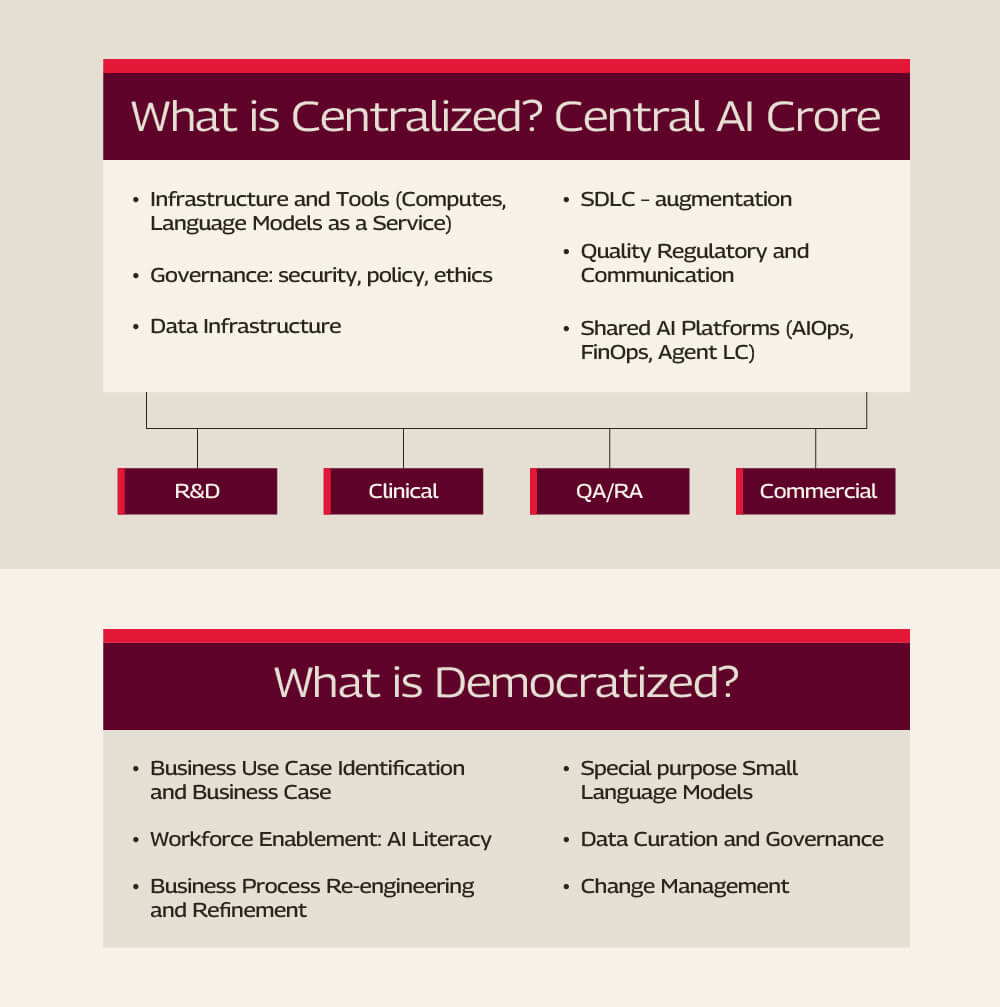
Key principles include treating AI artifacts as regulated assets, separating public foundation models from proprietary layers, and aligning cyber, legal, and scientific leadership voices into a unified front.
Looking Ahead: Gaining Enduring Advantage
With GenAI, digital capability moves from supporting science to participating within it. What comes next will be shaped less by technical novelty and more by how deliberately GenAI is integrated into the core.
From what we observe at Tech Mahindra, the most durable progress is made when GenAI is elevated from episodic experimentation to an enterprise-wide thread. The early leaders are setting flywheels in motion that will accelerate innovation while preserving the trust that is the lifeblood of this industry. Sustained momentum and small daily successes will define the next phase of global leadership.
TAGS:
Health & Life Services
Frequently Asked Questions
Our FAQ section is designed to guide you through the most common topics and concerns.
While previous digital waves focused on operational efficiency and data ‘literacy,’ GenAI represents a shift toward ‘scientific participation.’ Earlier, AI was used for statistical analysis at the margins; GenAI actively influences scientific workflows—predicting protein structures and suggesting experimental sequences—effectively moving from a back-office tool to a co-pilot in the lab.
Yes, but only through augmentation rather than replacement. The goal is to provide ‘fast foresight’ to clinical and biostatistics teams, allowing them to spot safety signals or protocol flaws earlier. By embedding explainability and human-in-the-loop checkpoints, AI becomes a tool for higher-order vigilance rather than a shortcut that bypasses rigor.
We recommend a ‘federated model.’ A central AI council acts as the rule-setter—defining security, ethics, and architectural standards—while individual functional units (R&D, Clinical, and Commercial) retain the autonomy to run their own ‘plays’ and experiments within those established guardrails.
Protection must move beyond traditional data security to include ‘AI-native’ security. This involves isolating public foundation models from proprietary data layers, treating model weights and training sets as regulated IP, and establishing clear lineage from data to AI-driven decisions to satisfy both internal IP requirements and external regulatory audits.
References
- McKinsey & Company McKinsey & Company. (n.d.). Generative AI in the pharmaceutical industry: Moving from hype to reality. Retrieved from
- Nature Publishing Group Mak, K. K., & Pichika, M. R. (2019). Artificial intelligence in drug discovery: Progress, challenges and future prospects. Na…
- Nature Publishing Group Jumper, J., Evans, R., Pritzel, A., et al. (2021). Highly accurate protein structure prediction with AlphaFold. Nature.
- NVIDIA NVIDIA. (n.d.). BioNeMo platform overview. Retrieved from
- NVIDIA NVIDIA. (n.d.). Parabricks genomics acceleration. Retrieved from
- PhRMA Pharmaceutical Research and Manufacturers of America. (n.d.). Research and development policy issues. Retrieved from
- JAMA Network Wouters, O. J., McKee, M., & Luyten, J. (2020). Estimated research and development investment needed to bring a new medicine to market, …
