


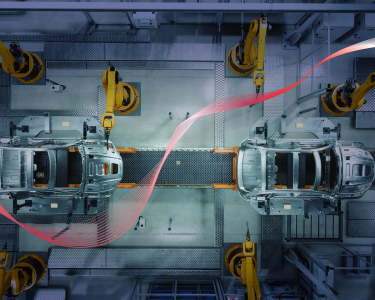





- Information lag in manufacturing is structural and is caused by data silos across functions that restrict visibility and delay decisions.
- An architectural redesign empowers enterprises to gain real-time visibility and shift from a consolidated, centralized model towards domain-owned, continuously available data.
- A digital nervous system built on data mesh principles acts as a unified layer that aids in data ownership, modeling, management, and insight extraction.
- Project Vihaan channelized the digital nervous system model to drive tangible results and accelerate decision cycles.
The Data Paradox
In a world where data-driven decisions are the norm, modern manufacturing is no exception. Today, manufacturers need real-time data to align operations, mitigate risks, and respond to customer demands. However, in large-scale manufacturing, data is often ‘trapped’ across departmental silos, leading to limited visibility and delayed decisions. In volatile markets such as the post-COVID landscape, this delay is expensive.
Closing this gap requires shifting from static, report-driven visibility to continuously available, domain-owned data that flows across the enterprise. The digital nervous system model builds on this foundation to deliver enterprise-wide visibility that turns real-time data into a strategic lever for growth.
Real-time data drives modern manufacturing and powers risk mitigation, customer experience, and operational stability.
Why Information Lag is an Architectural Problem
Most manufacturing enterprises operate on periodic reporting. They collate data from various operating systems, such as ERP, MES, CRM, and other tools, and reconcile it into dashboards and review packs. What this creates is a decision lag. Eventually, when a CXO sees a report, the data reflects past performance rather than the current reality.
This is not a data scarcity problem but an architectural mismatch. Manufacturing decisions are deeply interconnected across functions. Sales influence production. Production affects inventory. Inventory impacts cash flow. Yet each function updates, reports, and reviews performance at different intervals. When visibility moves at different speeds, the enterprise loses synchronization.
Traditionally, enterprises responded by consolidating data into centralized warehouses to create a single version of the truth. These models reduced fragmentation, improved reporting consistency, and were adequate in slower, more predictable environments. But as the speed and scale of operations increased, their limitations became structural.
To support today’s operational velocity, information flow must be redesigned to move as continuously as the business itself.
From Reports to Real-Time Signals—The ‘Digital Nervous System’ Approach
Moving beyond information lag and achieving real-time enterprise intelligence requires a structural redesign of how data is owned, modeled, and shared across the enterprise. To move from reports to real-time signals, enterprises need a strategic approach.
Data as a Product
The digital nervous system approach treats data as a product. Ownership sits with the domains that generate it, such as supply chain, finance, and production, etc. Each function defines and governs its datasets with clarity and accountability. Rooted in data mesh principles, this domain-driven model enables data to be published in standardized formats while preserving responsibility at the source.
Continuous Accessibility
In high-stakes environments like manufacturing, information flow should not stop. By gathering signals from service centers, production lines, and sales channels, the model allows information to move across systems and remain accessible to stakeholders. With minimal latency and built-in governance, it preserves control while enabling speed.
Enterprise-Level Signal Processing
Layered on top of this model is an enterprise control mechanism, a unified visibility layer that monitors performance across functions, detects deviations, and enables early intervention. This control tower provides end-to-end visibility with drill-down capabilities, allowing leadership to trace issues to their source and act before they escalate.
Much like a nervous system in the human body, this fully digitalized system connects sensing, processing, and response into one coordinated loop. It represents a generational shift in how enterprises consume and leverage data.
A digital nervous system model unifies data ingestion, signal processing, and response orchestration to drive coordinated enterprise intelligence.
Project Vihaan: Operationalizing the Digital Nervous System
So what does the digital nervous system model look like when it's actually built? Project Vihaan answers that. Designed to overcome data silos and eliminate information lag, the project aimed to transform the data ecosystem of Mahindra & Mahindra (M&M).
The Challenge
For years, M&M relied on a traditional reporting model built around disparate systems and periodic consolidation. As operational complexity expanded, the enterprise required greater speed and synchronization in decision-making. To thrive, M&M needed real-time, enterprise-wide visibility and intelligence-led operations connecting every function, from the shop floor to the C-suite, while supporting future innovation.
The Solution
Project Vihaan introduced the Mahindra Data Platform (MDP), an enterprise-wide data layer built on data mesh principles. By integrating over 25 core systems, the platform improves cross-functional visibility and synchronization.
MDP: Architected for Scale, Insights, and Intelligence:
MDP establishes a modern, federated data environment that supports integration, governance, and analytical use cases at scale. Built on a Google Cloud–based Data Mesh architecture, it features a petabyte-scale data marketplace for democratized access, strong data governance powered by industry-leading cataloging tools, real-time data ingestion from core systems, and seamless integration with AI/ML models and predictive engines.
Apart from the MDP, the model also embeds an operating heartbeat (OH), which is a CXO-level control tower for 360-degree visibility. Together, they enable continuous enterprise visibility and coordinated decision-making.
The Outcome
The results were concrete: a 60% acceleration in S&OP cycles, a 30% productivity gain through automation and integrated dashboards, a significant reduction in decision cycles, and a 24% improvement in operational speed across functions. Above all, leadership gained something the old model never offered: continuous, enterprise-wide visibility into operational health.
Project Vihaan delivered 60% faster decision cycles, 30% productivity gains, and 24% operational acceleration across functions.
The Way Forward
In an industry still catching up to its own data, M&M has already moved on to what comes next. With Project Vihaan, the future looks promising. The upcoming roadmap unveils conversational AI layers for leadership and frontline teams, virtual twins for manufacturing and supply chain operations, federated learning ecosystems, expanded master data management (MDM) and data modernization, and data monetization opportunities across business verticals. With the digital nervous system model now stable, scalable, and AI-driven, it's ready to redefine enterprise intelligence for the automotive industry.
Conclusion
As manufacturing braces for the next wave of disruption, embracing the potential of its data with agile, scalable architecture becomes imperative. With the digital nervous system model in place, enterprises gain a bird’s-eye view of business performance, swiftly translate insights into action, and strengthen control in volatile market and supply chain conditions.
The future of manufacturing runs on real-time data. Where does your enterprise stand?
Frequently Asked Questions
Our FAQ section is designed to guide you through the most common topics and concerns.
A digital nervous system is a modern enterprise data architecture that continuously captures and processes operational signals from systems such as ERP, MES, and CRM. It enables real-time enterprise visibility and supports faster, intelligence-driven decision-making.
Information lag is primarily caused by fragmented systems and periodic reporting structures. When operational data moves at different speeds across functions such as production, supply chain, and finance, decision-makers receive delayed insights.
Real-time data allows organizations to monitor operational performance continuously, detect disruptions early, optimize production planning, and maintain alignment across the supply chain.
Data mesh decentralizes data ownership by assigning responsibility to individual business domains. This ensures that data is managed as a product, improves quality and governance, and allows information to be shared across the enterprise efficiently.
A control tower acts as an enterprise visibility layer that aggregates signals from multiple operational systems. It enables leadership teams to monitor performance, detect anomalies, and trace operational issues to their root causes.
Manufacturers can reduce decision latency, improve cross-functional coordination, enhance operational productivity, and create a strong foundation for advanced capabilities such as AI, predictive analytics, and digital twins.