

Scale at Speed™






 English (Global)
 French (Canada)

- As sports expands globally, technology partnerships have shifted from operational support to becoming a core pillar of how leagues scale and compete.
- Rising demand for personalized, always-on experiences is driving leagues to invest in technology that keeps fans engaged beyond match day.
- The growing value of sports data shows that competitive advantage now depends as much on insights and analytics as on athletic talent.
- As sporting ecosystems become more connected, secure, resilient, and trusted technology foundations are becoming business-critical.
- Leagues that treat technology as a long-term strategic growth partner will be better positioned to innovate, engage, and lead.
Technology Powering Modern Sports Leagues
Sport has always been defined by talent, competition, and the raw emotion of human endeavor. But in the modern era, what unfolds beyond the field of play has become as consequential as what happens in it. The sporting landscape has undergone a transformation so profound that technology has become the very architecture upon which the contemporary sports league is constructed.
A New Era of Scale and Ambition
The scale of this shift can be seen in the numbers. The global sports technology market was valued at approximately USD 32.36 billion in 2025 and is projected to reach USD 200.83 billion by 2034, representing a compound annual growth rate of 22.6%.1
The global sports market itself was valued at approximately USD 495.38 billion in 2025 and is expected to reach USD 654.22 billion by 2030, growing at a compound annual growth rate of 5.8%.2 Last year alone, the sports technology industry witnessed a record USD 200 billion in total deal value across 1,026 announced transactions, more than double the merger and acquisition activity of the previous year.3
This is a story of fundamental restructuring, of how sport is produced, consumed, and experienced.
Technology partnerships have moved from the margins to the center, and the leagues that understand this are the ones building for the future.
The Transformation of Fan Experience
The modern sports fan expectation today is for immersion: Real-time statistics, personalized content, multi-platform access, social interaction, and a continuous connection to teams and players that extends far beyond the final whistle. 90% of surveyed fans consume sports content beyond watching live events, underscoring the growing importance of interactive and digital sports experiences, according to IBM's 2025 global sports fan study. The same research found that 85% of respondents see value in integrating artificial intelligence into their sports experience, with 63% expressing trust in AI-generated sports content. Fans identified real-time game updates (35%) and personalized content (30%) as their top priorities for AI-enhanced engagement.4
Technology partners enable leagues to meet these demands at scale. Cloud infrastructure, artificial intelligence-enabled production pipelines, automated highlights, and remote broadcasting capabilities transform a single match into a global content ecosystem, spanning live broadcasts, short-form video, player interviews, statistical analysis, social media moments, and personalized highlights, all adapted for different geographies, languages, and platforms. For leagues seeking a global footprint, the ability to deliver localized, high-quality, interactive content allows the competition to travel far beyond the venue and feel local in markets thousands of miles away.
Data as the New Currency of Competition
Most sports league today generates vast quantities of data, from player performance metrics and fan behavior patterns to system loads during peak traffic. The opportunity lies in converting this raw information into meaningful insight. The sports analytics market, valued at approximately USD 3.73 billion in 2025, is expected to reach USD 13.88 billion by 2030, at a compound annual growth rate of 30.04%.5 This explosive growth reflects a fundamental recognition that data is central to how competition is understood, strategized, and commercialized.
Teams use data to refine preparation and sharpen strategy. Leagues use it to understand fan behavior, optimize formats, and identify growth opportunities. Broadcasters use it to tell richer stories, while sponsors use it to create more relevant experiences and measure impact with unprecedented precision.
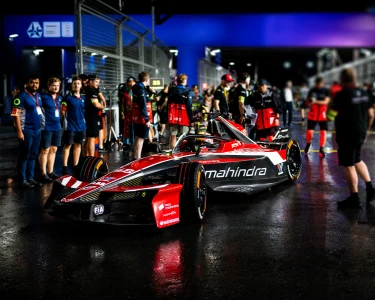
Formula E offers a compelling illustration. Data is integral to energy management, powertrain optimization, race strategy, and performance. Tech Mahindra's work with Mahindra Racing on Rubicon, a strategy simulation tool that uses data-driven modelling to anticipate race scenarios and optimize decisions before and during a race, demonstrates how technology partnerships can move beyond sponsorship to directly influence competitive performance. The same data that powers on-track decisions also helps broadcasters explain critical moments, deepen fan understanding, and create stronger commercial narratives.
Across the sporting world, similar partnerships are reshaping the competitive landscape. Intel's multi-year strategic partnership with McLaren Racing provides high-performance compute and artificial intelligence capabilities for real-time data analytics, aerodynamic simulation, and vehicle-dynamics analysis. Oracle Red Bull Racing has developed an artificial intelligence-powered strategy agent, while Mercedes-AMG Petronas uses Microsoft Azure for advanced analytics.
Building Trusted and Resilient Ecosystems
Modern sports leagues are complex interconnected systems, linking athletes, teams, officials, broadcasters, sponsors, venues, platforms, and millions of fans across the globe. The underlying infrastructure must be scalable, resilient, and secure. Technology partners provide cloud scalability, cybersecurity, identity management, data governance, and platform reliability that make this possible.
Trust is equally fundamental. Fans and participants must have confidence in the integrity of the competition, the security of their data, and the reliability of their experience. This encompasses secure playing systems, fair-play monitoring, identity verification, and robust data protocols. As Deloitte's analysis of sports regulation observed, regulators and industry leaders must stay ahead of emerging technologies such as artificial intelligence to ensure they are not used to circumvent established regulations.6 Innovation must always be supported by governance and trust, and technology partners are essential to delivering both.
Accelerating Innovation, Participation, and Growth
Technology partnerships also enable leagues to experiment with new formats, fantasy platforms, gamified experiences, subscription products, virtual events, and immersive sponsor activations. These innovations deepen engagement and create new revenue streams that were unimaginable a decade ago. Sports sponsorship will continue to grow, driven in part by the enhanced measurement and personalization that technology enables.
Perhaps most significantly, technology can connect elite sport with grassroots participation. Online tournaments, learning platforms, coaching tools, and community challenges link professional leagues with schools, academies, clubs, and emerging talent. In chess, a fan can move seamlessly from watching a match to analyzing it, learning from it, and participating online, all within the same ecosystem. In motorsport, the connection between engineering, software, data science, and real-time decision-making inspires the next generation of technologists and innovators.
Sport is also a powerful talent-branding platform. Many audiences have an affinity with qualities that technology companies value: Analytical thinking, teamwork, resilience, creativity, and continuous learning. The strongest partnerships are therefore not transactional. They combine a league's deep understanding of sport and fandom with a technology partner's capabilities in data, artificial intelligence, design, engineering, and scale.
The Path Forward
The future of sport will remain fundamentally human. The drama, the emotion, and the unpredictability of competition will always be its heart. But technology will increasingly determine how those sporting moments are created, understood, shared, and scaled. It will decide who sees them, how they experience them, and how the league grows because of them.
In modern sport, technology is no longer operating behind the scenes. It is becoming part of the very architecture of the league.
Organizations that embrace this as a strategic partnership to be leveraged will lead the way forward. As for the rest, they may find themselves as spectators in an industry that is no longer waiting for them to catch up.
TAGS:
Experience Services
Data Analytics
Frequently Asked Questions
Our FAQ section is designed to guide you through the most common topics and concerns.
Technology partnerships help sports leagues adapt to changing fan expectations, manage growing volumes of data, and scale digital experiences globally. They enable leagues to improve engagement, streamline operations, protect critical systems, and create new commercial opportunities, making technology a strategic driver of long-term growth rather than just a support function.
Technology allows leagues to deliver personalized content, real-time match insights, AI-powered recommendations, interactive experiences, and multi-platform access. This helps fans stay connected with teams, players, and competitions beyond live events, creating a more immersive and continuous relationship with the sport.
Sports organizations use data analytics to evaluate athlete performance, optimize strategies, understand fan behavior, and improve business outcomes. The blog highlights how Tech Mahindra's collaboration with Mahindra Racing uses a data-driven strategy simulation platform to support race planning, scenario analysis, and faster decision-making, demonstrating the growing impact of data on competitive performance.
Modern sports leagues operate across interconnected platforms involving athletes, teams, broadcasters, sponsors, venues, and millions of fans. As digital engagement grows, technology infrastructure must remain secure, reliable, and scalable. Strong governance, cybersecurity, identity management, and data protection help maintain trust in both the competition and the fan experience.
Sports leagues should seek technology partners that can combine expertise in AI, analytics, cloud, cybersecurity, and digital engineering with a strong understanding of industry challenges. As discussed in the blog, organizations increasingly collaborate with partners such as Tech Mahindra to build scalable platforms, unlock value from data, accelerate innovation, and create connected experiences that support sustainable growth.
References
- Fortune Business Insights. (2026). Sports technology market size, share & industry analysis, 2026–2034. Fortune Business Insights.
- The Business Research Company. (2026). Sports global market report 2026.
- Sports Business Journal. (2026, February 3). New report highlights $200B year in sports tech deals. Sports Business Journal.
- IBM. (2025). IBM study: Sports fans demand more dynamic digital content, powered by AI. IBM Newsroom.
- Mordor Intelligence. (2025). Sports analytics market size & share analysis - growth trends & forecasts (2025-2030).
- Deloitte. (2025). 2025 sports industry outlook: Staying ahead of the game. Deloitte Insights. deloitte.com
- Research and Markets. (2026). Sports market report 2026. Research and Markets.