

Scale at Speed™







 English (Global)
 French (Canada)

- Given the short timeline for minimal compliance, organizations can now meet ISO 20022 Hybrid Mandate requirements without undertaking massive, multi-year ERP upgrade projects.
- November 14, 2026, is the deadline for decommissioning unstructured addresses for cross-border payments.
- Organizations must minimally comply by augmenting unstructured address data with additional Town and Country fields
- Long-term migration will now require adopting the XML-based ISO 20022 PAIN.001 structured format.
- Most systems and institutions are still not compliant with the mandate, leaving them exposed to payment rejections and operational disruption post November 14, 2026.
The Reality: Race Toward ISO 20022 Hybrid Compliance
Over the past months, global treasury teams and IT leaders have been puzzled by the same pressing challenge: modernizing address management to comply with the new ISO 20022 Hybrid Mandate November 14, 2026, marks a hard stop for organizations using legacy file formats for cross-border payments. Compliance now hinges on adopting ISO 20022 hybrid or structured data standards, including payment initiation messages such as PAIN.001.1
Tech Mahindra has developed a short term, ready to deploy solution to enable organizations to comply to ISO 20022 Hybrid Mandate by transforming the legacy file formats to ISO Compliant formats thus giving organizations enough time to upgrade to full compliance with the ISO 20022 PAIN.001 structure.
Designed to bring speed, transparency, and interoperability to payment data, the mandate leaves little room for delay. The act of noncompliance or failure to meet these requirements by the deadline will lead to serious consequences, such as delays in payments or even outright rejection of cross-border transactions. Tech Mahindra offers a non-invasive, 6-week migration utility program that aids seamless compliance by adhering to address structuring and also supports data enrichment with extended benefits.
The Key Challenges to Compliance
ISO 20022 Hybrid Mandate is not just a formatting upgrade. It is a data remediation challenge, and this distinction is critical for compliance. Technically, the primary hurdle is the data gap. Most companies are still operating on legacy address data stored in unstructured free-text blocks limited to 35 characters per line. The new requirement mandates that the address be converted into a granular XML structure with separate tags and classifications. Moving from this ambiguous text to structured financial data requires semantic enrichment, a capability most organizations fundamentally lack.
Typically, most organizations use legacy ERP systems such as SAP, Oracle, Microsoft Dynamics, or even mainframes. These systems cannot inherently segregate and output in the required format and be compliant with pain.001 messages with structured addresses. If organizations decide to build this capability internally, it will take months of development and cause major disruption to existing roadmaps. A complete overhaul is also off the table, as it's expensive, time-consuming, and a nightmare for the IT teams. Additionally, most treasury and data teams have not yet measured the actual data gap, i.e., how many vendor records are missing key fields or contain ambiguous address information that will fail validation.
The Cost of Inaction
Failure to migrate is a breach of compliance with clearing banks and global payment market infrastructures (PMIs). This non-compliance can lead to serious repercussions, such as:
- Rejection of cross-border transactions
- Frozen cross-border liquidity
- Delay in vendor payments
- Significant disruption in global supply chains
The 6-Week Sprint: Tech Mahindra’s Non-Invasive Migration Approach
While the rest of the industry remains trapped in multi-year upgrade cycles, Tech Mahindra provides a streamlined, non-invasive alternative. Powered by a software factory model, the approach requires no overhaul and expedites migration from the get-go. Here’s a rundown.
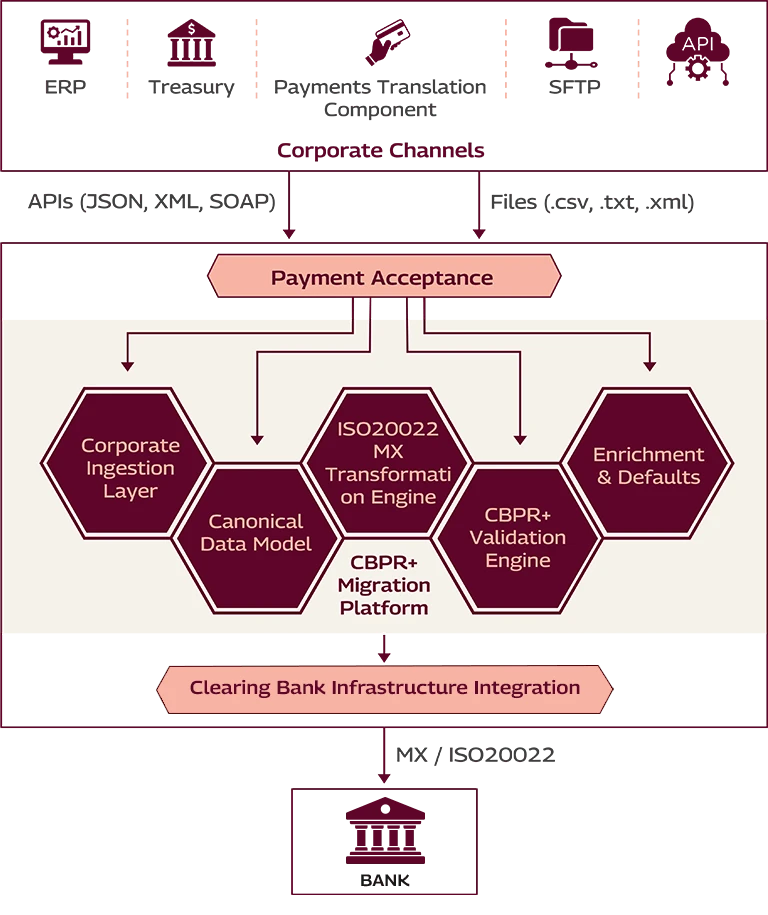
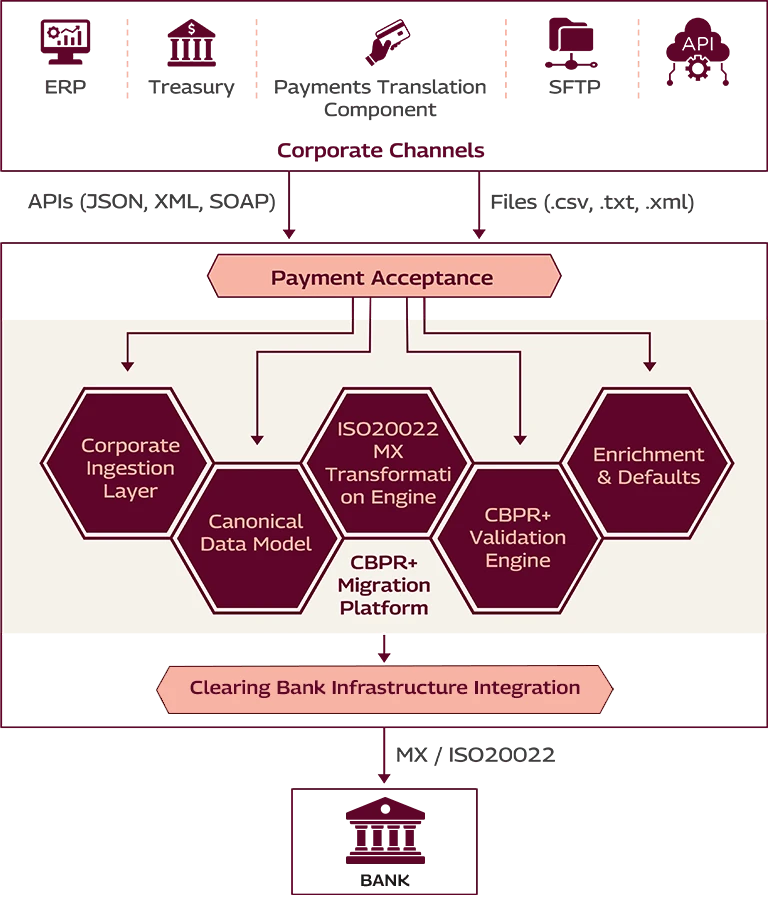
Figure 1: TechM’s Migration Architecture
Our approach is through a robust data enrichment and translation layer. Embedded with built-in governance and sovereignty, our solution provides treasury teams with the compliance they require and reduces the IT teams' burden. Here’s what it encompasses:
- Agnostic Translation Hub: Regardless of the current system's output format, our engine accepts legacy SWIFT MT101, SAP IDOCs, CSVs, and fixed-length flat files for standardization without requiring any ERP upgrade.
- Intelligent Data Enrichment: Runs logic that parses unstructured address strings and maps them into the mandated format. Also, to prevent rejection, we handle translation, padding, and truncation rules.
- End-to-End Orchestration and Testing: Beyond migration, TechM provides complete support throughout testing lifecycles. By coordinating directly with clearing bank’s operations team, we manage penny testing and syntax validation through the test portal. Moreover, by orchestrating user acceptance testing (UAT) with treasury teams, we reduce the pressure on internal teams.
To completely address the migration hurdles, we deploy a phased execution model.
| Implementation Phase | Focus |
| Phase 1 - Discovery and Mapping | Audit legacy data and map it to ISO XML requirements. |
| Phase 2 - Build Configurable Transformation Engine | Deploy semantic rules and data enrichment logic to convert legacy address blocks into hybrid or structured formats. |
| Phase 3 - Rigorous SIT + Data Quality Validation | Rigorously conduct testing, including system integration testing (SIT), syntax validation, and penny testing. |
| Phase 4 - UAT and Execution | Finalize user acceptance with the treasury team and sign-offs on clearing banks’ rails. |
| Phase 5 - Hypercare and KT | 4 weeks of post-deployment support, including monitoring, issue resolution, and complete knowledge transfer. |
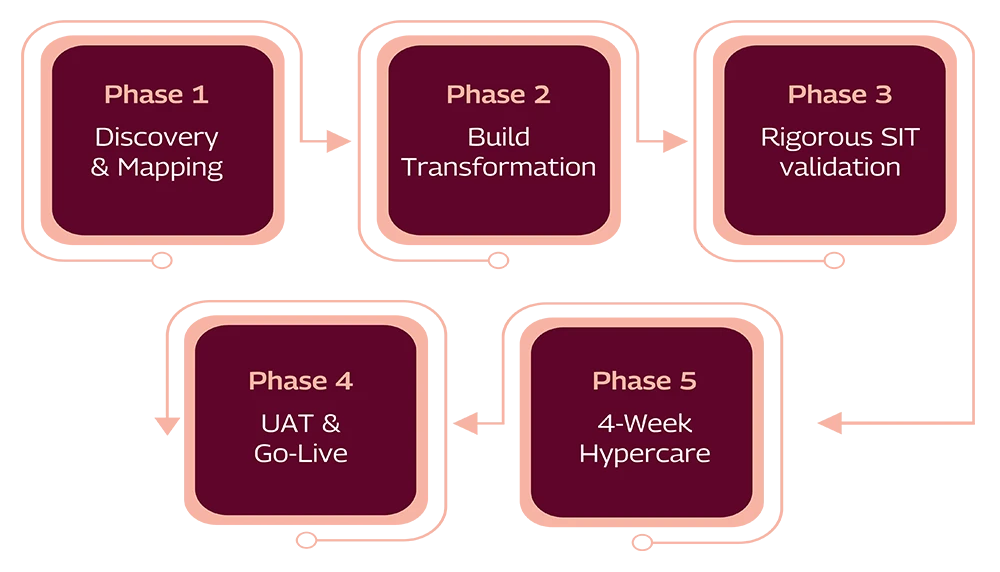
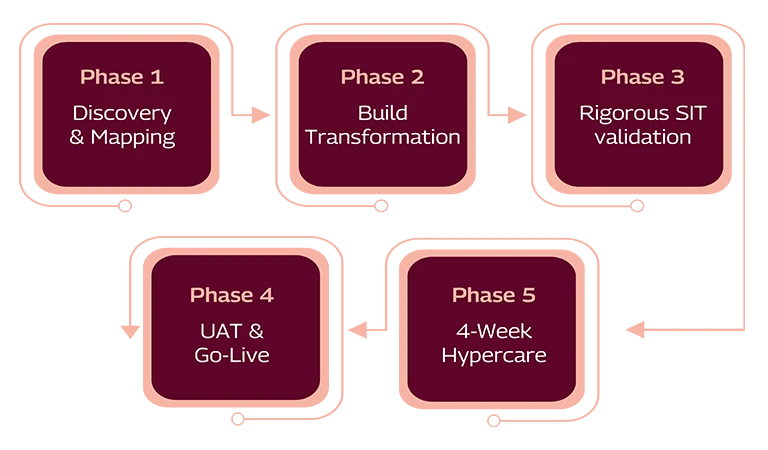
Figure 2: TechM’s 6-Week Sprint on Migration
Beyond Compliance: The Strategic Upside
Compliance with the deadline is the immediate catalyst; however, the shift to structured addresses offers a significant strategic payoff for global payment processes. The real value of migration extends beyond regulatory adherence and provides:
- Advanced Cash Forecasting: Accurate, structured payment data benefits the treasury team as well as the global payment operators. This organized approach enables reliable cash flow visibility that reduces reliance on buffer cash, improves liquidity planning, and supports better decision-making.
- Automated Reconciliation: Rich, structured payment and party data enable precise auto-matching of transactions, minimizing manual intervention and significantly reducing reconciliation errors.
- Foundation for Next-gen Operations: Compliant, high-quality data establishes the framework for real-time payment tracking, global treasury operations, and capital management strategies. It also paves a path for innovation in payment processing.
J.P. Morgan and Tech Mahindra Partnership
J.P. Morgan has partnered with Tech Mahindra to help its corporate clients rapidly comply with the ISO 20022 hybrid mandate, leveraging Tech Mahindra’s ready-to-deploy solution and deep payments transformation expertise. Through this collaboration, J.P. Morgan’s corporate customers can seamlessly adopt structured and hybrid address formats across their payment flows, reducing the risk of payment repairs, rejections, and operational disruption. Tech Mahindra’s accelerators, validation frameworks, and integration capabilities enable end-to-end implementation—spanning ERP, treasury, and payment systems—within an accelerated 6 week timeline. This partnership is designed to provide future-proof corporate payment infrastructures, ensuring they remain aligned with evolving ISO 20022 standards while maintaining resilience, regulatory confidence, and strong connectivity with J.P. Morgan’s global transaction banking platforms.
The Final Word
The target date for the ISO 20022 Hybrid Mandate is fast approaching, and organizations facing the deadline are expected to accelerate migration and close compliance gaps. However, most treasury teams still lack a clear execution path to address legacy data and meet structured formatting requirements.
Institutions that treat this exercise as a strategic data enrichment initiative rather than a formatting update are well-positioned to secure cross-border transactions, meet regulatory demands, and achieve operational resilience.
With extensive ISO compliance expertise, we offer a 6-week migration utility solution to simplify compliance and provide a comprehensive roadmap for structured addressing through our ISO 20022 transformation services.
The window is rapidly closing. The time to act is now.
TAGS:
Banking & Financial Services
Insurance
Private Equity
Frequently Asked Questions
Our FAQ section is designed to guide you through the most common topics and concerns.
CBPR+ is a global payments standard aligned to ISO 20022 that mandates structured data in cross-border transactions. It aims to improve transparency, interoperability, and straight-through processing. For payments initiated via pain.001 messages, particularly through large correspondent banks, structured address data is no longer optional and becomes mandatory by the stated deadline.
Failure to meet CBPR+ requirements can result in rejected or delayed cross-border payments. This may disrupt vendor settlements, constrain liquidity movement, and impact supply chains. Non-compliance also increases operational risk, as payment systems may be unable to process transactions that fail schema validation or mandatory field checks.
Legacy systems often store addresses as free-text fields with limited character lengths. CBPR+ requires addresses to be segmented into defined XML elements, such as street, building number, and country. Converting ambiguous text into validated, structured data requires enrichment logic rather than simple reformatting.
A full ERP upgrade is not strictly required. Compliance can be achieved by introducing an external translation and enrichment layer that converts legacy payment outputs into CBPR+-compliant formats. This allows organizations to meet requirements without altering core ERP configurations or disrupting existing
Structured data enhances automated reconciliation, improves cash flow visibility, and supports more accurate forecasting. It also forms the foundation for real-time payment tracking and advanced treasury analytics. These benefits extend the value of CBPR+ beyond regulatory adherence into long-term operational efficiency.
