

Scale at Speed™







 English (Global)
 French (Canada)

- AI access and experimentation alone do not produce enterprise value; sustainable adoption requires business outcomes, human accountability, process redesign, technology controls, and unit economics.
- ROI and Trust must operate as a single discipline, with value and trust designed into the full lifecycle of every AI use case.
- Responsible AI moves from policy to engineered and continuously measured behavior, supported by accountability, lifecycle assurance, end-to-end governance, and technological guardrails.
- As AI becomes agentic, every material agent needs defined ownership, permitted actions, human validation, runtime intervention, and accountability for outcomes.
- Accountable AI ultimately connects cost and value per verified business outcome, enabling enterprises to move from AI consumption to measurable economics and dependable business performance.
For many enterprises, getting onboard with AI means making it an access program. They deploy a set of models, obtain licenses, implement employee integration and training, and encourage experimentation. While this approach creates an illusion of progress through activity, it does not produce enterprise value. Sustainable AI adoption, on the other hand, requires a management approach that unifies business outcomes, human accountability, process redesign, technology controls, and unit economics. The central question for a CXO therefore is about how to convert AI into trusted, repeatable, and economically attractive outcomes.
Tech Mahindra’s point of view is that ROI and Trust should be a single operating discipline rather than two separate workstreams. Trust without value is a compliance nightmare, and value without trust leads to limited adoption and indefensible outcomes. The enterprise must design both into the full lifecycle of every AI use case and govern generative and agentic AI with the same seriousness applied to financial controls, cybersecurity and operational resilience.
AI is now a leadership agenda encompassing growth, productivity, customer experience, operational resilience, national competitiveness, and public trust. Even a small slip-up can result in significant consequences for the enterprise. With so much at stake, accountability must remain with leaders who are answerable for decisions made by AI models and agents. What follows is our strategic perspective on responsible AI across the entire enterprise AI lifecycle. Drawing on our delivery and implementation experience, this paper presents a proactive risk management and AI adoption approach for organization-aligned outcomes.
Responsible AI is built by responsible humans. Trust is earned when accountability remains unmistakably human.
The Shift CXOs Must Make
To embed trust into AI by design, CXOs must make the following shift.
| Current Focus | Recommended Approach |
| Model access and experimentation | Outcome-led portfolios with explicit value hypotheses |
| Training as the adoption strategy | Role, process, and decision-right redesign |
| One-time model approval | Lifecycle assurance and runtime monitoring |
| Human-in-the-loop as a generic control | Named human accountability with the authority to validate, override, and stop |
| Security is focused only on infrastructure and data | End-to-end AI security across prompts, models, tools, agents, identities, and actions |
| Cost per license or API call | Cost and value per verified business outcome |
| Responsible AI as policy | Responsible AI as engineered, evidenced, and continuously measured behavior |
The ROI and Trust Framework
To adopt Responsible AI as an integral capability, we recommend a framework that embeds trust across three enterprise dimensions, including People, Process, Technology and Tools. The framework also evaluates performance through a two-sided scorecard: value realized and trust sustained. Operating with a central objective to continuously govern enterprise AI across its lifecycle, the framework establishes accountability, understands context and risk exposure, measures performance and risk, and manage both through evidence-led decisions.
1. Foundation: Responsible AI by design
The first pillar of the framework is Responsible AI, which states that all AI systems should have a defined purpose, risk classification mechanisms, designated ownership, approved boundaries, evidence requirements, and retirement conditions. Control principles such as fairness, privacy, safety, accountability, and explainability must be established through defined thresholds, assessments, and breach responses. For high-risk applications, comprehensive oversight is required that includes audit trails and authorized personnel who can evaluate, override, and halt systems. The level of human oversight should increase based on the system’s risk, autonomy, and potential impact.
Additionally, trust should be treated as an enterprise asset. As models, data, business environments, risk landscapes, and customer expectations evolve, control mechanisms should also keep pace. Therefore, every AI system should be periodically validated against its intended outcomes, operating context, risk factors, and performance limits. The findings should guide improvements to the AI system and its control mechanisms.
2. People: Accountability, Capability, and Adoption
The second pillar determines how people should be organized, equipped, and held accountable to support responsible AI. This specifically focuses on:
- Executive accountability: Assigns an executive for each material AI execution and outcome.
- Agent ownership: Establishes an accountable owner for every production agent who is responsible for its mandate, permissions, performance, incidents, and retirement.
- Decision rights: Defines authority to approve, challenge, override, pause, or decommission AI systems.
- Role-based capability: Develops AI literacy through differentiated paths for every role.
- Operating culture: Encourages employee behavior for value creation and responsible escalations.
- Work redesign: Categorize work as human-led, AI-assisted, or autonomous and define relevant authority.
While building capability, enterprises must also create internal confidence to question AI. Employees should know how to use AI systems, understand when to rely on them, recognize weak evidence, escalate concerns, and apply professional judgement. Rather than unquestioning adoption, informed, responsible use is the objective.
3. Process: End-to-End Governance
The next pillar focuses on governance across the AI lifecycle and business workflows. AI governance must be embedded into business intake, product management, architecture, procurement, SDLC, change management, risk, legal, security, and finance. Running governance as a separate review queue is not enough. The lifecycle should cover the following stages.
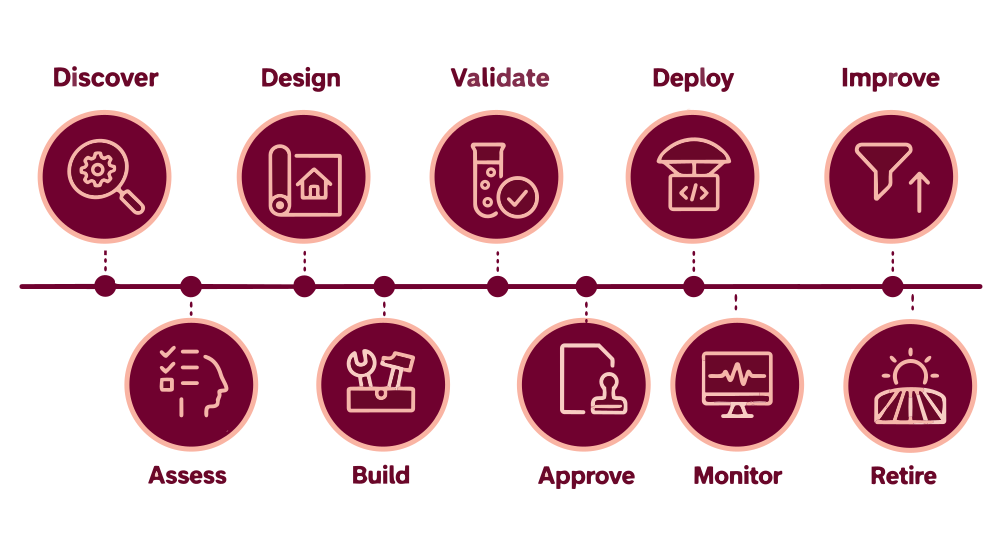
Figure 01: AI Lifecycle Stages
Each gate should produce evidence that is reusable for audit and decision-making. The National Institute of Standards and Technology's (NIST) Generative AI Profile reinforces this lifecycle governance and context-specific evaluation.1
For agentic systems, enterprises must have strong process assurance that assesses the quality of outputs as much as the consequences of actions. Explicit approval and exception paths, segregation of duties, transaction limits, rollback procedures, incident response, evidence retention, and post action reconciliation should be part of the plan. In addition, validation should cover both expected tasks and edge cases, including incorrect tool selection, cascading retries, conflicting goals, policy violations, unsafe delegation, and failures involving multiple agents.
Furthermore, enterprises should verify that policies are working in practice. If principles do not have any impact on day-to-day work such as approval criteria, architectural choices, test plans, incident responses etc., the lack of operational evidence points to ineffective governance. It is policy that is translated to repeatable decisions that creates trust.
4. Technology & Tools: Integrate Trust into AI Stack
The fourth pillar of the framework focuses on technological guardrails to build trust into AI systems. To achieve this, enterprises need:
- Data foundation: Provenance, quality, consent, permitted use, classification, residency, retention and lineage for training, retrieval and generated data.
- Identity and access: Least privilege for users, agents, tools, service accounts and machine identities; time-bound credentials and action-level authorization.
- Model and agent control: Model routing, grounded generation, prompt and output filtering, tool allow-lists, policy-as-code, memory controls and safe fallback.
- Security: Protection AI against prompt injection, jailbreaks, data leakage, model theft, poisoned knowledge, malicious tools, and supply-chain compromise.
- Evaluation: Task success, accuracy, hallucination, robustness, bias, privacy, explainability, security, and domain-specific harm.
- Observability: Trace the prompt, context, model, tools, decisions, actions, cost, latency, and human interventions for every material execution.
- Resilience: Circuit breakers, rate and spend limits, rollback, graceful degradation, disaster recovery, and kill switches.
5. Sovereignty and Control
The last pillar of the framework comes down to retaining meaningful control over data and intelligence. For effective governance, enterprises must understand what is collected, why it is used, where it is processed, which model and tools can access it, and how long that access persists and when it ends. With this clarity, enterprises can make deliberate choices about data residency, jurisdiction, intellectual property, model dependencies, portability, and operational control.
For CXOs, these choices also raise a critical question: Which elements of the AI value chain are strategic enough to retain control over? And which needs the least control? Priorities may differ by use case, but the assessment should cover data, models, prompts, embeddings, agent memory, orchestration, evaluation evidence, and encryption keys. It should also consider the ability to switch providers while maintaining governance and operational continuity.
Agentic AI: The Change in the Accountability Equation
A model proposes output, while agents can perceive, decide, invoke tools, and alter systems of record. The rise in autonomy demands assurance from validating content to governing delegated authority. Enterprises, therefore, should treat every material agent as a bounded digital role with a job description, ownership, permitted resources, a transaction ceiling, an escalation path, and a performance review.
The following table helps enterprises define and verify accountability for each agent:
| Accountability question | Evidence the enterprise should require |
| Who owns the agent? | Named business owner and technical custodian |
| What may it do? | Purpose, scope, policy, action, and spending boundaries |
| What must a human validate? | Risk-based review points, sampled checks, and mandatory approvals |
| How do we know it worked? | Verified outcome, not only task completion or model confidence |
| How can it be stopped? | Runtime intervention, kill switch, and rollback procedure |
| Who bears the consequence? | Clear decision rights, escalation, and incident accountability |
Every autonomous action increases the need for accountability. As AI gains authority, governance must gain precision.
Tokenomics: The Shift from AI Consumption to Unit Economics
While Responsible AI addresses accountability and authority, leadership should also consider the economics of delivering trusted AI outcomes. When it comes to AI, licensing is just one part of the total cost. Other aspects depend on prompts, retrieved context, output length, model choice, reasoning, retries, validations, tool calls, agent-to-agent communication, human review, and compute. Token economics should therefore track how much AI consumption each task needs, what it costs, and whether it delivers verified business outcomes.
Hence, CXOs should manage:
- Cost stack: Data preparation, model access or hosting, inference and tokens, vector and memory services, tool calls, orchestration, evaluation, security, observability, human review, remediation and change.
- Value stack: Includes capacity released, cycle-time reduction, quality improvement, revenue enabled, risk avoided, customer experience, innovation speed and strategic option value.
To manage both the cost and value stacks, CXOs need specific measures that connect AI costs with intended outcomes. The following metrics can guide this assessment.
Key Measures of AI Cost and Value
- Cost per verified outcome
- Value per 1,000 executions
- First-pass task success
- Human-review minutes
- Exception and rework rate
- Model and routing efficiency
- Cost of controls
- Avoided-loss value
- Adoption and capability
- Adoption-adjusted benefit
- Time to value
These measures provide a foundation for calculating ROI:
Risk-adjusted ROI = (Realized benefit + Monetized risk avoided − Total lifecycle cost) ÷ Total lifecycle cost
Furthermore, leadership should not reduce AI ambitions just to labor arbitrage. Cost take-out can fund the journey, but the larger prize should always be solving problems that were previously too complex, expensive, or inaccessible. Enterprises should aim to deliver better outcomes in their respective sectors that embed resilience, inclusion, trust, and strategic differentiation.
The CXO's Scorecard for Assessing Value and Trust
Bringing value and trust into a single view gives CXOs a clearer basis for deciding where to invest, where to scale, and where to strengthen controls. The following table outlines the key details.
Dimension | Illustrative Measures |
| Portfolio value | Realized benefit; revenue enabled; capacity released; risk avoided; time to value |
| Unit economics | Cost per verified outcome; token and compute efficiency; human-review cost; rework cost |
| Outcome quality | Task success; accuracy; defect/hallucination rate; customer or employee impact |
| Trustworthiness | Safety, fairness, robustness, explainability, privacy, and traceability scores |
| Security | Attack success; leakage; critical vulnerabilities; time to remediate |
| Human accountability | Owner coverage; oversight coverage; override effectiveness; unresolved exceptions |
| Agent control | Actions within mandate; unauthorized tool calls; failed hand-offs; successful rollback |
| Governance and regulatory readiness | Inventory coverage; risk-classification coverage; evidence completeness; control compliance |
| Adoption and capability | Active use in redesigned workflows; proficiency by role; value-producing adoption |
| Incidents and improvement | Severity, recurrence, detection/containment time, remediation SLA, and lessons embedded |
An Operating Model for Accountable AI
The most effective model is a federated one where responsibility is shared between a central AI team and key business units. In this model, a small, central AI team establishes policies, methods, controls, and reporting; the business units own outcomes and risk decisions; the engineering and platforms team embeds reusable controls, and independent functions provide challenge and assurance. Holistically, the model calls for representatives across all functions to work together through a governance forum. The objective of the model is not to limit innovation or slow AI but to support better decisions faster through shared evidence and pre-approved patterns.
With this model, trust becomes an operating capability and a scaling advantage. Executives gain the confidence to move use cases from pilot to production, employees gain the confidence to adopt them, regulators gain the evidence to assess them, and customers gain the confidence to rely on them.
The Implementation Roadmap
Tech Mahindra recommends a pragmatic 12-month roadmap for enterprises in pursuing their accountable AI ambitions.
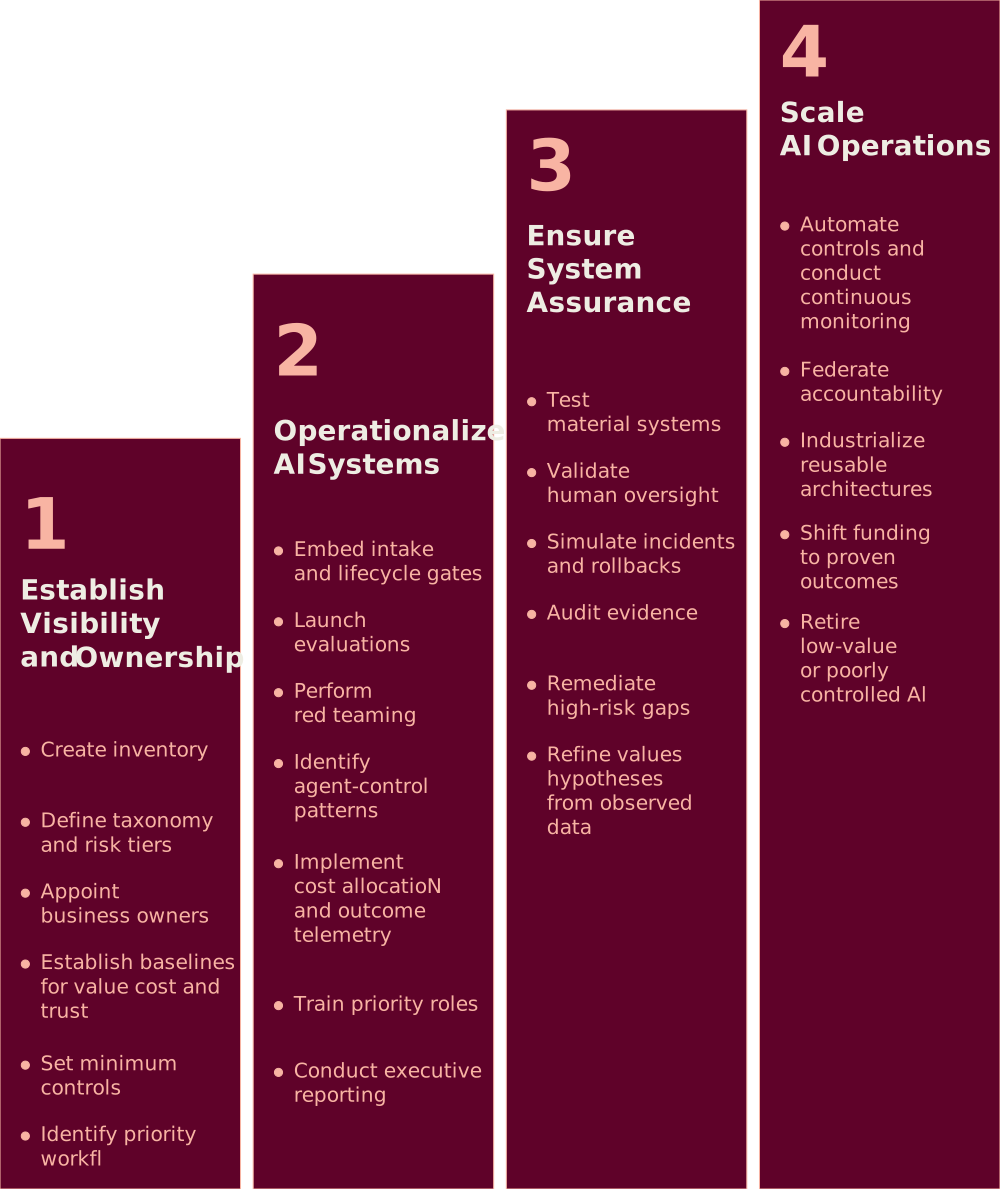
Figure 2: A Roadmap to Operationalize and Scale Accountable AI
Tech Mahindra’s Approach to Accountable AI
Enterprise AI leadership will not be defined by an organization’s ability to provide broad access to models. Rather, it will be defined by the ability to consistently turn probabilistic technology into dependable business performance. To achieve this, enterprises need an integrated capability to identify risk and value, engineer controls and economics, and transform the operating model.
Tech Mahindra brings this together through a lifecycle approach:
- Discover the AI estate, business opportunity, regulatory exposure, and economic baseline.
- Engineer secure architectures, assessments, guardrails, policy-as-code, observability, and agent controls.
- Transform governance, roles, workflows, skills, and measurement.
With this approach in place, Responsible AI becomes how the enterprise operates. The differentiator is not trust instead of speed, but trust that enables speed, reuse and scale.
Evidence-led Trust in Action
Tech Mahindra’s experience demonstrates that value and trust reinforce each other in practice:
- In a high-quality testing environment, Tech Mahindra implemented AI to reduce test results by 75%. This saved 2000 hours of manual effort annually and reduced human intervention by 80%, allowing teams to accelerate work through repeatable quality testing.
- For a public sector institution, we deployed a secure AI assistant that operates within the client’s controlled estate, delivering 30-40% efficiency improvement while protecting confidentiality and compliance.
- By enriching a telecommunications provider's 640,000 data assets with business context, we reduced manual search effort by 25% and strengthened ownership and confidence in governed insights.
Collectively, these examples demonstrate that trust is not an abstract promise. It can be built and sustained through better quality, clearer control, safer adoption, and measurable performance. Capabilities such as TechM VerifAI can make that trust reviewable by testing, validating and monitoring whether AI remains accurate, secure, reliable, relevant and fit for purpose.
For CXOs, the next priority is clear: Trust must be evidenced continuously, and the evidence must be intelligible to business owners, risk functions and boards.
TAGS:
Artificial Intelligence
Frameworks
Consulting and Management Services
Frequently Asked Questions
Our FAQ section is designed to guide you through the most common topics and concerns.
Enterprises must move beyond model access, licenses, training, and experimentation toward outcome-led AI portfolios. This requires explicit value hypotheses, named human accountability, redesigned workflows, lifecycle governance, technological controls, and measurement based on verified business outcomes.
Trust and ROI should operate as a single discipline because value without trust can lead to limited adoption and indefensible outcomes, while trust without measurable value can become a compliance burden. Enterprises should therefore design accountability, controls, performance, risk, and unit economics into the full lifecycle of every AI use case.
Every material AI agent should have a named business owner and technical custodian, a defined purpose, clear permissions, action and spending boundaries, and an escalation path. Enterprises should also establish human review points, mandatory approvals, runtime intervention, rollback procedures, and clear accountability for incidents and consequences.
CXOs should measure realized benefits, revenue enabled, capacity released, risk avoided, time to value, cost per verified outcome, outcome quality, trustworthiness, security, human accountability, agent control, adoption, and regulatory readiness. These measures provide a balanced view of whether AI is creating value while operating within approved boundaries.
A federated operating model can help enterprises scale Responsible AI by distributing responsibility across a central AI team, business units, engineering and platform teams, and independent assurance functions. The central team establishes policies and reusable controls, while business units own outcomes and risk decisions, supported by evidence-led governance.