

Scale at Speed™







 English (Global)
 French (Canada)

- Autonomous AI agents require explicit identity models to establish trust, accountability, and controlled access.
- Traditional identity frameworks are insufficient for AI agents due to their dynamic behavior and delegated authority.
- AI agent identity introduces new challenges around governance, scalability, interoperability, and impersonation risks.
- Secure identity mechanisms are foundational to protecting sensitive operations handled by autonomous agents.
- Amazon Bedrock AgentCore Identity delivers enterprise-grade, zero-trust identity management purpose-built for agentic AI that is secure and scalable.
The State of AI Agents and the Need for Identity
Today, AI agents are redefining how businesses operate. Recent breakthroughs in these autonomous systems have allowed them to perceive their environment, make independent decisions, and take actions to achieve specific goals. As agentic AI evolves, these systems are becoming integral to critical operational functions, including customer service, data processing, automation, IT Ops, and decision support.
While these agents are transforming core tech operations, they are also introducing complexities in management, especially in oversight. To counter these challenges, agents must now possess specific machine identities to verify their legitimacy and permitted actions. With a reliable identity model for each AI agent, organizations can find the right balance to build trust, enforce boundaries, and ensure clear accountability.
AI agents must have distinct machine identities to establish trust, enforce accountability, and prevent unauthorized actions in autonomous systems.
AI Agent Identity and Traditional Identity Models
The distinction between identity systems for an AI agent and a conventional model is quite telling. Traditional identity systems expect users to behave predictably and have fixed access. AI agents, on the contrary, are different. They autonomously make choices, use an array of tools, and take actions with delegated authority. Due to its dynamic nature, agentic systems demand flexible, intent-based approaches to adapt to the agent’s current goals and objectives.
Moreover, traditional identity systems rely on audit trails and role-based access controls (RBAC) to manage predictable user behavior. AI agents don’t operate within these boundaries. They execute multi-step tasks, make decisions on the fly, and interact with multiple systems in a single workflow. This makes simple logging insufficient. What’s needed is deeper visibility into how decisions are made, including reasoning paths, confidence levels, and contextual signals. Because these systems are non-human and continuously active, identity cannot rely on periodic validation. It has to be verified continuously, with trust evaluated in real time.
Unlike human users, AI agents operate with dynamic intent and delegated authority, requiring continuous authentication and context-aware access controls.
Identity Challenges in Agentic AI
Five challenges make identity the central constraint for agentic systems.
- Decentralized and Interoperable Environments: Autonomous agents often operate across distributed networks and come from different vendors or domains, which demands overall compatibility. Agents must recognize this and trust each other's identities while managing access to numerous credentials.
- Dynamic Agent Behavior and Context: AI agents evolve and adapt, complicating identity tracking and management. Maintaining operational history and context across sessions is essential for accurate identification and oversight.
- Scalability and Security: As the number of autonomous systems grows, identity solutions must efficiently scale while maintaining strong security to prevent vulnerabilities.
- Governance, Accountability, and Impersonation: To ensure accountability, autonomous AI agents require immutable activity logs, cryptographic signatures, and clear ownership. The risks of shadow agents and agent impersonation must be addressed to prevent unauthorized access and actions.
- Threats to Agent Integrity: Prompt injection, manipulation, privilege escalation, and credential theft are key attack vectors. These threats allow attackers to manipulate agent behavior, escalate privileges, move laterally within systems, or impersonate agents by stealing credentials. These known threat patterns must be effectively contained.
As AI agents scale across decentralized environments, identity becomes the primary control point for preventing impersonation, privilege abuse, and unauthorized access.
Critical Approaches to Securing the Identity of AI Agents
To secure autonomous systems and ensure systemic trust, organizations must adapt to emerging global standards and recommended protocols.
- NIST Center for AI Agent Standards and Innovation (CAISI): NIST launches initiatives and recommends protocols to foster public trust in AI agents, catalyze an interoperable agent ecosystem, and accelerate global adoption.1
- NIST AI Risk Management Framework: NIST provides voluntary guidance for trustworthy AI development and deployment, emphasizing governance, risk assessment, and mitigation strategies.2
- OWASP Agentic Security Initiative: OWASP offers threat-model-based referencing for emerging agentic threats and recommends mitigation strategies.3
Key implementation protocols for protection:
- Digital Certificates and Public Key Infrastructure (PKI): Agents must have issued digital certificates that verify their identity using cryptographic keys, and PKI should be enforced to secure authentication and communication between agents.
- Identity Tokens and Claims: Use token-based identity systems that encapsulate an agent's identity, permissions, issuer details, and validity timeframe to reduce risks.
- Zero Trust Architecture: Adapt to zero trust principles to ensure that every agent’s identity is continuously verified, regardless of its location or network environment.
- Decentralized Identifiers (DIDs): Embed DIDs to allow agents to maintain self-sovereign identities that are not reliant on centralized authorities, which improves privacy and resilience against single points of failure.
Amazon Bedrock AgentCore Identity: Secure Agent Access at Scale
Organizations should empower AI agents to access resources securely on behalf of users, safeguarding sensitive credentials and upholding compliance. AgentCore by Amazon is designed to meet these requirements, offering enterprise-grade protection and strong access control. It secures agent identity and enables access management capabilities that are compatible with existing identity providers, avoiding the need for user migration or rebuilding authentication flows. This approach ensures that AI agents access only what they need, when they need it. Furthermore, this centralized management of agent identities not only reduces operational burden but also fortifies the organization’s security posture, supporting trustworthy and efficient AI operations.4
Key Features of AgentCore Identity
Here’s a rundown on the extended capabilities of AgentCore Identity.
- Access Control: Fine-grained authorization, ensuring agents only access authorized tools and data on behalf of the user.
- Scalable Architecture: Streamlines large-scale agent management through a centralized directory, secure token vaults, and automated scaling to ensure robust authentication and authorization for inbound and outbound interactions. AgentCore Runtime automatically scales from zero to thousands of concurrent sessions, with each session operating within a dedicated microVM to prevent data leakage.
- Dual Authentication Model: Provides comprehensive identity and credential management through a dual-authentication approach.
- Inbound Authentication: Validates users and applications calling the agents by integrating with enterprise identity providers such as Amazon Cognito, Okta, and Microsoft Entra ID. For cross-account scenarios, it leverages AWS IAM roles and policies for secure permission delegation. When agents need to communicate with each other across accounts, the AgentCore Runtime supports secure agent-to-agent (A2A) communication using OAuth 2.0 or AWS IAM (SigV4-signed requests).
- Outbound Authentication: Enables agents hosted on AgentCore Runtime to securely access third-party services. It supports both two-legged OAuth (machine-to-machine) and three-legged OAuth (on behalf of users) mechanisms to access the resources. The solution securely authenticates non-AWS services using OAuth 2.0 and API keys. It provides ready-to-use integrations with popular services such as Google, GitHub, Slack, and Salesforce, making setup easy and simple.
- Secure Token Vault: Encompasses a token vault that provides security for storing OAuth 2.0 tokens, OAuth client credentials, and API keys with comprehensive encryption at rest and in transit. All credentials are encrypted using customer-managed AWS Key Management Service (AWS KMS) keys. It implements strict access controls by binding credentials to specific agent-user combinations and enforces zero token sharing to prevent credentials from being accessed by other users or agents.
- AgentCore SDK Integration: The built-in SD kit enables seamless credential handling with declarative annotations such as @requires_access_token and @requires_api_key, automatically managing token retrieval, injection, and OAuth flows. This reduces development effort and security risks by abstracting complex authentication logic and ensuring that all credential operations adhere to security best practices.
- Multi-tenant Agent Security: The solution supports two primary multi-tenant architectures: silo (dedicated) and pooled (shared) models.
- In the silo model, each tenant gets a fully dedicated agent runtime, gateway, memory, and resources. Strong isolation is achieved through IAM execution roles attached to these dedicated resources.
- In the pooled model, agents, tools, and resources are shared across tenants, introducing greater complexity in tenant isolation and authorization.
AgentCore Identity handles authentication for both models and uses JWT tokens to propagate tenant context to the agents. It applies attribute-based access control (ABAC) to dynamically restrict access to shared resources based on tenant attributes.
Identity Enforcement Across the AgentCore Stack
To achieve end-to-end security, AgentCore enforces identity and access controls consistently across three critical components.5
AgentCore Runtime
Runtime is the execution layer of AgentCore. It assigns distinct identities to agents and integrates with corporate identity providers, such as Okta, Microsoft Entra ID, or Amazon Cognito.
It enables agents to maintain a local state, including in-memory objects and temporary files, across multiple invocations within the same session. Each user session runs in its own dedicated, isolated microVM. This approach provides a strong security boundary, preventing one user's agent from accessing another user's data and ensuring a consistent, secure environment for complex, multi-step execution patterns.
The Runtime supports long-running sessions (up to 8 hours) and asynchronous operations, making it ideal for complex, multi-step workflows involving research, data processing, or extended reasoning without blocking the client.
AgentCore Memory
Memory is the persistence layer of AgentCore. It offers managed infrastructure with both short-term and long-term memory capabilities, supporting semantic search and various extraction strategies.
The Runtime maintains session-specific state and immediate conversation history within a dedicated, isolated execution environment, known as a microVM. For persistence across sessions, AgentCore Memory asynchronously processes raw events with LLMs to extract, consolidate, and store key insights such as user preferences, facts, and summaries in a vector store.
This layer allows agents to remember users across separate interactions, creating personalized experiences without requiring developers to manage complex memory infrastructure.
AgentCore Gateway
Gateway is the final control access layer. It exposes tools using the model context protocol (MCP) and handles authentication for both incoming agent requests and outgoing tool calls.
A Case in Point: Customer Support Agent for Banking
A bank deploys AI-powered support agents to handle customer requests such as transaction inquiries, card blocking, and service requests. Since these agents handle sensitive financial and personal information, there is a risk of unauthorized access and potential data leakage. Additional concerns and risks include fraud, compromised sessions, erroneous AI actions, or misinterpretation of customer intent.
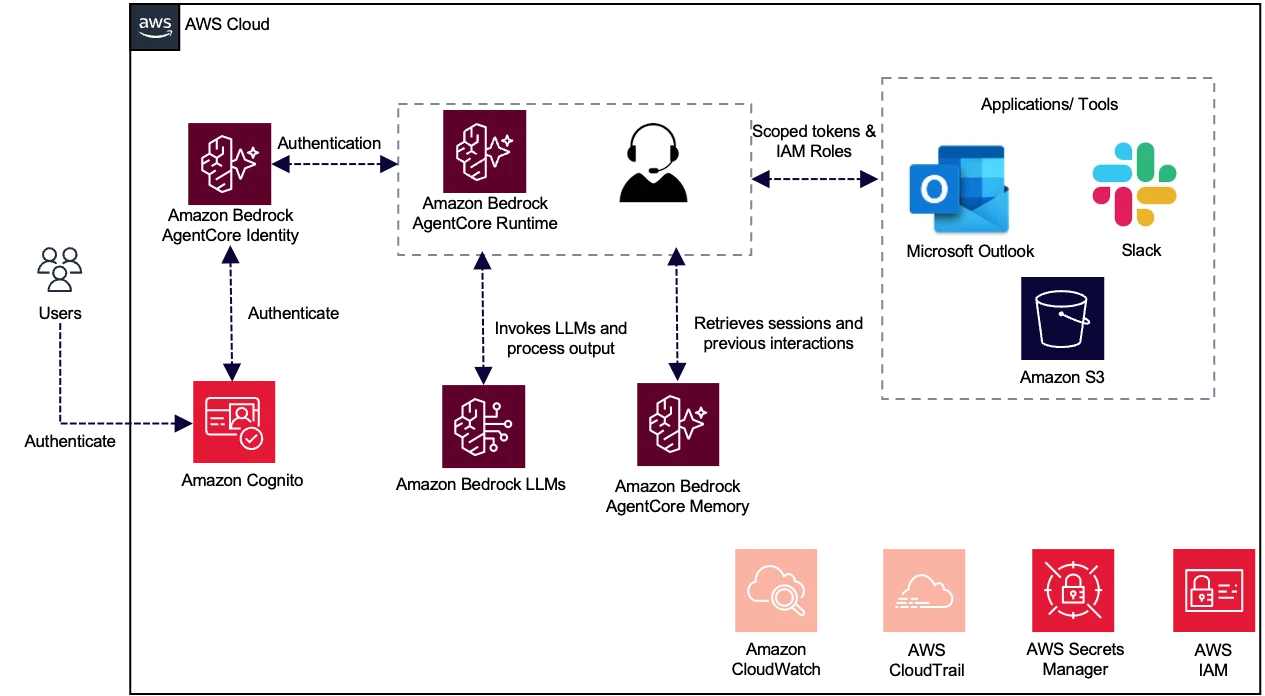
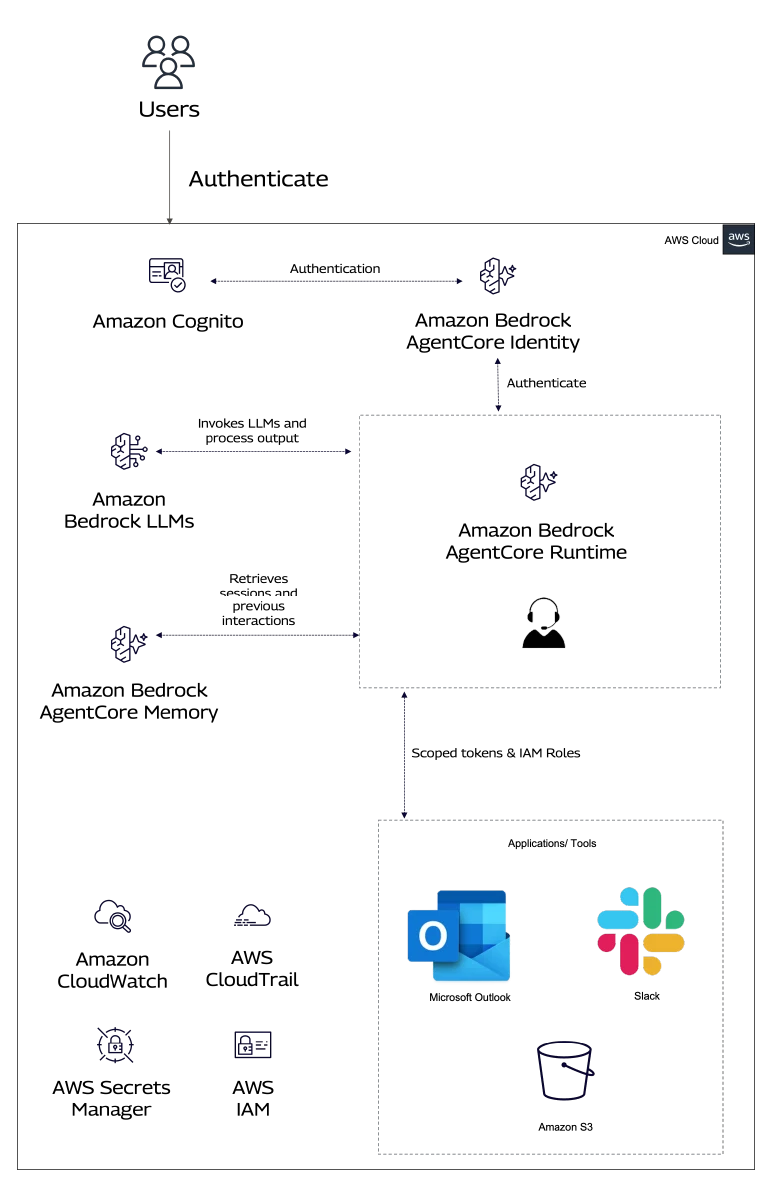
Figure 01: Reference Architecture
How AgentCore Identity Helps in this Scenario
AgentCore Identity delivers strong protection and control in this banking workflow. Here’s how.
- Customer Authentication: AgentCore Identity helps securely authenticate customers via the bank’s identity provider and delegates authorization to agents to act on their behalf.
- Scoped Tokens: With the solution, the agent receives scoped, time-bound access tokens, ensuring they can access only specific customers’ data and are bound to perform permitted actions.
- Secure Token Vaults: All backend interactions with core banking systems use short-lived tokens from AgentCore’s encrypted credential vault. This eliminates hardcoded credentials and uses customer-managed AWS KMS keys for encryption at rest and in transit.
- Policy Enforcement and Validation: AgentCore enforces policies to further secure agent interactions with tools and backend applications. By intercepting all agent traffic through its gateways, it evaluates each request against defined policies before allowing tool access. Customized policies can be created for checking user identity, permissions, or context, or to restrict sensitive data exposure through masking and scope limitations.
- Audit and Logging: Full visibility is achieved through AWS CloudTrail for API activity logging, AWS Config for compliance monitoring, and Amazon CloudWatch for real-time metrics and alerts.
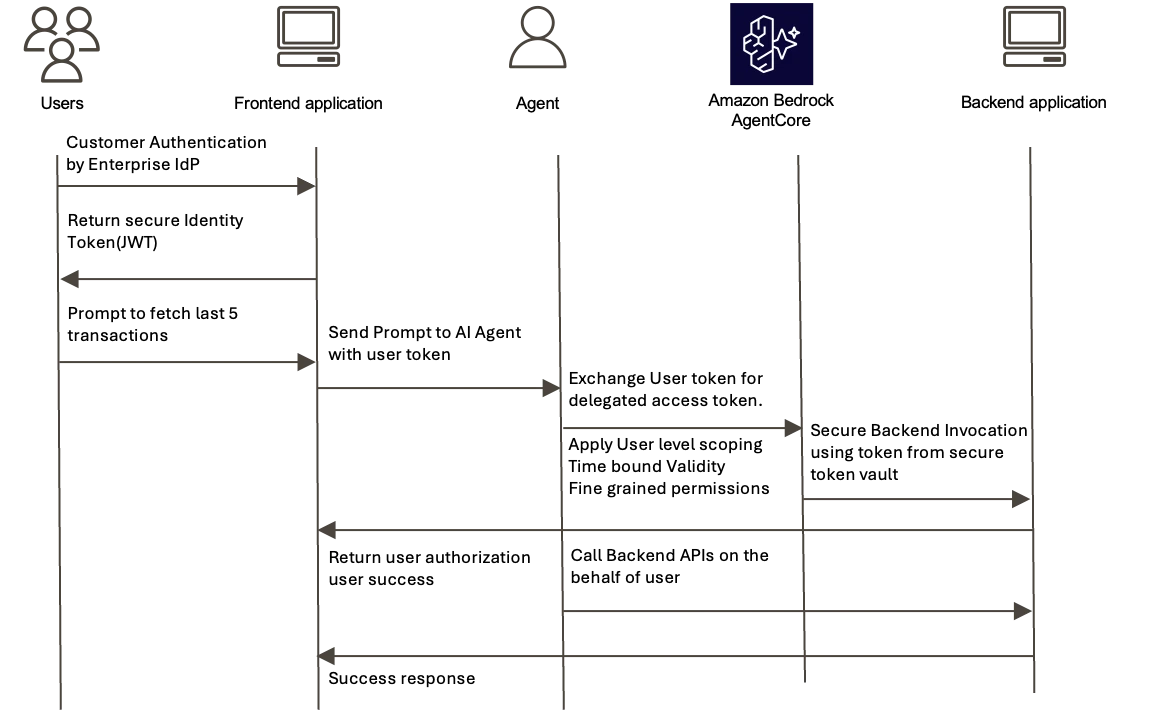

Figure 02: High-Level End-to-End Transaction Flow
Best Practices for Designing AI Agent Identity
To effectively design and implement identity for AI Agents, start with the following:
- Adopt Zero Trust Principles: Continuously verify each AI agent’s identity, regardless of location or network environment, to reduce risk and ensure secure access.
- Centralize Identity Management: Use enterprise-grade solutions to centrally manage AI agent identities and access permissions, minimizing operational overhead while strengthening security.
- Assign Unique Workload Identities: Provide each AI agent with a distinct identity to enable precise control over credentials and access to resources.
- Apply Least Privilege Principles: Grant agents only the permissions required for each task, and review permissions regularly to prevent privilege escalation.
- Implement Token-Based Authentication: Use scoped, short-lived tokens to authenticate agents and minimize credential exposure. Additionally, enable automatic token refresh and enforce token expiration policies.
- Protect Sensitive Operations: Conduct re-authentication or explicitly enforce human approval for actions involving sensitive data or system changes.
- Audit and Monitor Access: Regularly review agent and user access logs to detect unauthorized activity and ensure compliance with existing security policies.
The Bottom Line
Organizations deploying AI agents must non-negotiably prioritize identity and access management from day one. Without proper identity safeguarding, a compromised AI agent can pose significant risks, leading to unauthorized actions, credential theft, privilege escalation, and loss of accountability at scale.
By implementing strong, purpose-built identity controls, such as those provided by Amazon Bedrock AgentCore Identity, enterprises can confidently unlock the power of agentic AI while protecting what matters most.
TAGS:
Enterprise Applications
Cyber Security
Cloud and Infrastructure Services
Frequently Asked Questions
Our FAQ section is designed to guide you through the most common topics and concerns.
AI agent identity refers to the mechanisms that uniquely identify autonomous AI agents, define their permissions, and ensure secure, accountable interactions across systems.
Traditional models assume predictable user behavior, whereas AI agents act dynamically with delegated authority and evolving contexts.
Risks include impersonation, unauthorized access, credential theft, privilege escalation, and loss of accountability.
Zero Trust requires continuous verification of agent identity and permissions regardless of network location or environment.
Centralized management reduces operational complexity, improves governance, and strengthens security consistency at scale.
References
- National Institute of Standards and Technology. (2026, February). Accelerating the adoption of software and AI agent identity and authorization (Conc…
- National Institute of Standards and Technology. (2024). AI risk management framework (AI RMF 1.0).
- OWASP Foundation. (2025, February 17). Agentic AI – Threats and mitigations. OWASP GenAI Security Project.
- Amazon Web Services. (2024). Introducing Amazon Bedrock AgentCore Identity: Securing agentic AI at scale. AWS Machine Learning Blog.
- Amazon Web Services. (2024). Building intelligent event agents using Amazon Bedrock AgentCore and Amazon Bedrock knowledge bases. AWS Machine Learnin…