

Scale at Speed™







 English (Global)
 French (Canada)

- Cloud computing really does leave a mark on the environment, you know, with all those data centers running nonstop and the hardware that goes into them, plus the networks using up energy just to keep everything connected.
- I think the biggest part of the emissions in ICT comes from the hardware itself, like the embodied stuff from making and using all that equipment over its life. It is kind of surprising how much that adds up compared to just running the servers.
- There are ways to cut down on this, though. Picking the right regions for your cloud setup and optimizing things strategically can lower both the carbon output and the costs, sometimes by a lot. It feels like that could make a real difference without too much hassle.
- AI is getting involved here too, helping make cloud operations more aware of carbon use by predicting what is needed and automating the tweaks. That part seems promising, but I am not totally sure how widespread it is yet.
- Sustainable practices in the cloud are turning into something businesses have to pay attention to, like a metric for how well they are doing overall and staying ahead of competitors. Some companies might see it as just another trend, but others are already jumping on it.
The Hidden Carbon Cost of Cloud Adoption
For a long time, the cloud has been imagined as an endless, almost invisible space where our data and applications live, detached from the physical world. However, the cloud is powered by vast networks of servers, data centers, and energy systems that leave a very real footprint on our planet. As businesses continue to accelerate their cloud adoption, the environmental impact of this digital infrastructure is no longer a side note; it’s becoming a central topic in boardrooms and strategy discussions.
Every file we store, every app we launch, and every piece of data we move across the cloud comes with a hidden environmental cost. These emissions may be invisible to us, but they are increasing rapidly. Research from organizations such as the International Energy Agency (IEA) shows that data centers already account for around 1%[SS1] of global energy-related CO₂ emissions. And with the explosive growth of AI and other compute-heavy workloads, electricity demand from digital infrastructure is expected to rise sharply in the coming years. This isn’t just a technical challenge for IT teams; it’s a pressing business and climate issue that requires leadership attention at every level.
Decoding Cloud Carbon Footprint (CCF)
CCF is the amount of greenhouse gases released because of your cloud computing activities. To manage these emissions, you need to know where they come from. The emissions mainly come from three sources:
- Data Centers (≈25% ):
The bulk of operational energy use and emissions in the ICT value chain is driven by servers, storage, and cooling in data centers. Recent inventories and modelling (IEA; sector reviews) indicate that data-center operational emissions constitute a substantial share of the ICT footprint, though the exact share varies by country and whether embodied emissions are included. - Embodied Emissions (≈60% ):
Several recent multi-country analyses (including ITU /World Bank country case studies and life-cycle research) find that manufacturing, transportation, construction, and end-of-life emissions from devices and infrastructure frequently dominate the ICT footprint. In some country case studies, the device/embedded share reaches ~60–80% of the ICT footprint; when aggregated across countries, a conservative, evidence-backed estimate of embodied emissions falls in the ~45–70% range. - Cloud Network / Data Transmission (≈15%):
While energy consumption from telecom networks and data transmission is significant, it is not the primary driver of the sector's carbon footprint. The majority of the ICT impact actually stems from two areas: the manufacturing of user devices and the massive power requirements of data centers. The IEA and ITU analyses show that networks are material, typically accounting for a fifth of the ICT lifecycle footprint in most national case studies.
Understanding where emissions originate is the first step toward managing and reducing your cloud carbon footprint.
The estimates on how emissions are distributed, they come from mixing together some public research and other things. Like reports from the International Energy Agency, I know that's the IEA, and then there's the International Telecommunication Union, or ITU for short. World Bank studies play a part too, I think.
From Measurement to Management: Actionable Strategies for a Greener Cloud
Major cloud providers such as AWS and Azure already offer built-in dashboards to track sustainability metrics, but many organizations are also turning to open-source tools for greater flexibility and transparency.
Visibility into emissions matters—but real impact comes from targeted actions that reduce both carbon footprint and cost.
These tools make it easier to dig deeper into your CCF and understand where the biggest impact lies. Once you have clear visibility into the data, the real value comes from action. Here are four practical strategies that can help reduce emissions while also cutting operational costs:
- Optimize your Workloads: One of the easiest ways to cut costs and lower emissions is simply to eliminate waste. By spotting and shutting down idle resources, cleaning up unused or ‘zombie’ servers, and fine-tuning configurations, organizations can prevent unnecessary energy use and save money at the same time. Small steps in optimization often add up to significant impact when scaled across an entire cloud environment.
- Deployment in Greener Regions: Cloud regions aren’t all the same when it comes to sustainability. Some locations rely more heavily on renewable energy, resulting in much lower carbon intensity. By intentionally placing workloads in these ‘greener’ regions, organizations can cut emissions dramatically without touching a single line of code. In fact, our analysis shows that running workloads in a low-carbon region such as us-east-2 can result in negligible emissions compared to regions that depend more on fossil fuels.
- Modernize with Containers and Serverless: Shifting to modern architectures like containers and serverless computing can make cloud operations far more efficient. These approaches allow workloads to run at higher density and with smarter resource allocation, so you’re only consuming and paying for the exact compute power required. The result is leaner infrastructure, reduced waste, and a more sustainable way to scale applications.
- Clean Up your Storage: Data tends to pile up quickly, and unused files can quietly add to both costs and emissions. A simple but effective practice is regular housekeeping, deleting outdated snapshots, old logs, and unattached storage volumes. This not only saves money but also eases the energy load on data centers, making your cloud environment leaner and more sustainable.
From what the simulations in our internal sustainability dashboard suggest, using the recommended optimization strategies could lead to a reduction of up to about 20 percent in both CO2 equivalent emissions and cloud costs.
That sounds promising, but these are just projections. They come from controlled demo workloads, so it is not like they apply everywhere yet. I am not totally sure how that scales in real scenarios, but it seems worth looking into more. The dashboard makes it look straightforward, though maybe I am oversimplifying.
AI: The Double-Edged Sword of Cloud Sustainability
Artificial intelligence brings an interesting twist to the sustainability conversation. On one hand, training large AI models consumes significant amounts of energy. On the other hand, AI is also one of the most effective tools we have for improving cloud operations. By applying AI-driven strategies, organizations can get more value out of every watt of energy, essentially doing more with less. Here are a few smart ways AI can help drive greener outcomes:
- Carbon-aware Scheduling: Automatically run non-urgent computing jobs at times or in locations where renewable energy is most abundant.
- Predictive Autoscaling: Use machine learning to forecast demand more accurately, reducing idle capacity and preventing over-provisioning.
- Smart Workload Placement: Intelligently recommend or automate the deployment of new workloads to regions with the lowest carbon intensity.
Integrating AI into cloud management allows organizations to shift from reactive fixes to a proactive, intelligent sustainability strategy. At Tech Mahindra, we’re actively exploring how AI-driven solutions can help clients design cloud environments that are not only smarter and more efficient but also greener. By harnessing AI in this way, businesses can align technology innovation with their sustainability goals.
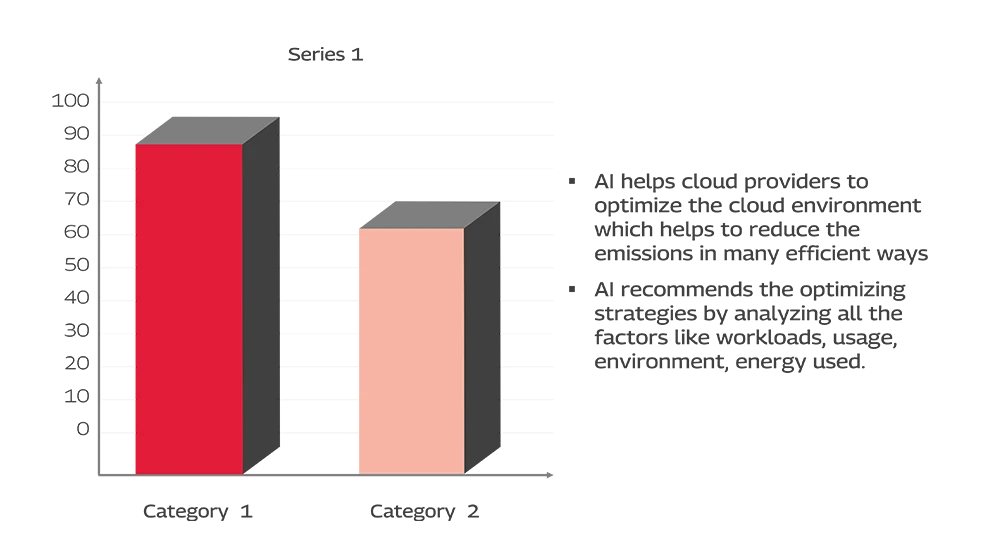

Figure: Emission comparison between traditional workloads vs AI-optimized workloads
Aligning with Net-Zero Goals
To align with global climate goals like the Paris Agreement , businesses can follow a few guiding principles:
- Measure everything, especially Scope 3 emissions
- Set science-based targets, not just estimates
- Prefer renewable-powered regions
- Automate sustainability into DevOps pipelines
- Offset only when necessary
These steps can help companies build a framework for sustainable cloud usage, not just for compliance, but for conscience.
Sustainability as the New Performance Metric
Focusing on cloud sustainability changes the way we think about IT performance. It’s no longer just about uptime or processing speed; it’s about the broader impact. Efforts to lower the carbon footprint naturally drive efficiency, cut waste, and unlock meaningful cost savings. What begins as a responsibility to the planet can quickly become a powerful source of competitive advantage for business.
Sustainable cloud strategies must align with broader enterprise climate commitments and measurable net-zero targets.
These principles align with global frameworks such as the Science Based Targets initiative (SBTi) and guidance from the United Nations Framework Convention on Climate Change (UNFCCC).
Every organization that relies on the cloud contributes to its environmental footprint, but that also means each one has the power to be a part of the solution. Simple actions, like choosing a cleaner region, removing unused files, or fine-tuning workloads, can add up to a meaningful impact. In today’s digital era, sustainability isn’t a limitation on innovation; it’s becoming the new standard for measuring performance.
Ready to transform your cloud carbon footprint into a business advantage? Our cloud experts can help you design strategies that are both sustainable and efficient, ensuring your technological investments deliver impact for the planet and performance for your organization. Connect with us to explore how a greener cloud can power smarter growth.
TAGS:
Sustainability
Artificial Intelligence
Frequently Asked Questions
Our FAQ section is designed to guide you through the most common topics and concerns.
Cloud emissions primarily stem from data center energy usage, embodied emissions from hardware manufacturing, and network-related data transmission. Data centers require significant power for servers and cooling systems, while hardware manufacturing adds substantial lifecycle emissions. Networks also contribute to overall energy consumption. Understanding these emission sources helps organizations prioritize areas for the greatest reduction impact.
Organizations can use built in cloud provider dashboards and open source tools that track energy consumption, workload efficiency, and region-specific carbon intensity. These tools offer visibility across compute, storage, and networking, helping teams identify high emission workloads. Measuring these metrics regularly allows businesses to benchmark progress and understand the environmental impact of their cloud operations.
Greener regions operate on grids with higher renewable energy penetration, resulting in significantly lower carbon intensity for the same workloads. By choosing such regions for compute- or data-heavy operations, organizations can lower emissions without modifying code or infrastructure architecture. Region selection becomes a strategic sustainability lever with measurable impact.
AI enhances sustainability by enabling carbon aware scheduling, predictive autoscaling, and optimized workload placement based on energy availability. These techniques reduce idle capacity, align computing with renewable energy windows, and minimize unnecessary resource consumption. AI driven automation helps organizations operate more efficiently and lower emissions over time.
Effective strategies include eliminating idle resources, optimizing workloads, adopting containers or serverless models, and performing regular storage cleanup. These steps reduce over provisioning, improve infrastructure efficiency, and remove unnecessary data usage. When consistently applied, such actions reduce both operational spend and the environmental impact of cloud environments.
References
- International Energy Agency. (2023). Data centres and data transmission networks.
- International Telecommunication Union. (2022). Environmental impact of ICT.
- World Bank. (2022). ICT sector environmental sustainability reports.
- Amazon Web Services. (2023). Customer Carbon Footprint Tool.
- Microsoft. (2023). Sustainability Calculator.
- Science Based Targets initiative (SBTi). (2023).
- United Nations Framework Convention on Climate Change (UNFCCC). (2015). Paris Agreement.
