

Scale at Speed™







 English (Global)
 French (Canada)

- For telecom enterprises, the evolution towards autonomous network operations (ANO) is an imperative. This journey involves gradual progression along the maturity curve to reach the highest level of operational autonomy.
- Moving from traditional network management through intelligent network management and closed-loop operations to agentic AI-based autonomous operations requires progressive advancement through distinct maturity levels.
- While key stakeholders aspire to achieve this, they often lack clarity on their current ANO maturity level.
- Taking a methodical approach to baseline ANO maturity also helps define and derive business and operational value from ANO. For example, business value could be related to customer lost hours (CLH) and customer-impacting incidents, while operational value could be related to metrics such as mean time to resolve (MTTR) and the number of field dispatches (truck rolls).
- Tech Mahindra’s Assess, Gap Analysis, Improvement, and Plan (AGiP) framework helps telecom enterprises establish their ANO maturity baseline, identify capability gaps, and develop improvement plans to support strategic transformation.
The Current Reality
Telecom networks are becoming increasingly distributed and dynamic, while their management remains largely reactive. As network environments expand across technologies and architectures, the volume and speed of operational decisions exceed what traditional, human-led network management can efficiently handle. This management gap is strengthening the case for greater autonomy.
Three shifts are accelerating this transition:
- AI-led Network Growth: Demands fast, adaptive network operations rather than reactive, manual operations
- Network Complexity: Increases the difficulty of coordinated monitoring and management across multiple network generations, cloud-native architectures, and containerized networks
- Self-X and Zero-X Capability: Requires extended automation support to enable self-managing and zero-touch network operations
Traditional network management was built for predictable, human-driven traffic. AI-led growth has made that model unsustainable.
To tackle these challenges, network providers are slowly shifting towards modern intelligent network management powered by predictive analytics. With an intelligence-driven approach, the industry aims to achieve full autonomous network operations (ANO).
At the highest maturity level, it aspires to:
- Realize the vision of a Virtual Network Operations Center (NOC) or Dark NOC
- Shift from human-led, machine-assisted operations to human-assisted, machine-led operations
To support the industry in this progression, the TeleManagement Forum (TM Forum) has created a program focused on autonomous networks. The program draws active participants from network providers, system integrators, and managed service providers and presents a defined path towards greater autonomy.
The First Step: Establishing the Maturity Baseline
Often, telecom stakeholders struggle to understand the maturity level of their network operations. For many, operational efficiency and its associated KPIs are established as baselines. However, these metrics do not indicate where their network operations stand on the ANO maturity scale.
The saying, ‘What gets measured gets improved,’ underscores the first step in autonomous network evolution. This step helps establish a maturity baseline specific to autonomous operations.
While communication service providers recognize the importance of this first step, Tech Mahindra’s observations indicate that they are often limited in their ability to define a baseline or are constrained by a lack of in-house skills. To address this, the industry consortium under the TM Forum autonomous networks program has defined a methodology, ANLET, that enables network providers to assess their ANO maturity and establish a baseline.
Tech Mahindra’s Strategic Framework for Defining the Maturity Index
By blending ANLET with Tech Mahindra’s global industry experience, we present AGiP, a framework that helps in defining the ANO maturity baseline. AGiP draws on key TM Forum guidelines and best practices to provide a structured approach to maturity assessment.1,2,3&4
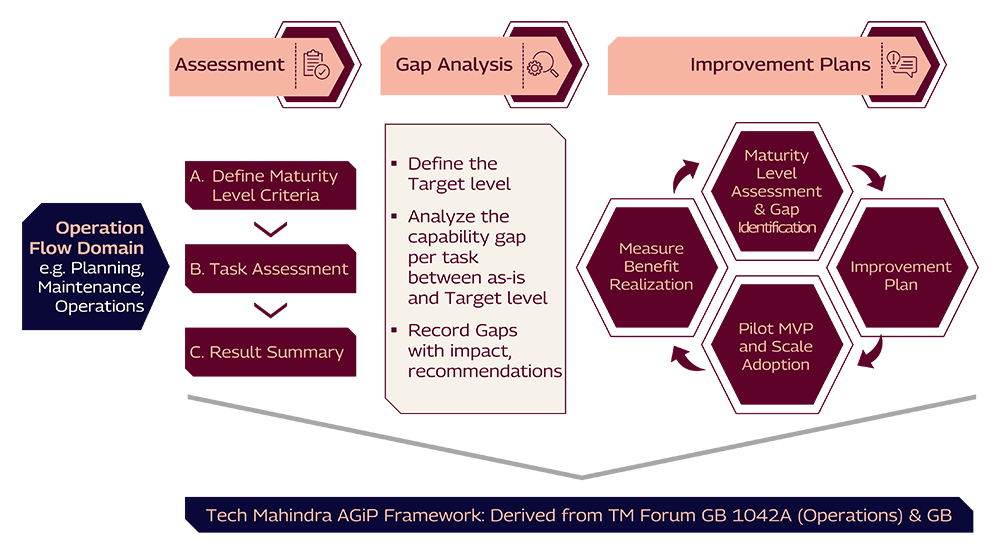
Figure 1:Tech Mahindra’s AGiP Framework
The critical first step in ANO evolution is establishing the maturity baseline, and Tech Mahindra’s AGiP framework offers a proven approach.
The framework follows a three-phase approach.
1. Assessment Phase
Network providers need to define the assessment scope by selecting the operational flow domain, such as planning, engineering, optimization, maintenance, and operations. Once the scope is finalized, the assessment encompasses:
- Contextualizing the predefined criteria for each maturity level from Level 1 to Level 5
- Assessing the tasks within the selected operational flow domain with inputs from SMEs and technical experts
- Evaluating each task against its implementation across processes and systems and assigning the maturity level that best matches its current state
- Consolidating the task-level maturity results to generate the overall assessment summary
2. Post-assessment Phase
This is the gap analysis stage, where the target ANO maturity level is defined based on the organization’s priorities, such as key result areas, balanced scorecards, and operational improvement metrics. The analysis involves:
- Identifying gaps for each task by comparing its current capabilities against the defined criteria for the target maturity level
- Calculating the maturity index score for each task and aggregating the scores at the cognitive activity level
- Recording identified gaps and their impact and providing high-level recommendations across:
- Processes such as maintaining a record of activities following change management or establishing a process for change overrun beyond the approved maintenance window
- OSS and AI Ops Use Cases, including predictive analytics, GenAI-based field dispatch advisors, or Agentic AI for ticket escalation
- Operating Model and Staff Realignment, for instance, shifting L1 activities to NOC
3. Improvement Phase
The last stage focuses on developing improvement plans based on the identified gaps and recommended actions.
Finally, the outcomes from these three phases are used to build a comprehensive ANO transformation roadmap. Developed collaboratively with key stakeholders and SMEs, the roadmap outlines measurable business and operational benefits, required AI/ML interventions, and their alignment with the organization’s data strategy.
The Final Word
ANO is becoming a strategic next step for telecom networks as they evolve toward more intelligent, adaptive operations. However, its implementation demands a deliberate, phased approach. Establishing the ANO maturity baseline provides the required foundation for success. It enables service providers to identify where automation and AI can deliver meaningful value, align interventions with their data and operating models, and prioritize improvements against measurable outcomes.
Tech Mahindra's AGiP framework turns that starting point into a structured roadmap, one that ties automation investment to measurable outcomes instead of guesswork. What gets measured gets improved. For telecom networks moving toward autonomy, that measurement starts with the baseline.
TAGS:
Network Operations
Artificial Intelligence
Intelligent Automation
Communications
Frequently Asked Questions
Our FAQ section is designed to guide you through the most common topics and concerns.
Autonomous Network Operations (ANO) is an operating model that uses automation, analytics, artificial intelligence, and closed-loop processes to manage network activities with reduced human intervention. ANO maturity progresses through multiple levels, moving from traditional manual operations to intelligent, self-managing, and ultimately autonomous operations that can predict, decide, and act with minimal human involvement.
Establishing an ANO maturity baseline helps organizations understand their current level of network autonomy. It provides a structured way to measure capabilities, identify operational gaps, prioritize improvements, and define realistic transformation goals. A maturity baseline also enables organizations to track progress and align automation investments with business objectives and operational outcomes.
Telecom operators are facing growing network complexity, increasing traffic demands, cloud-native architectures, and the need for real-time operational responses. Traditional management approaches often rely on reactive processes and manual interventions, making it difficult to scale efficiently. ANO helps address these challenges through greater automation, predictive insights, and improved operational agility.
ANLET, or the Autonomous Network Level Evaluation Tool, is a methodology developed by TM Forum to help communications service providers assess their autonomous network maturity. It provides evaluation criteria, maturity levels, and assessment guidance that organizations can use to establish a baseline, measure capabilities consistently, and identify areas for improvement.
A maturity assessment helps organizations evaluate current capabilities across processes, systems, and operational activities. The assessment identifies capability gaps, highlights areas where automation and AI can add value, and supports the development of targeted improvement plans. These insights can then be used to create a transformation roadmap with measurable objectives and prioritized initiatives.
References
- TM Forum. (2024). Autonomous network level evaluation tool (ANLET) (GB1059, Version 1.0.0).
- TM Forum. (2023). Autonomous network levels evaluation methodology (IG1252, Version 1.2.0).
- TM Forum. (2021). Autonomous network levels evaluation methodology (IG1252, Version 1.1.0).
- TM Forum. (2022). Best practice of level evaluation for autonomous networks service experience (IG1218D, Version 1.0.0).