

Scale at Speed™






 English (Global)
 French (Canada)

- Nemotron 3.5 Lightning is promising for India-scale educational AI. It balances quality, cost, and deployment needs for multilingual learning.
- Its hybrid architecture improves efficiency. MoE, Transformer attention, and Mamba help deliver strong reasoning with lower compute.
- The model performs well on STEM tasks. It showed strong understanding across Physics, Chemistry, Mathematics, and Biology.
- Fine-tuning boosts educational performance. It improved formulas, calculations, and step-by-step problem solving.
- Indic language quality is uneven. Hindi and Devanagari-script languages performed better than low-resource languages.
- Future gains depend on better language alignment. Better data, tokenizer coverage, and language-specific tuning matter more than model size.
Evaluating NVIDIA Nemotron 3.5 Lightning Through Project Indus As governments and enterprises pursue AI strategies for regional needs, the challenge is no longer simply accessing foundation models. The challenge is identifying architectures that can balance quality, inference efficiency, multilingual capability, and deployment economics on a scale.
As part of Tech Mahindra‘s Project Indus initiative, we evaluated NVIDIA Nemotron 3.5 Lightning for educational AI workloads aligned to the NCERT curriculum across multiple Indic languages. The objective was to assess whether modern hybrid architecture combining Mixture-of-Experts (MoE), transformer attention, and Mamba State Space Models could provide a practical foundation for multilingual educational AI serving millions of learners.
Three Key Findings
Our evaluation demonstrated three important findings:
- The model demonstrated strong curriculum-oriented reasoning across Physics, Chemistry, Mathematics, and Biology tasks, indicating that the underlying educational reasoning capability transfers effectively to NCERT-aligned scenarios.
- The Mixture-of-Experts architecture delivered an attractive quality-to-compute profile, particularly for educational workloads where large numbers of concurrent interactions must be supported economically.
- Performance varied across Indic languages. Higher-resource languages, particularly Hindi and other Devanagari-script languages, showed stronger alignment, while low-resource and script-diverse languages highlighted opportunities for further language-specific adaptation and data enrichment.
These observations suggest that efficient open-weight architectures can play a meaningful role in AI programs for India where model quality, deployment economics, and regional language adaptation must be balanced simultaneously.
Tech Mahindra also found that fine-tuning improved the model’s ability to handle educational STEM questions, particularly mathematical formulas, calculations, and step-by-step problem solving. For lower-performing languages, factual accuracy also improved in Dogri and Kashmiri compared with the baseline. Overall, fine-tuning improved multilingual STEM comprehension, mathematical reasoning, and domain-specific educational knowledge while maintaining much lower inference latency, indicating the strength of the hybrid architecture.
Why We Evaluated Nemotron 3.5 Lightning
Project Indus was established to build AI capabilities tailored for India’s linguistic and educational ecosystem.
While global foundation models continue to advance rapidly, many have limited optimization for the linguistic diversity, curriculum requirements, and deployment economics required for India-scale education programs.
At the India AI Impact Summit 2026, Tech Mahindra announced its ambition to expand Project Indus into a multilingual educational AI initiative powered by advanced model adaptation techniques and NVIDIA AI Enterprise software.
As part of this effort, NVIDIA provided early access to Nemotron 3.5 Lightning, enabling Tech Mahindra to evaluate the model as a potential foundation for curriculum-aligned educational assistants.
The key question was straightforward: Can an efficient open-weight model deliver frontier-level educational reasoning while remaining economically viable to deploy locally at scale?
Understanding the Nemotron 3.5 Lightning Architecture
The most distinctive aspect of Nemotron 3.5 Lightning is not its parameter count, but its architecture. Rather than relying on traditional dense Transformer design, the model combines three complementary mechanisms:
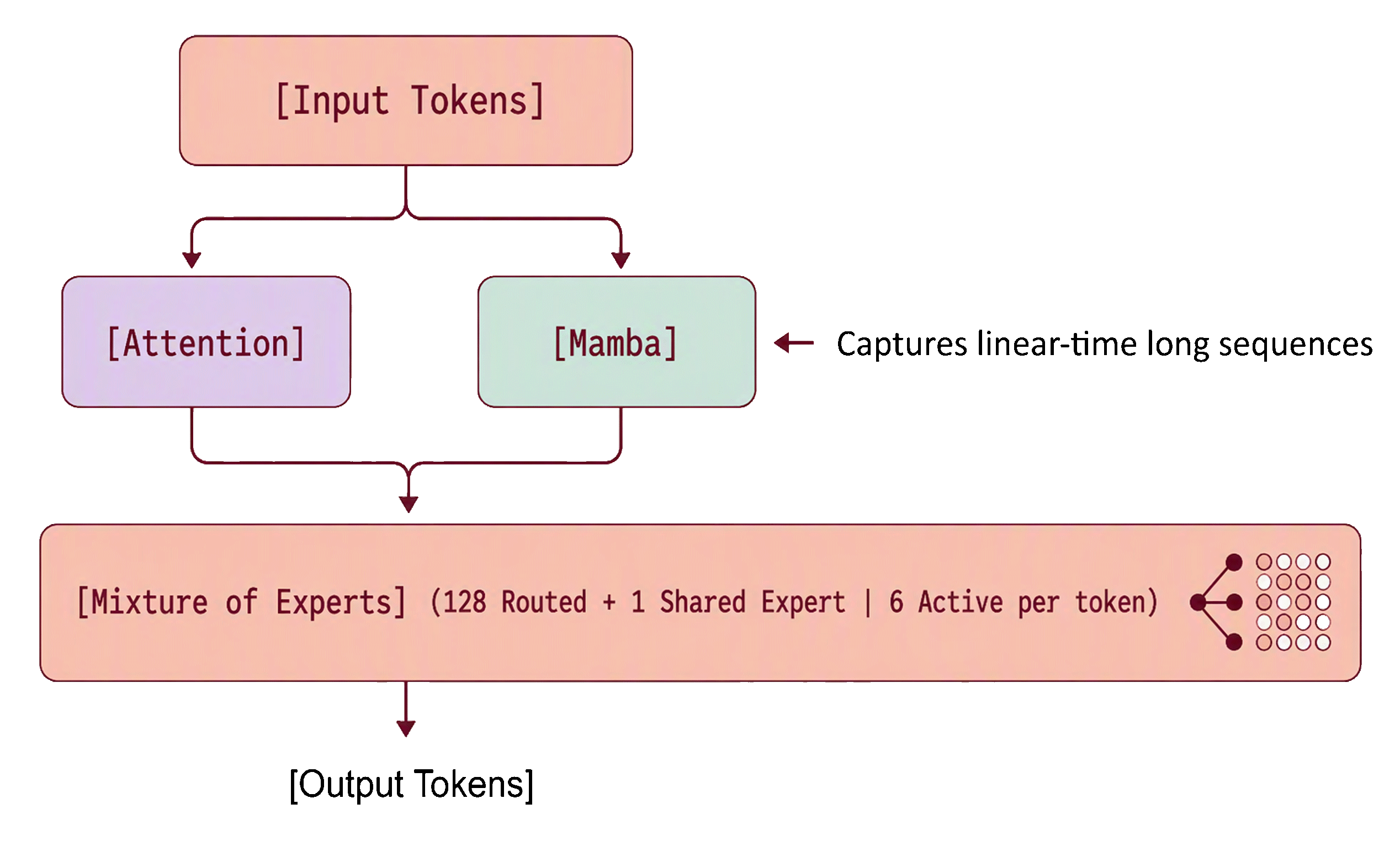
This hybrid approach seeks to balance reasoning quality, long-context processing, and inference efficiency.
Mamba + Transformer Hybrid Design
Traditional Transformer architectures scale quadratically as context length increases. Nemotron introduces Mamba State Space Model layers alongside Transformer attention layers.
In practical terms, attention layers preserve long-range reasoning and context retrieval, while Mamba layers improve sequence processing efficiency. For workloads involving extended educational interactions, this combination offers an architectural alternative to scaling purely through larger dense transformer models.
For educational applications, this becomes particularly relevant because tutoring interactions often involve long multi-turn conversations requiring sustained contextual understanding.
Mixture-of-Experts Efficiency
A second differentiator is the Mixture-of-Experts design.
The version evaluated by Tech Mahindra was the Nemotron 3.5 Lightning 30B-A3B model shared through NVIDIA‘s early access program. NVIDIA indicated that while the model contains approximately 30 billion total parameters, only around 3 billion parameters are active during token generation. This was intended to deliver frontier-level quality while maintaining inference costs closer to a smaller model class.
For educational AI deployments, active parameter count is often more relevant than total parameter count. Large tutoring systems are constrained not only by model capability but also by latency, concurrency, infrastructure utilization, and operating cost. The A3B architecture is therefore an interesting design point because it seeks to retain the representational capacity of a larger model while activating only a small fraction of parameters during inference.
Architectural Observation
A recurring pattern throughout the evaluation was that educational reasoning performance remained relatively stable, while output quality varied primarily due to language alignment, script fidelity, and language-resource availability. This suggests that future improvements in Indic educational AI may be driven more by targeted language adaptation strategies than by increases in model size alone.
Experimental Setup
The evaluation focused on educational use cases aligned with the NCERT curriculum.
The benchmark suite covered Physics, Chemistry, Mathematics, and Biology across multiple grade levels and language configurations. The evaluation framework measured domain correctness, curriculum alignment, script fidelity, language purity, educational structure, and role adherence as an NCERT educator persona.
Phase 1: Pilot Validation on NVIDIA DGX Spark
Prior to scaling training, a pilot verification run was executed on NVIDIA DGX Spark.
The objective was to validate hardware compatibility, gradient stability, fine-tuning workflow, and educational inference quality.
The pilot used 1,000 training samples, 3 epochs, with a 39-minute runtime and 98.92% token accuracy.
The pilot successfully demonstrated stable operation, structured educational responses, and high script fidelity without memory failures.
Phase 2: Full Training on NVIDIA Hopper Infrastructure
Following pilot validation, the full educational dataset was used for supervised fine-tuning.
Configuration included NVIDIA H200 GPU, 112,000 educational records, 57.88 million processed tokens, 892 training steps, and 12 hours 52 minutes total runtime.
The final evaluation achieved 87.61% token accuracy and validation perplexity of approximately 1.63.
These results indicate that domain adaptation can be achieved at scale while preserving overall model stability and educational reasoning capability.
Key Findings
The most interesting observation was that reasoning quality and language fidelity emerged as two separate dimensions.
Strong Educational Reasoning
Across Physics, Chemistry, Mathematics, and Biology evaluations, the model consistently demonstrated strong conceptual understanding. Examples included Newtonian mechanics, chemical equations, algebraic reasoning, geometry, and biological systems.
This suggests that the underlying reasoning capability of Nemotron transfers effectively into educational environments.
Language Fidelity as the Primary Challenge
One of the more interesting outcomes of the evaluation was the separation between domain reasoning capability and language fidelity.
Across most test cases, the model displayed a consistent understanding of educational concepts and instructional workflows even when the target language output was not fully aligned. This suggests that the underlying reasoning and knowledge representation transferred effectively across tasks, while language-specific adaptation became the dominant factor influencing user-facing quality.
Performance was strongest in English and Hindi, with several Devanagari-based languages also demonstrating encouraging results. Sanskrit, Nepali, and Maithili, for example, benefited from shared script characteristics and exhibited varying degrees of transfer from the model’s existing language representations.
For lower-resource languages and script-diverse language families, the primary limitations were not factual accuracy, but output consistency. Observed behaviors included neighboring-language substitution, code-mixing, and script contamination. These findings indicate that future improvements are more likely to come from targeted language alignment, tokenizer optimization, and training data refinement than from changes to the model’s core reasoning architecture.
Lessons Learned
Three practical lessons emerged from this exercise:
- Architectural efficiency and language coverage should be evaluated independently.
- Active parameter count can be a more useful deployment metric than total parameter count for large-scale educational workloads.
- For Indic educational AI, improvements in data quality, tokenizer coverage, and language-specific alignment may deliver greater gains than increasing model scale alone.
What This Means for AI for India
The evaluation offers an encouraging direction for AI initiatives in India.
First, it validates that efficient open architectures can serve as practical foundations for domain-specific AI systems.
Second, it demonstrates that educational reasoning quality can be preserved while operating within a significantly smaller active-parameter footprint.
Third, it highlights the importance of continued investment in Indic-language alignment, particularly for low-resource languages and script-sensitive deployments.
For Tech Mahindra, this ties back well into our strategy behind Project Indus: combine open model innovation, domain-specific adaptation, synthetic data generation, and rigorous evaluation to build AI systems that are locally relevant while remaining operationally viable.
Conclusion
From an architectural perspective, Nemotron 3.5 Lightning represents a practical application of three emerging trends in foundation model design: sparse activation through Mixture-of-Experts routing, long-context efficiency through Mamba State Space Models, and the continued strengths of Transformer-based attention mechanisms.
Our evaluation indicates that this architecture provides a strong foundation for educational AI workloads, particularly where reasoning quality, deployment economics and scalability must be balanced simultaneously. While additional alignment work remains necessary to improve consistency across the breadth of Indic languages, the results demonstrate that much of the remaining challenge lies in language adaptation rather than core model capability.
Beyond the model evaluation itself, the exercise provided a useful reference point for how open foundation models can be adapted to regional educational contexts. The findings also reinforce a broader industry lesson: advances in architecture and infrastructure must be matched by equivalent investments in language resources, evaluation frameworks, and domain-specific alignment if AI initiatives are to achieve production readiness.
TAGS:
Artificial Intelligence
Education
Frequently Asked Questions
Our FAQ section is designed to guide you through the most common topics and concerns.
A hybrid AI architecture combines multiple model technologies, such as Transformer attention, Mixture-of-Experts (MoE), and Mamba State Space Models, to balance reasoning quality, scalability, and computational efficiency. This approach enables organizations to deliver high-performance AI solutions while optimizing infrastructure costs and deployment requirements.
Multilingual educational AI must support diverse languages, large user volumes, and continuous learning interactions. Hybrid architecture helps meet these requirements by improving inference efficiency, maintaining educational reasoning quality, and enabling cost-effective deployment at scale.
Mixture-of-Experts architecture activates only a subset of model parameters for each query rather than the entire model. This reduces computational overhead, lowers operational costs, and supports higher concurrency while preserving model performance.
The primary challenges include language alignment, script fidelity, tokenizer coverage, and the availability of high-quality training data for low-resource languages. Addressing these areas is critical to delivering consistent and accurate educational experiences across India's linguistic diversity.
The evaluation demonstrates that efficient open AI architectures can provide a practical foundation for multilingual educational systems. It also highlights that future improvements will depend not only on model innovation but also on investments in language adaptation, curriculum alignment, and regional AI ecosystems.