







- Enterprises are focusing on powerful AI models, instead of reshaping end-to-end enterprise workflows.
- Think of enterprise workflows as the true unit of value in AI transformations.
- Redesigning workflows begins with mapping the current processes, identifying the user pain points, and applying agents across the entire system.
- Constant monitoring and evaluation are prerequisites, as they enable teams to identify recurring tasks and detect issues early.
- Define measurable business value for the Agentic AI workflow through a use case discovery exercise.
- TechM Orion is a platform that enables orchestration layers for AI to act across systems.
Moving Beyond the AI Pilot Purgatory
A major disconnect lies in the enterprise AI landscape today. Enterprises are focusing on powerful AI models, instead of reshaping end-to-end enterprise workflows. The value does not scale.
McKinsey’s 2025 State of AI survey1 findings attest to it. While 88% of companies apply AI in at least one function and 62% are experimenting with AI agents, only one-third have scaled beyond pilots, and 39% reported measurable EBIT impact.
AI becomes truly transformative only when treated as a core business capability, not a standalone initiative. Until AI is embedded into the enterprise’s way of working, it will remain in pilot mode. At Tech Mahindra, we are unlocking limitless possibilities from pilots to production-scale Agentic AI deployments through our industry and domain expertise.
Leveraging my experience, I have explained a practical framework for scaling Agentic AI workflow orchestration from pilots to production.
The Context: It’s not the Agent; It’s the Agentic AI Enterprise Workflow
Think of enterprise workflows as the true unit of value in AI transformations. They define how work is executed across the organization effectively and efficiently. In an agentic AI strategy, redesigning workflows begins with mapping the current processes, identifying the user pain points, and applying agents across the entire system, and not just within isolated tasks.
This redesign process must be validated at every step. Constant monitoring and evaluation are prerequisites, as they enable teams to identify recurring tasks, detect issues early, refine agent logic, and improve performance after deployment.
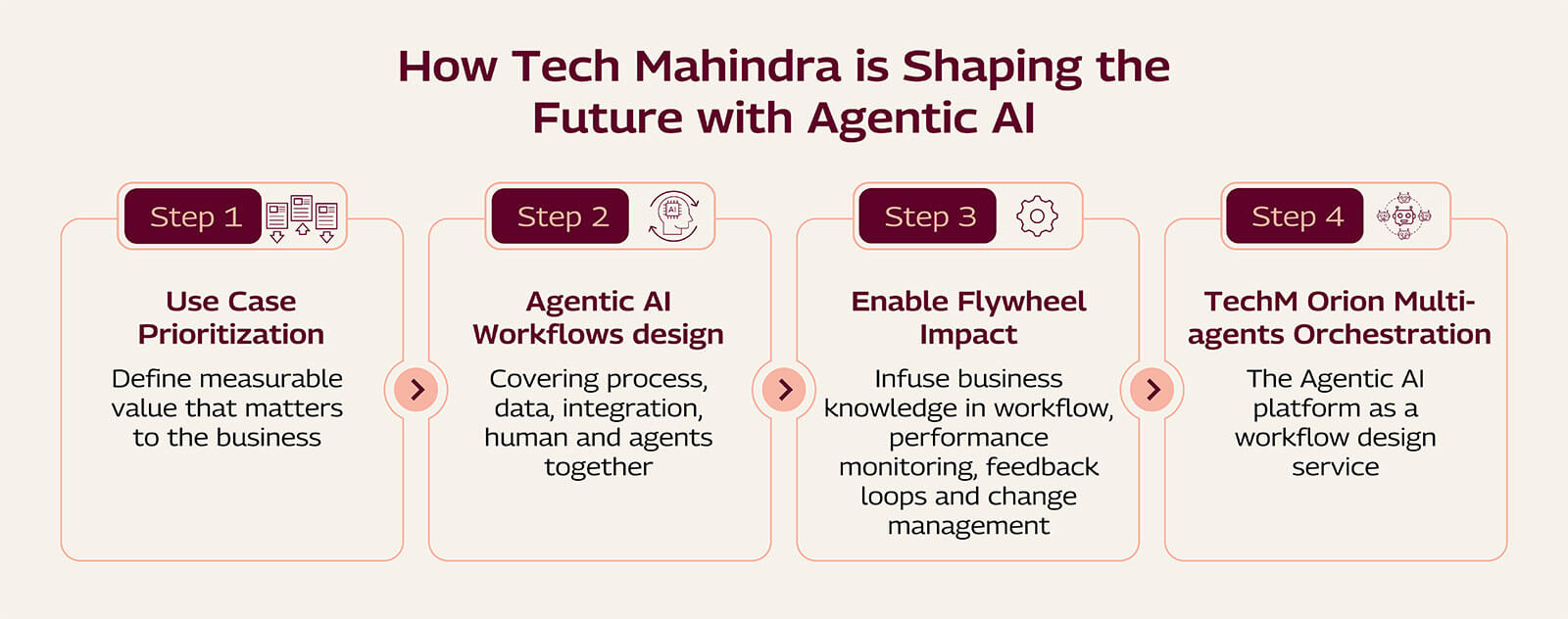
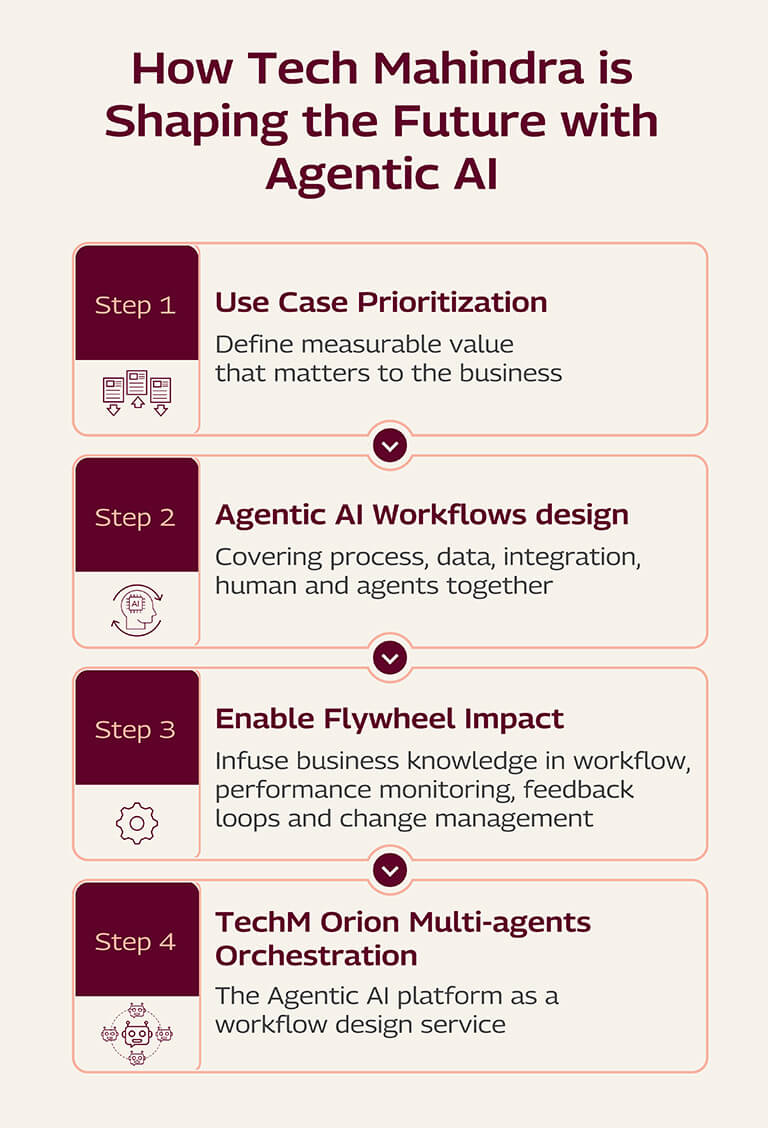
In the coming years, we will see enterprises shift from static workflows to dynamic, self-adjusting processes. Businesses can address this shift through a clear four-step process:
Step 1: Use Case Discovery and Prioritization
Define measurable business value for the Agentic AI workflow through a use case discovery exercise. Several core principles must guide the process:
- Build a Transformation Squad: Involve business and IT leaders from sales, operations, supply chain, and finance early
- Make it a Business-led Conversation: Focus on high-impact use cases that justify a 10× improvement
- Design Pilots with Scale in Mind: Build a production-ready solution that can handle enterprise volumes from day one
- Measure Business Outcomes: Track revenue uplift, cost reduction, cycle-time improvement, and risk reduction, not just model accuracy or adoption metrics.
- Design for Accountability: Define how AI is applied to decision rights, performance metrics, and accountability structures
AI pilots are giving way to an AI-driven operating model where teams no longer experiment in isolation. They are redesigning how decisions flow and work gets executed.
Step 2: Apply Agentic AI Workflow Design
Enterprise workflow maturity begins with documentation. Workflow cannot be reinvented without domain knowledge, business-process context, and relevant datasets. Orchestrating AI agents succeeds when workflows are documented, standardized, and governed. Agents need clear responsibilities and continuous feedback to improve effectiveness over time.
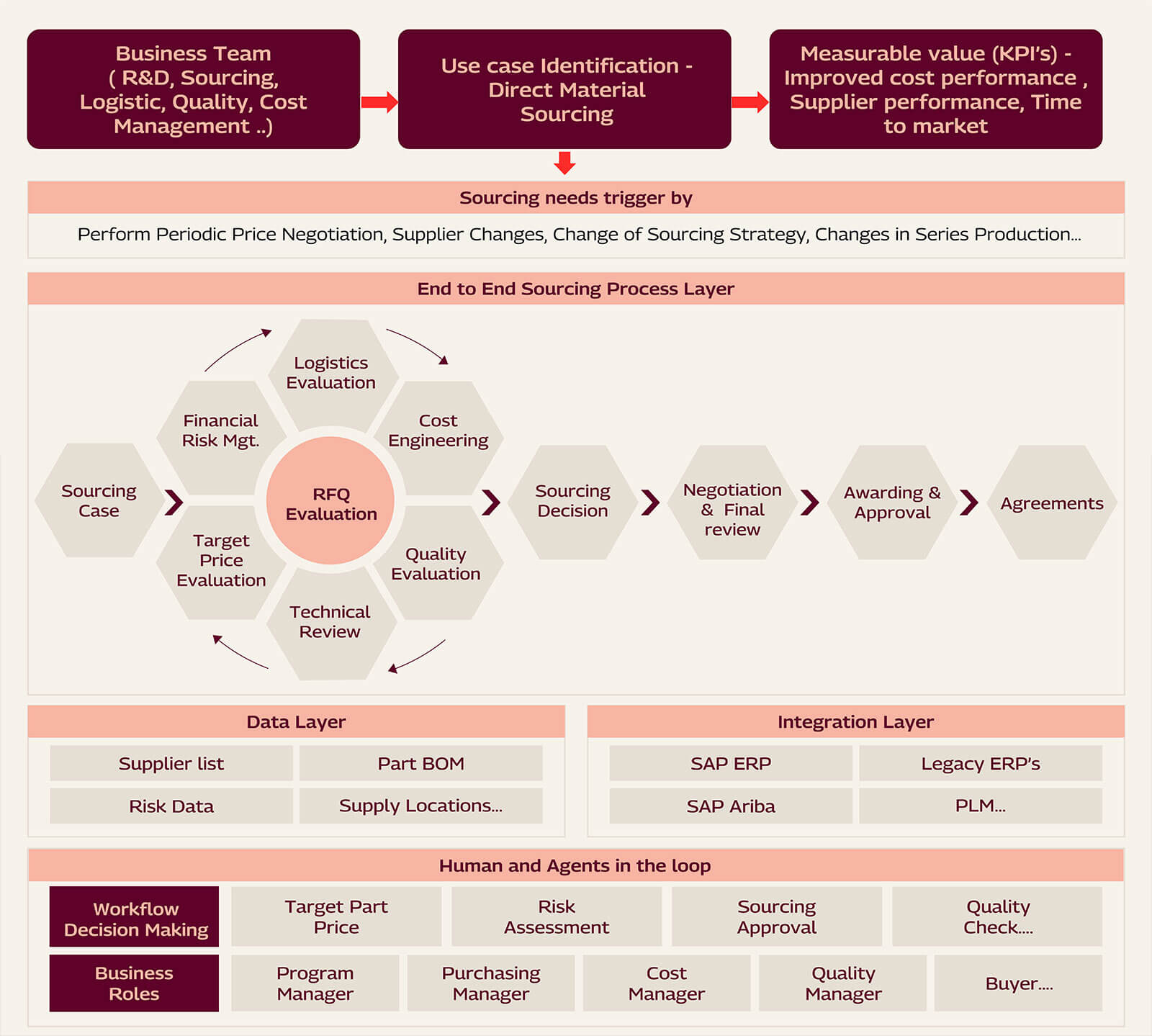
Guardrails, such as rules requiring human approval at critical points, make agentic workflows more predictable and reliable. To move these principles from theory to practice, let's examine a real-world application: Direct material sourcing in the automotive sector.
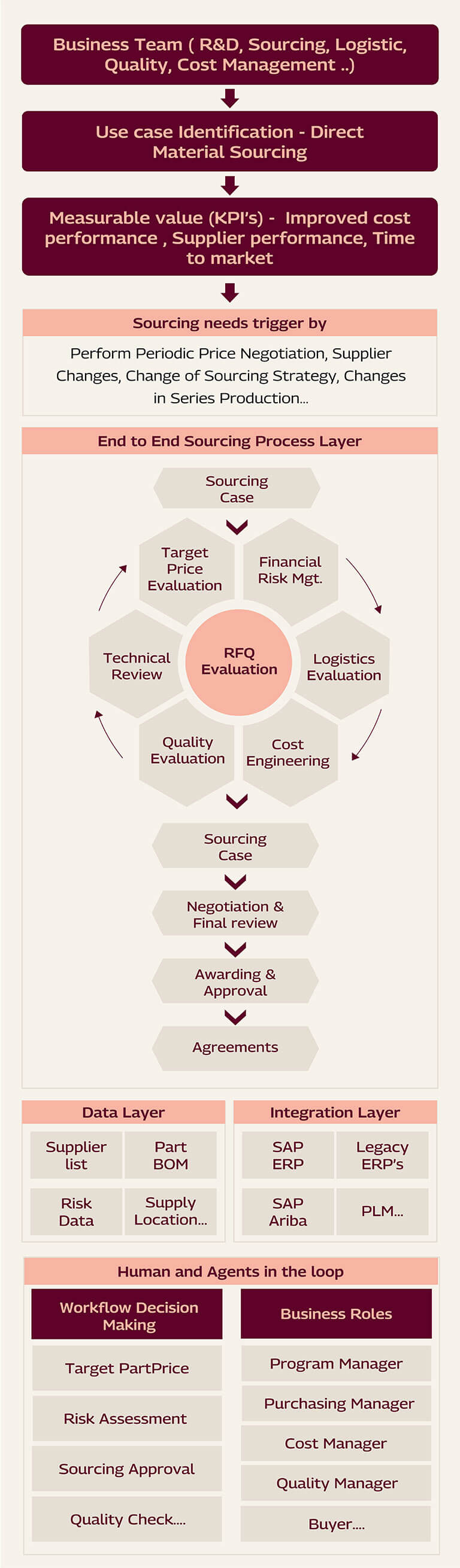
As shown in the high-level diagram below, we take a methodical and collaborative approach:
- Define the Cross-Functional Team: The business and IT team jointly select the direct material sourcing use case and identify measurable value aligned with sourcing needs for automotive series production.
- Map the End-to-End Workflow: The end-to-end process flow, data, and integration layer were defined, with both business users and multiple agents working together.
- Assign Agent Responsibilities: AI agents would take over execution-heavy, data-intensive tasks such as optimizing operations, handling routine decisions, and operating consistently across functions.
- Elevate the Human Role: With agents handling routine tasks, humans would focus on relationship management, cross-functional work, and complex problem-solving tasks.
- Ensure Human-in-the-Loop Control: Critical control points remained under human supervision to maintain oversight and accountability throughout the workflow. Only specific tasks would be executed by business users.
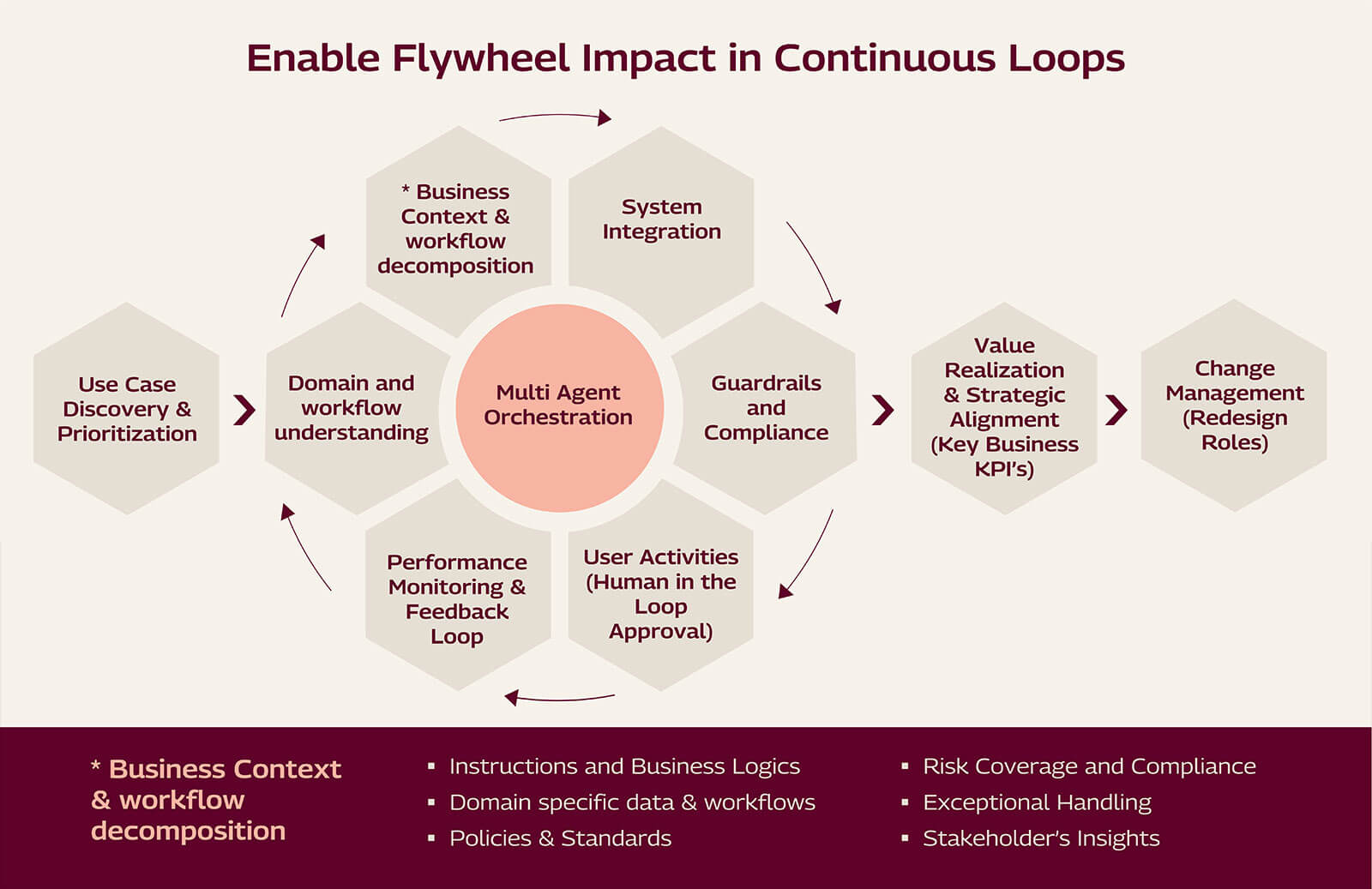
Step 3: Enable Flywheel Impact – Infuse business knowledge in workflow
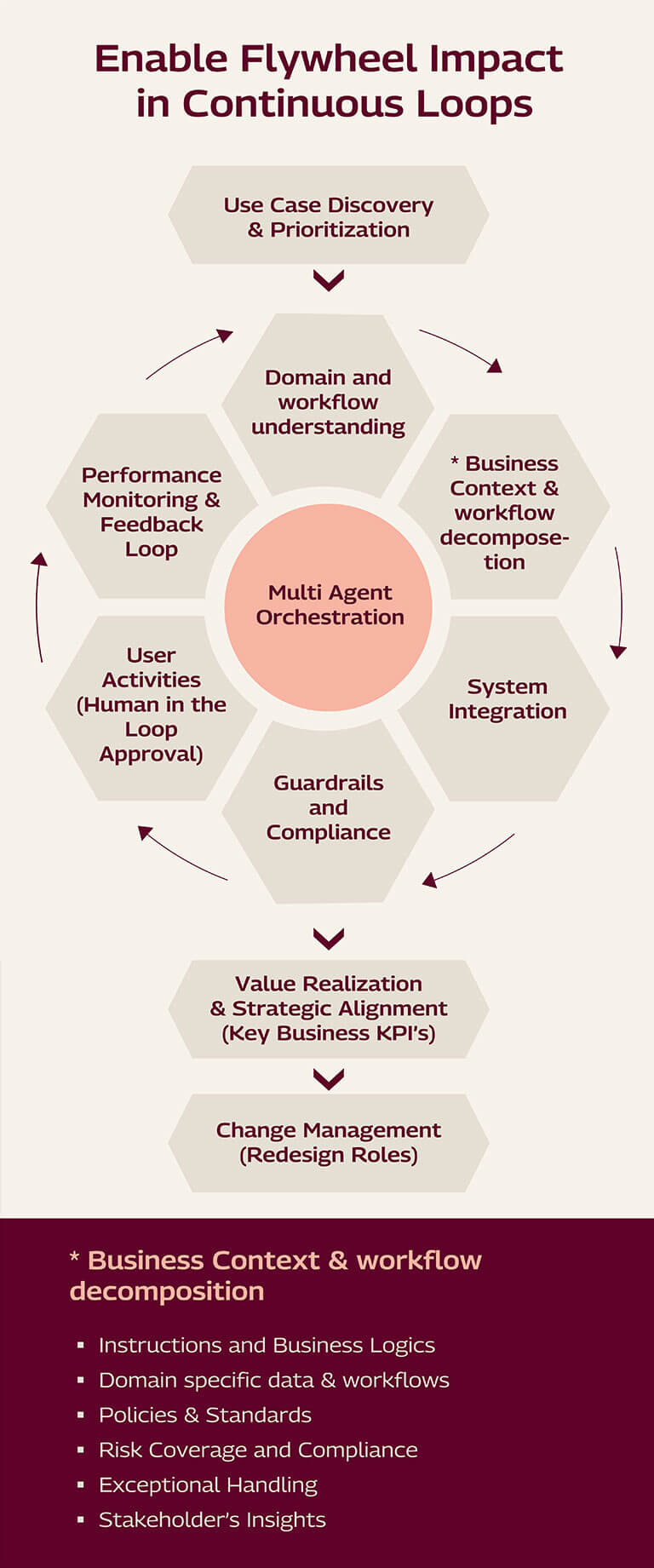
In enterprise AI, it is the business context that makes agents valuable. The most effective agents improve through a continuous learning flywheel, by drawing insights from proprietary data, workflows, and user interactions. Over time, this expanding business context builds a shared enterprise memory, shaped by user input, agent insights from past actions, and external signals.
As AI models improve, this flywheel gets more powerful. The agents handle tasks across applications, perform real-time analysis and simulations, monitor outcomes, and trigger corrective actions. This is how we ensure the system delivers measurable value and aligns with business KPIs, creating a continuous improvement loop.
Step 4: The Agentic AI Platform as a Workflow Design Service
Many organizations have AI platforms, but they remain fragmented. Data, workflows, and decision logic are still disconnected. To scale AI effectively, enterprises need a platform that enables centralized AI governance and allows AI agents to operate autonomously across complex workflows.
TechM Orion is a platform that enables orchestration layers for AI to act across systems. It goes beyond isolated applications. It serves as the central ‘brain’ connecting multiple model providers, data platforms, security layers, and workflow tools. This central system unifies your enterprise data, AI agents, and business rules, creating a single, coherent structure for making intelligent decisions.
On this foundation, organizations can build their own agent fabric. This control layer defines which agents are deployed, how they collaborate, and which vendors are permitted to operate within the enterprise.
Shaping the Future: How SAP is Enabling Agentic AI Workflow Design
As a leader in enterprise applications, SAP’s strategy focuses on enabling best-in-class applications. It captures enterprise workflows with deep process expertise and enterprise-specific context at scale. This creates a harmonized, governed data layer that powers world-class AI.
SAP has a roadmap to address key requirements for agentic AI workflow design early.
- Expanding Agent Capabilities: They are expanding their ‘Joule’ agents across domains like procurement, with capabilities for sourcing, bid analysis, and negotiation.
- Introducing AI-Native Coordination: New platforms, like SAP Supply Chain Orchestration, are being introduced to sit above planning, logistics, procurement, and manufacturing to enable real-time agentic visibility across the supply chain.
- Delivering Role-Based Assistants: They are delivering new AI assistants that enable ‘Joule’ to plan and execute multistep workflows independently across finance, supply chain, and other functions.
- Enabling Customization and Extensibility: Within Joule Studio, agents can now be tailored to industry-specific norms and domain knowledge with documents, categories, thresholds, and communication channels. This also enables true extensibility, allowing the use of custom tools for pre- and post-processing, such as enriching supplier data for qualification.
- Industrial-specific AI applications: Based on deep domain know-how of SAP processes.
- Advancing the Integrated Experience: Finally, they are enabling true ‘Agent2Agent’ interoperability and have introduced a Model Context Protocol gateway within SAP Integration Suite API Management.
The Tech Mahindra Edge in Agentic AI Workflows
Our leadership in Agentic AI is led by proven expertise and industry recognition.
We help organizations identify high-impact agentic workflow hotspots. Once high-impact agentic workflow hotspots are identified, business and functional experts must challenge requirements, remove unnecessary steps, and simplify processes before designing agentic workflows.
Tech Mahindra’s ambition to build an Agentic AI workflow services hub marks a strategic inflection point for enterprise operations in the AI era. This discipline ensures AI agents are deployed where they create the most value. It demands a clear focus on metrics that drive real business outcomes.
Our agentic AI workflow business designers and SAP domain experts integrate systems and processes to manage human and agent teams. We support the leading organizations to redesign value chains and drive the agentic operating models as control points to align it with business reinvention goals. The future of enterprise AI is strategic by design.
Agentic AI Workflows: The Next Operating Model for Enterprises
Agentic AI has shifted the conversation from 'when' to 'how,' how to redesign organizational structures, integrate workflows, and drive measurable business outcomes.
The organizations best positioned to lead AI adoption understand organizational context. They control data flows, integrate end-to-end enterprise workflows, and operate reliably, at scale, and within enterprise constraints.
The most adaptive ones will be deeply connected internally and externally. They will operate at scale, with speed, intelligence, and strategic flexibility. The future belongs to those who can master business workflows. It sets the foundation for sustained growth rather than episodic innovation.
Frequently Asked Questions
Our FAQ section is designed to guide you through the most common topics and concerns.
Agentic AI workflows use autonomous software agents that sense, decide, and act across systems to complete multi-step business tasks with minimal human intervention.
Many pilots show promise but stay isolated. Agentic workflows provide a scalable way to operationalize AI, embed it into processes, and drive consistent business impact.
Organizations struggle with orchestration across agents, governance, reliability, integration with existing systems, and measuring value at production scale. A structured framework helps address these gaps.
The blog outlines a practical approach to design, orchestrate, and monitor multi-agent workflows from pilot to production, using domain context and repeatable patterns to ensure measurable outcomes.
Agentic workflows can streamline operations, reduce manual effort, improve decision quality, and accelerate response times across functions such as IT operations, service requests, and data-driven processes.