
Scale at Speed™





 English (Global)
 French (Canada)

Abstract
In a progressively unpredictable global landscape, with disruptions across supplier value chains, logistics networks, and changing customer requirements, traditional planning models and standalone AI use cases are falling short. This is driving organizations toward autonomous supply chain transformation, where decisions are continuously optimized, precisely sensed, and successfully executed across enterprise-wide operations.
Powered by advanced analytics, ML, NLP, real-time data integration, and agentic AI, organizations can move beyond localized optimization to enterprise-wide decision orchestration across manufacturing, procurement, demand, supply, and logistics. AI Intelligent Agents continuously monitor events, recommend actions, and trigger workflows across ERP, WMS, and TMS systems, enabling the shift toward progressively autonomous execution, while human oversight ensures governance and exception management.
Key Insights
From Siloed AI to Enterprise Orchestration
Move beyond fragmented AI deployments to orchestrate decisions across demand, procurement, manufacturing, logistics, and fulfillment. Integrate data, intelligence, and workflows to optimize cost, service levels, and risk across the entire supply chain ecosystem.
AI Agents Drive Autonomous Execution
Deploy AI Intelligent Agents to continuously monitor events, recommend corrective actions, and trigger workflows across ERP, WMS, and TMS systems. Accelerate the shift from decision support to semi-autonomous and autonomous operations.
Six AI Enablers Power Supply Chain Resilience
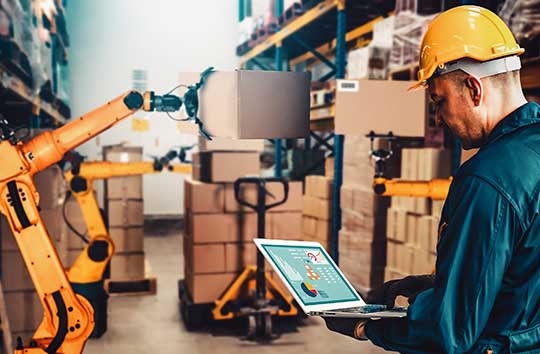
Strengthen supply chain performance through AI-powered demand sensing, inventory optimization, supplier risk management, production planning, logistics optimization, and warehouse automation. Improve agility, visibility, and responsiveness at scale.
Building Adaptive, Self-Learning Supply Chains
Establish a strong data foundation, scale high-impact use cases, and embed AI into operating models. Create resilient, self-learning supply chains that continuously adapt to disruptions while maintaining human oversight and governance.