





- The journey of water does not end at the tap; it begins at the source and returns to treatment facilities after use.
- Managing this lifecycle requires operating vast pipeline networks stretching up to 20,000 kilometers and thousands of physical assets.
- These vulnerabilities ripple through the entire lifecycle. Inefficiencies grow, costs increase, the environment is harmed.
- Field operations have long been recognised as the backbone of service delivery and field engineers acted as a first line of defence.
- However, they have been plagued by manual effort, reactive maintenance, increased workload, and limited visibility.
- We work with utilities to blend conventional wisdom with modern innovation to create a seamless, human-centred experience
The journey of water does not end at the tap; it begins at the source and returns to treatment facilities after use. This ‘source-to-tap’ and ‘sink-to-source’ lifecycle runs across networks of pipelines, treatment plants, pumping stations, and monitoring systems that utilities must manage every day. But maintaining stability across this system, especially under growing operational pressure, is becoming increasingly difficult.
The scale of this challenge is quite evident. Globally, 324 billion cubic meters of water are lost every year due to leaks1. In the UK alone, 1 trillion liters leak annually2. Additionally, serious pollution incidents have surged by 60%3, and average service disruptions have increased to 15–20 minutes per event4. These figures point to a system that is under dire strain.
So, what’s driving this pressure? The issue is structural. Managing this lifecycle requires operating vast pipeline networks stretching up to 20,000 kilometers and thousands of physical assets, many of them aging and increasingly exposed to risks, including:
- Natural forces: Floods, droughts, and storms damage infrastructure and disrupt supply
- Geological shifts: Soil movement and corrosive conditions accelerate pipeline wear
- Biological interference: Tree roots and burrowing animals compromise stability
- Human factors: Construction, encroachments, and poor hygiene practices lead to failures
- Aging infrastructure: Legacy systems and deteriorating assets strain operations
These vulnerabilities ripple through the entire lifecycle. Inefficiencies grow, costs increase, the environment is harmed, and the effects are felt across service delivery, employees (EX), and customers (CX).
The Case for Transformation
For uninterrupted service, field operations have long been recognised as the backbone of service delivery and field engineers acted as a first line of defence to these threats. However, they have been plagued by manual effort, reactive maintenance, increased workload, and limited visibility.
A typical day in field operations still begins with static work orders and outdated information. By the time an engineer arrives at the site, conditions may already have escalated. A burst pipe might occur, flooding the area, while the customer anxiously waiting for clarity. The engineer struggles to contact the control centre, hours pass, and frustration builds on both sides.
This is not an isolated incident. Across water utilities, ageing infrastructure, climate extremes, retirement of experienced personnel and workforce shortages made such scenarios increasingly common. Traditional methods can no longer keep pace – they slow emergency response, increase repeat visits, and leave employees overwhelmed with multitasking.
For customers, this often results in prolonged outages, unclear timelines, and a growing sense of being unheard. At the same time, employees experience mounting frustration and stress, leaving both sides feeling overlooked and dissatisfied.
| Service Impact | Impact on EX | Effect on CX |
| Delayed service visits | Disconnected tools and systems | Long wait times, missed appointments |
| Incorrect billing or meter readings | Missing or outdated information | Confusion, disputes, loss of trust |
| Poor communication from service teams | Poor connectivity in remote areas | Lack of updates, uncertainty |
| Slow emergency response | Limited access to real-time data | Prolonged outages, safety concerns |
| Limited support for vulnerable groups | Lack of accessibility features and tailored workflows | Feeling excluded or underserved |
| Lack of real-time updates | Inconsistent coordination within teams | Unclear timelines, reduced confidence |
| Repeated visits for unresolved issues | Heavy workload and multitasking | Inconvenience, wasted time |
| Uneven service quality across regions | Environmental and infrastructure constraints | Inconsistent experiences, regional dissatisfaction |
| Ineffective digital tools | Difficulty adopting new technologies | Hesitation to adopt smart services |
| Declining quality of experience | Limited time for customer engagement | Lack of empathy, poor service perception |
As this cycle intensifies, the pressure mounts. Regulatory demands, climate change, and rising customer expectations are amplifying the need for agility and precision.
The TechM Approach to Modernising Field Operations
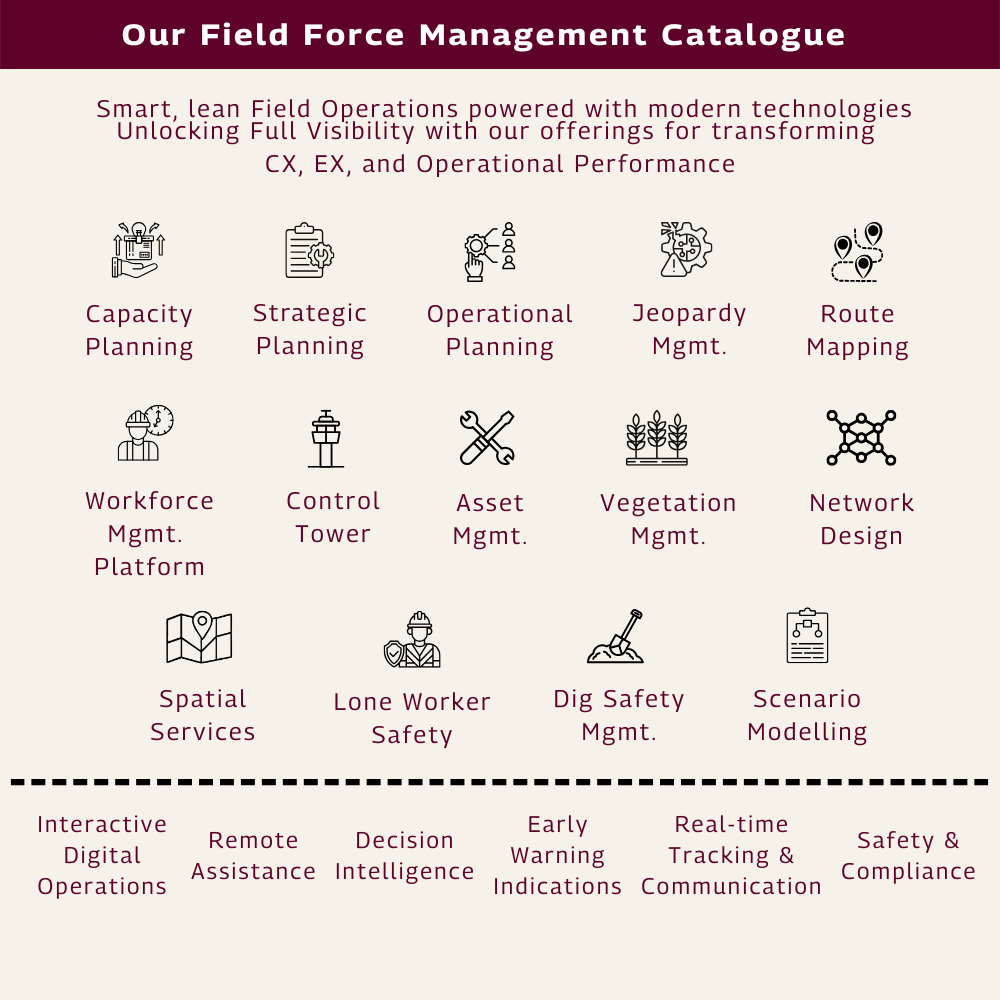
Tech Mahindra works with utilities to blend conventional wisdom with modern innovation to create a seamless, human-centred experience and rethink how field operations are planned, executed, and managed.
In practice, this approach centers on:
- Smarter planning and execution, using automation to simplify scheduling, routing, inventory use, and work order management
- Earlier visibility into failures, through sensor data and analytics that support proactive maintenance and better resource decisions
- Stronger on-site support for field teams, with mobile access to asset history, procedures, and remote expert input, even in low-connectivity environments
- Centralized operational oversight, giving control teams real-time visibility into crew activity, progress, and coordination
- Improved asset insight, using spatial data, remote monitoring and digital models to support inspection, vegetation management, and network planning
Our solutions cover the entire ‘source-to-tap’ and ‘sink-to-source’ lifecycle, breaks down silos and enable intuitive, mobile-first, context-aware operations with real-time synchronizing data across enterprise systems.
Intelligence with Purpose
The future of water utilities depends on a seamless blend of human expertise and intelligent technology. By shifting from reactive firefighting to proactive resilience, organisations can overcome operational challenges and meet customer demands on time. Tech Mahindra supports this shift through integrated digital enablement by embedding automation, predictive insights, and connected workflows to deliver smarter, faster, and more empathetic services while ensuring that transformation is practical and impactful. Through intuitive, agile, adaptive, and human-centric systems, we ensure water reaches every tap reliably and sustainably and is managed intelligently for generations to come.
Frequently Asked Questions
Our FAQ section is designed to guide you through the most common topics and concerns.
The increasing complexity of field operations, aging infrastructure, and heightened customer expectations are pushing utilities to rethink how they plan, execute, and manage field activities. The blog highlights the need for more resilient, efficient, and human‑centered operational models.
The content emphasizes combining human expertise with digital technologies such as AI, automation, and mobility to improve visibility, decision-making, and responsiveness. This synergy enables more accurate planning and smoother execution across field environments.
Traditional models often rely on fragmented processes, limited real-time insights, and manual interventions. These challenges can hinder operational efficiency, delay issue resolution, and increase the burden on field teams managing distributed assets.
The blog stresses designing tools and processes around the daily realities of field teams. This includes intuitive interfaces, reduced manual tasks, and real-time data access, which collectively enhance worker safety, productivity, and job satisfaction.
Utilities must transition toward data-driven planning, integrated platforms, predictive maintenance, and cross-functional collaboration. These shifts support more proactive operations, improved service reliability, and sustainable long-term field performance.
Endnotes
- World Bank Group (04 Nov 2025) Globally, 324 billion cubic meters of water are lost every year
- CITY Am (09 Sept 2024). Water firms in England and Wales lost more than 1 trillion liters in leaks last year.
- GOV.UK (18 July 2025). Serious pollution incidents up 60% in 2024 from the previous year.
- Discover Water (2024). Average service disruptions per event.