

Scale at Speed™







 English (Global)
 French (Canada)

- Conversational AI and agentic AI are reshaping the early stages of mortgage origination by creating a connected borrower journey from product discovery to application initiation.
- Intelligent, context-aware interactions reduce friction during qualification, pre-approval, and document collection, while enabling borrowers to move through the process at their own pace.
- By orchestrating specialized AI agents across lending workflows, financial institutions can streamline operations, improve processing efficiency, and reduce manual effort.
- This allows loan officers to focus on complex financial advice and high-value customer interactions while delivering a faster, more seamless mortgage experience.
Reimagining the First Mile of Mortgage Origination
Traditionally, mortgage lending has been a highly relationship-driven process.
While automation has helped digitize channels and middle and back-office operations, enabling near straight-through processing, the most critical path of the lending journey remains product discovery, customer qualification, and the successful submission of the loan application, even in fully digital lending environments.
With GenAI-powered conversational chatbots already gaining traction across global financial institutions and delivering intelligent, interactive customer experiences, mortgage origination can also be reimagined through an intelligent conversational assistant. These chatbots also guide borrowers through the mortgage loan application process.
Conversational AI transforms mortgage origination by enabling borrowers to explore, qualify, and apply for loans through intelligent, guided interactions.
An AI-powered conversational assistant enables home buyers to navigate the discovery process independently, at their own pace and through any preferred channel. Borrowers can explore mortgage options and seek clarification without hesitation or perceived pressure of interacting with a loan officer, which in turn significantly reduces the weeks of effort spent scheduling appointments and the multiple rounds of inquiries with the loan officer. If the conversational AI assistant can educate the home buyer on fundamentals, the loan officer’s time is utilized efficiently to address complex financial scenarios, provide personalized advice, and offer reassurance at key decision points.
With increasing margin pressures, lending institutions are under constant pressure to become operationally efficient while enhancing service delivery. Introducing conversational assistance during the initial leg of mortgage origination helps handle routine tasks such as product discovery, eligibility checks, and pre-approval while leveraging humans for critical tasks that enable quick, efficient loan application closure. Loan officers can handle higher volumes and improve productivity without a proportional increase in staffing.
The following sections illustrate the role of AI-powered conversational AI assistants in the early stages of mortgage origination, from product discovery through pre-approval and the initiation of the loan application process.
Helping Borrowers Discover the Right Mortgage Product:
In the conventional mortgage origination process, prospective home buyers complete lengthy application forms to determine their loan eligibility before scheduling appointments with loan officers to evaluate mortgage options and next steps. Alternatively, generative AI-powered conversational assistants can understand borrower's requirements and engage in dynamic, context-aware conversations to interactively guide users in determining the right product for their requirements, akin to a human advisor.
To maintain continuity in case of a disruption, the AI agent collects information such as contact details, personal identification number, and preferred channel, enabling the customer to pause and resume the conversation across multiple channels without having to restart. Through this process, the home buyer is equipped with information on mortgage products to proceed with the next steps in the journey.
Eligibility and Product Recommendation:
Once the borrower is equipped with sufficient information on mortgage products, the conversational assistant guides them to the next stage: the mortgage qualification process. The AI assistant collects information on income, expenses, existing debt obligations, property details, and down payment details from the borrower to perform an affordability assessment and provide an estimated loan amount for which the borrower is likely to qualify.
The conversational assistant can also simulate different monthly repayment scenarios based on the borrower's repayment capacity. Machine learning (ML) models can analyze customer information and history to recommend the most suitable mortgage products (fixed vs variable, open vs. closed, etc.) aligned to the borrower's financial profile, repayment capability, and risk appetite. Borrowers can interactively compare various scenarios before finalizing the suitable product.
Digital Pre-Approval:
As a next step, the borrower is transitioned to the pre-approval stage. The conversational assistant guides the borrower through structured pre-approval questions and provides an indicative list of required documentation. The borrower is also presented with consent forms to authorize credit bureau inquiries and access to bank statements for transaction analysis, as applicable. The conversational assistant provides a secure URL to enable the borrower to upload the required documentation through a secure portal, along with a unique reference number enabling the borrower to check the status of the pre-approval process.
Intelligent Document Processing:
AI-powered document processing is the most widely adopted use case across industries, including financial institutions, where it delivers significant improvements in processing speed and operational efficiency. AI agents deployed in middle- and back-office operations verify that all required documents have been received; if not, they automatically trigger an email for any missing documents. AI performs an authenticity check to ascertain that there are no fraudulent documents. Once all documents are received, AI sends a pre-approval letter via email.
Agentic AI combines conversational guidance, intelligent automation, and enterprise orchestration to accelerate mortgage origination without removing the human from the decision-making process.
Application Initiation:
Once the home buyer has identified a suitable property using the pre-approval letter, the next step is to complete a formal mortgage application. By this stage, as most personal and financial information of the homebuyer as well as the required documents are already collected through the chat interface, AI agents can auto-populate a mortgage loan application using this data.
The pre-filled application is sent to the borrower for review, completion, and submission to enable further processing. If the borrower does not wish to proceed with the loan application, AI agents can also create a lead in the CRM application to enable follow-ups through a human or AI agent.
At any point in this journey, if the borrower wishes to speak to a human agent, the AI assistant creates a case in the system and schedules an appointment with a human for further queries while providing comprehensive summaries of all conversations and data collected from the borrower thus far.
It is recommended to use an agentic AI platform to deploy the entire sequence of mortgage origination, starting from product discovery through pre-approval and initiation of a mortgage loan application.
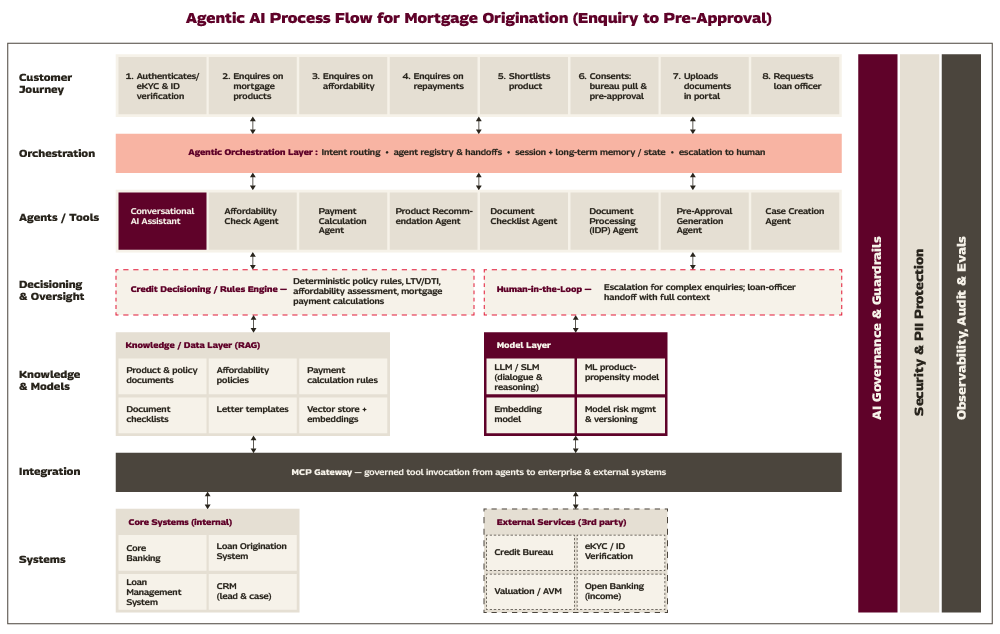
Figure 1: A visual representation of how various agents work in a coordinated manner through an agentic AI platform to complete the initial stages of mortgage origination.
Conclusion
With increasing margin pressures, lending institutions are under constant pressure to become operationally efficient while enhancing service delivery. Leveraging Agentic AI solutions powered by conversational AI assistants enables the automation of routine and time-consuming tasks, allowing the loan officer to focus on critical tasks that enable quick and efficient closure of the loan application. Loan officers are thereby able to handle higher volumes, enhance customer satisfaction and boost operational efficiency, without a proportional increase in staffing.
TAGS:
Banking & Financial Services
Frequently Asked Questions
Our FAQ section is designed to guide you through the most common topics and concerns.
Successful implementation requires more than deploying a chatbot. Financial institutions should ensure the solution integrates with core banking systems, credit bureaus, CRM platforms, document management systems, and enterprise knowledge repositories. Equally important are governance frameworks, data privacy controls, explainability, and regulatory compliance to build trust and support responsible AI adoption.
AI-generated recommendations should be supported by explainable decision-making, allowing lenders to understand the factors influencing product recommendations or affordability assessments. Combining AI with human oversight, audit trails, and governance policies helps institutions meet regulatory requirements while maintaining fairness and transparency.
Human oversight remains essential throughout the mortgage lifecycle. While AI can automate routine interactions and data-driven assessments, loan officers continue to play a critical role in reviewing complex financial situations, handling exceptions, providing personalized advice, and making final lending decisions where required.
The same Agentic AI framework can be extended to other banking processes, including personal loans, credit card onboarding, customer servicing, insurance claims, KYC verification, and collections. By orchestrating specialized AI agents across different workflows, financial institutions can create consistent, intelligent customer experiences across multiple business functions.
Key performance indicators include application completion rates, pre-approval turnaround time, document processing time, first-time-right application submissions, loan officer productivity, customer satisfaction (CSAT), Net Promoter Score (NPS), and overall mortgage processing costs. Monitoring these metrics helps institutions quantify both operational improvements and customer experience outcomes.